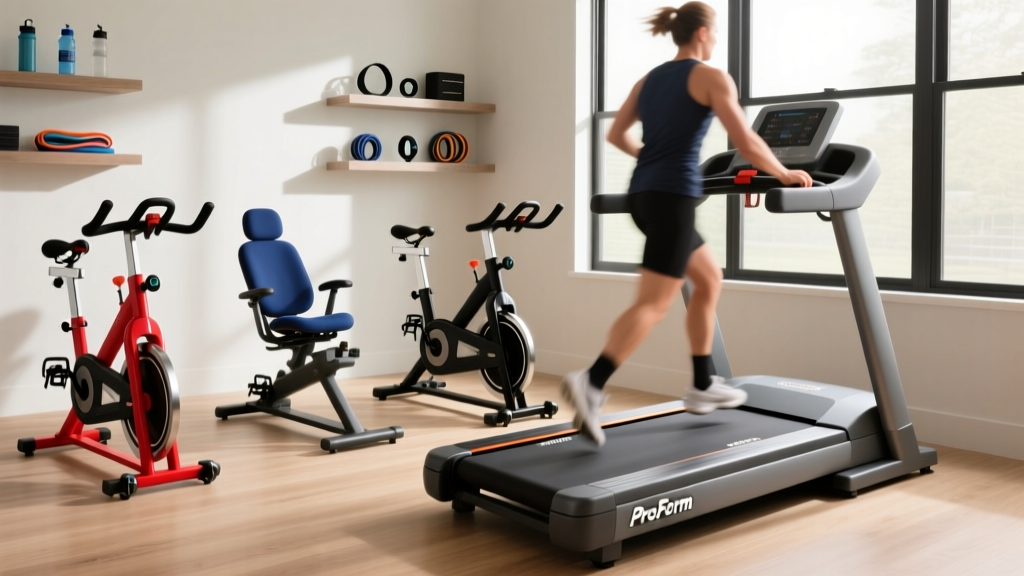
Stationary Bike Types vs ProForm Treadmill 5000: 2026 Budget Breakdown
Compare stationary bike types (upright, recumbent, spin) against the ProForm Treadmill 5000. Discover the best 2026 budget breakdown and value analysis.

The 2026 Home Cardio Dilemma: Bikes vs. Treadmills
Allocating a home gym budget in 2026 requires more than just looking at the sticker price. With equipment costs stabilizing after years of supply chain fluctuations, the true measure of value now lies in long-term utility, biomechanical suitability, and hidden operational costs. For buyers caught between cycling and walking or running, the decision often narrows down to specific stationary bike types (upright, recumbent, and spin) versus a budget-tier walking and jogging machine like the ProForm Treadmill 5000.
This comprehensive budget breakdown dissects the real-world costs, space requirements, and fitness ROI of these cardio staples. Whether you are rehabbing a knee injury or training for a triathlon, understanding where your money goes—and what it buys you—is critical.
Quick Budget Summary
- Upright Bikes: $499 - $899 (Best for general cardio and small footprints)
- Recumbent Bikes: $649 - $1,299 (Best for joint preservation and rehab)
- Spin Bikes: $799 - $2,495 (Best for high-intensity interval training)
- ProForm Treadmill 5000: $599 - $749 (Best for budget-conscious walkers and light joggers)
Deep Dive: Stationary Bike Types and True Costs
Not all stationary bikes are created equal. The geometry, resistance mechanism, and intended use case drastically alter both the upfront cost and the long-term value.
Upright Bikes: The Space-Efficient Workhorse
Upright bikes mimic the geometry of a traditional outdoor bicycle, engaging the core and upper body to a minor degree while keeping the footprint exceptionally small. In 2026, the market standard for a high-value upright bike is the Schwinn 230 (retailing around $599) or the Nautilus U618 (approx. $799).
Value Analysis: Upright bikes offer the highest cardiovascular return per square foot. A standard upright requires roughly 48 x 24 inches of floor space. However, the primary drawback is seat comfort; the narrow saddles can cause discomfort during sessions exceeding 45 minutes, which may reduce long-term adherence for casual users. Maintenance is minimal, usually limited to wiping down the magnetic resistance flywheel and checking pedal strap tension.
Recumbent Bikes: The Joint-Saving Investment
Recumbent bikes feature a reclined seating position with a full backrest and pedals positioned in front of the body. This design drastically reduces shear force on the knees and lumbar spine. According to the Mayo Clinic, low-impact aerobic exercises like recumbent cycling are crucial for individuals managing osteoarthritis or recovering from lower-body injuries.
Value Analysis: The Schwinn 270 ($649) remains a budget king, while the NordicTrack Commercial R35 ($1,199) caters to users wanting immersive iFIT integration. Recumbent bikes require a larger footprint (approx. 65 x 28 inches) and are heavier, making them difficult to relocate. The value here is measured in injury prevention and accessibility; for seniors or rehab patients, a recumbent bike is not a luxury, it is a medical necessity.
Spin Bikes: The High-Intensity Premium
Indoor cycles (spin bikes) are built for performance, featuring heavy flywheels (or advanced magnetic resistance systems), aggressive riding geometries, and infinite micro-adjustments. The 2026 landscape is dominated by the Schwinn IC4 ($799) for budget-conscious riders and the Keiser M3i ($2,395) for commercial-grade durability.
Value Analysis: Spin bikes command a premium due to their drivetrain components and compatibility with third-party apps like Zwift and Peloton. While the upfront cost is higher, the biomechanical efficiency allows for massive caloric expenditure in short timeframes. The American Heart Association recommends at least 150 minutes of moderate-intensity or 75 minutes of vigorous aerobic activity per week; a spin bike is arguably the most efficient tool to hit the vigorous threshold at home.
The Treadmill Alternative: ProForm Treadmill 5000 Value Analysis
When buyers have a strict $600 to $750 budget, they often cross-shop a mid-tier spin bike against an entry-level treadmill. This is where the ProForm Treadmill 5000 enters the conversation. Positioned as a budget-friendly, space-saving treadmill, it targets the massive demographic of daily walkers and light joggers.
Spec Check: ProForm Treadmill 5000- Motor: 2.5 CHP (Continuous Horsepower) - adequate for walking/jogging, not sprinting.
- Belt Size: 18" x 50" - sufficient for walking, but restrictive for runners with long strides.
- Footprint: 68" x 28" (unfolded), folds vertically for storage.
- Weight Capacity: Typically rated around 250-275 lbs.
Budget Breakdown & ROI: The ProForm Treadmill 5000 usually retails between $599 and $749. Compared to a $799 Schwinn IC4 spin bike, the ProForm saves you money upfront. However, treadmills inherently carry higher long-term maintenance costs. The belt requires silicone lubrication every 150 miles, and the motor draws significantly more electricity than a magnetic bike. Furthermore, the impact forces of walking or jogging on a budget treadmill deck (which lacks the advanced shock absorption of $2,000+ models) can lead to shin splints for heavier users.
The Verdict on the ProForm Treadmill 5000: It offers exceptional value only if your primary goal is low-impact walking, step-counting, and general mobility. If you intend to do high-intensity interval training (HIIT) or distance running, the 2.5 CHP motor will overheat, and the 50-inch belt will feel claustrophobic. In that case, reallocating that $700 toward a spin bike yields a much higher fitness ROI.
Head-to-Head Budget Matrix
| Equipment Type | Avg Entry Price | Floor Footprint | 5-Yr Maintenance | Best Use Case |
|---|---|---|---|---|
| Upright Bike (e.g., Schwinn 230) | $599 | 8 sq. ft. | $50 | General cardio, small apartments |
| Recumbent Bike (e.g., Schwinn 270) | $649 | 12.5 sq. ft. | $75 | Rehab, seniors, back pain |
| Spin Bike (e.g., Schwinn IC4) | $799 | 9 sq. ft. | $120 | HIIT, Zwift, athletic training |
| ProForm Treadmill 5000 | $649 | 13 sq. ft. | $250 | Daily walking, step goals |
Hidden Costs: Subscriptions, Electricity, and Resale
A critical error in 2026 home gym budgeting is ignoring the operational expenditure (OpEx) of connected fitness equipment.
The Subscription Trap
Many modern bikes and treadmills heavily restrict their manual modes to push users toward monthly subscriptions. If you buy a NordicTrack or ProForm machine, you are likely looking at an iFIT membership, which currently costs around $39 per month ($468 annually). Over a 5-year lifespan, that subscription adds $2,340 to your total cost of ownership. Conversely, bikes like the Keiser M3i or Schwinn IC4 offer robust manual modes and open Bluetooth FTMS protocols, allowing you to use free or cheaper third-party apps without locking the machine's basic functions behind a paywall.
Electricity and Depreciation
Treadmills are power hogs. A 2.5 HP motor on the ProForm Treadmill 5000 drawing continuous current during a 1-hour daily jog will noticeably impact your monthly electric bill compared to a spin bike, which uses virtually zero electricity (the screen and magnetic resistance draw less than a standard lightbulb). Furthermore, the secondary market is flooded with used treadmills, causing severe depreciation. High-end spin bikes (like Keiser or Peloton) hold their resale value significantly better than budget-tier treadmills.
Final Verdict: Where Should Your Money Go?
Your budget allocation should be dictated by your biomechanics and your fitness goals, not just the sticker price.
"If your goal is purely daily step accumulation and you have the floor space, the ProForm Treadmill 5000 is a highly cost-effective walking station. But if you want to maximize cardiovascular output, minimize joint impact, and avoid high maintenance costs, a magnetic spin bike or recumbent bike offers a vastly superior long-term ROI."
Choose Upright/Spin Bikes if: You are short on space, want to do HIIT workouts, plan to use third-party apps like Zwift, and want to avoid high electricity and maintenance costs.
Choose Recumbent Bikes if: You are managing lower back pain, recovering from surgery, or require a step-through design for safe mounting and dismounting.
Choose the ProForm Treadmill 5000 if: You are a dedicated walker, prefer weight-bearing exercises for bone density maintenance, and have a dedicated space where the machine can remain unfolded or easily folded without hassle.
More gear to consider
All reviews
Sole vs Horizon Treadmill: Elliptical vs Treadmill Space Layouts

Does Incline Treadmill Burn Fat? Noise Comparison
Setup Guide: NordicTrack T Series 16 vs Curved Manual Treadmills

Stair Climber vs Treadmill: Can I Buy a Treadmill With My HSA?

XTERRA TR 150 Treadmill Noise Test & Quiet Cardio Machine Guide
