
Real 12 3 30 Treadmill Results With Compact Home Setups
Discover how to achieve real 12 3 30 treadmill results using compact, space-saving treadmills without burning out your motor or sacrificing your apartment layout.

The Biomechanical and Mechanical Truth Behind the Trend
The viral 12-3-30 workout—walking at a 12% incline, 3 mph, for 30 minutes—has become a staple for low-impact, high-yield cardiovascular conditioning. According to fitness analyses featured in Runner's World, this specific combination elevates heart rate into Zone 2 or Zone 3 while heavily recruiting the posterior chain. However, the quest for authentic 12 3 30 treadmill results often leads small-space dwellers down a frustrating path: purchasing ultra-compact "walking pads" that mechanically cannot sustain the workload.
To achieve true 12 3 30 treadmill results, your equipment must overcome significant gravitational resistance. A 160-pound user walking at a 12% incline generates roughly 40% more continuous downward and backward force on the deck than flat walking. If you attempt this on a budget walking pad with a 1.5 HP (Peak) motor, the motor will overheat, the belt will stutter, and the internal motherboard will likely trip its thermal shutoff by minute 14. To get actual 12 3 30 treadmill results without destroying your equipment, you need a minimum of 2.5 CHP (Continuous Horsepower) and a verified mechanical incline mechanism, not just a software-simulated one.
⚠️ The "Walking Pad" Marketing Trap: Many 2026 models marketed as "compact treadmills" max out at an 8% to 10% incline. Even if the console displays 12%, cheaper models use micro-hydraulic lifts that buckle under dynamic loads exceeding 130 pounds. If your goal is strict 12-3-30 adherence, you must verify the machine's physical incline ceiling and continuous motor rating.2026 Compact Treadmill Matrix: Space vs. Performance
True space optimization requires balancing the machine's operational footprint with its folded dimensions. According to Consumer Reports, folding mechanisms on mid-tier treadmills have vastly improved, allowing for vertical storage without sacrificing deck rigidity. Below is a breakdown of the best compact-friendly treadmills that possess the mechanical fortitude for the 12-3-30 protocol.
| Model (2026 Lineup) | Motor (CHP) | Max Incline | Folded Dimensions (L x W x H) | Est. Price |
|---|---|---|---|---|
| Horizon Fitness T101 | 2.5 CHP | 15% | 55" x 28" x 9" | $599 |
| ProForm Carbon TLX | 2.6 CHP | 12% | 27" x 30" x 68" (Vertical) | $549 |
| Sunny Health SF-T723015 | 2.5 HP (Sustained) | 12% | 60" x 29" x 10" | $485 |
Why These Models Work for Micro-Spaces
- Horizon T101: The featherlight folding mechanism allows a single user to drop the deck safely. Its 55-inch folded length means it can slide under a standard elevated bed or behind a sofa, while the 15% incline motor easily handles the 12% requirement without thermal strain.
- ProForm Carbon TLX: This model folds vertically rather than horizontally. Its 27-inch depth when folded makes it ideal for narrow galley-style apartment layouts or shallow bedroom closets. The 12% incline is its absolute mechanical maximum, meaning the motor is optimized specifically for this gradient.
- Sunny Health SF-T723015: Sunny's auto-incline model bridges the gap between budget walking pads and premium gym gear. It features a slightly longer deck (49 inches), which is crucial for users with a longer stride who find standard 45-inch compact decks restrictive at 3 mph.
Designing the Micro-Apartment Cardio Zone
Achieving 12 3 30 treadmill results in a small apartment is not just about the machine; it is about the spatial layout, airflow, and acoustic management. When operating a treadmill at a steep incline, the motor generates 20-30% more ambient heat than during flat walking. If you push a compact treadmill flush against a wall, you risk suffocating the motor's intake fan.
Step-by-Step Layout Optimization
- Establish the Safety and Airflow Clearance: Never place the rear of the treadmill against a wall. You need a minimum of 24 inches of clearance behind the machine for emergency dismounts and motor ventilation. Lateral clearance should be at least 18 inches on the dominant side to allow for safe entry and exit.
- Implement High-Density Acoustic Matting: Incline walking alters the foot-strike pattern, often resulting in a heavier heel strike. To prevent low-frequency vibration from transferring to the floor below (a common issue in multi-story apartments), use a 3/8-inch thick, high-density EVA foam mat. Avoid cheap PVC mats, which compress entirely under the point-load of the treadmill's rear feet and trap heat against the motor housing.
- Manage the Visual Footprint: If your treadmill must live in your primary living space, orient it facing a window or a dedicated wall-mounted screen rather than facing into the room. This creates a psychological "zone" and prevents the machine from dominating the room's sightlines when folded.
Electrical and Environmental Edge Cases
One of the most overlooked aspects of small-space cardio layout is electrical load. The 12-3-30 workout demands sustained amperage draw. A 2.5 CHP motor running at a 12% incline can pull between 12 to 15 amps continuously.
The Shared Circuit Failure: Many older apartments wire the bedroom and living room outlets on a single 15-amp breaker. If your treadmill is plugged into a room where a space heater, window AC unit, or even a high-draw microwave is operating on the same circuit, the treadmill's incline surge will trip the breaker mid-workout. Always map your apartment's breaker box and ensure your cardio zone is on a dedicated 15-amp or 20-amp circuit. If an outlet is shared, use a heavy-duty 12-gauge extension cord routed to a dedicated kitchen or bathroom circuit (though hardwiring directly to a wall outlet without an extension cord is the gold standard for fire safety).
Maximizing the Physiological Return
Space optimization should never compromise the biomechanical integrity of your workout. As noted by Harvard Health Publishing, walking on an incline significantly boosts caloric expenditure and cardiovascular health without the joint impact of running. However, holding onto the handrails negates these benefits by artificially reducing the load on your lower body and altering your spinal alignment.
Compact treadmills often feature shorter handrails that can tempt users to lean back during the steep 12% incline. To ensure you are getting legitimate 12 3 30 treadmill results:
- Engage the Core: Keep your hands off the rails. If you must use them for balance, rest only your fingertips lightly on the console.
- Monitor the Belt: On compact models, the belt is narrower (usually 18 to 20 inches). Focus on a mid-foot strike directly in the center of the belt to prevent edge-fraying, a common failure mode on narrow-deck machines.
- Cool Down the Room: Because compact setups often lack the square footage for large floor fans, install a wall-mounted oscillating fan directed at the machine's motor housing and your torso to manage both mechanical and physiological heat.
By selecting a machine with the correct continuous horsepower and incline mechanics, and by engineering your apartment layout to support ventilation and electrical stability, you can reliably achieve 12 3 30 treadmill results without sacrificing your living space or your equipment's lifespan.
More gear to consider
All reviews
Stair Climber Guide & GoPlus 2 in 1 Folding Treadmill Troubleshooting

Star Trac Treadmill Models & Cardio Noise: Beginner Comparison Guide
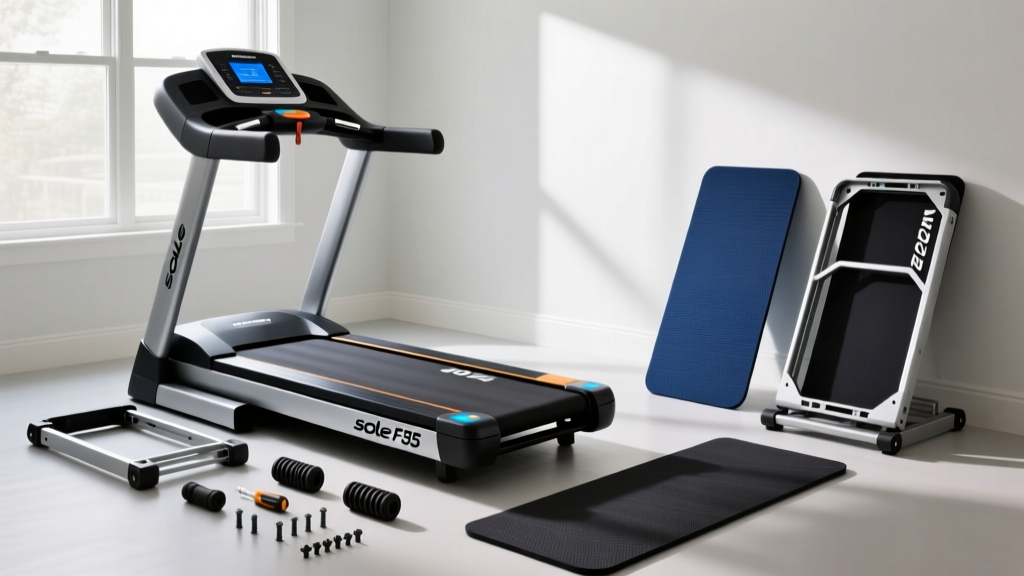
Sole F85 Treadmill Assembly vs Walking Pad Setup 2026

Curved vs Motorized: Assemble Sole F63 Treadmill & Troubleshoot

Compact Portable Cardio: Hands-On Johnson Treadmill Review
