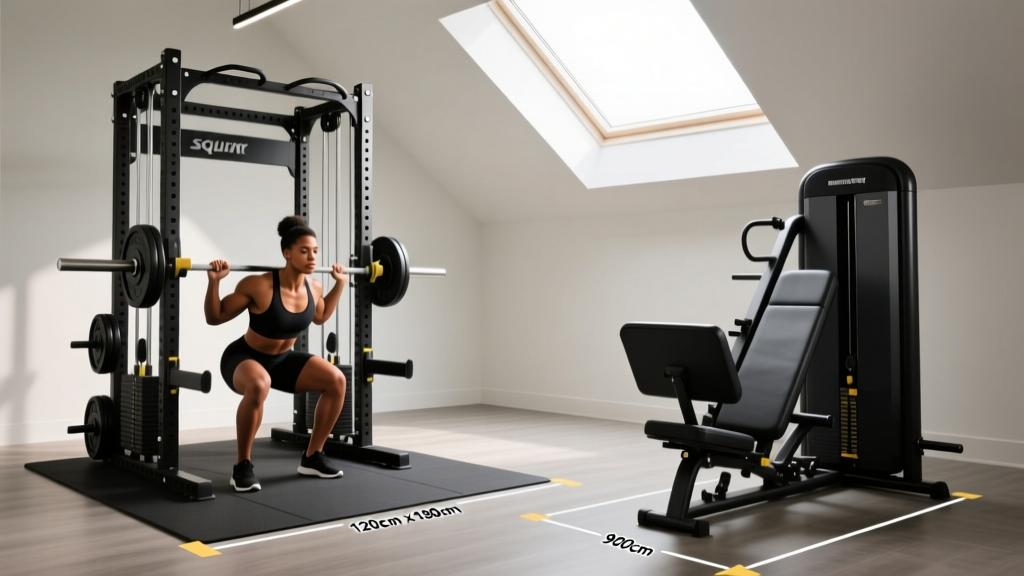
Optimizing Gym Layouts: Squat Racks & Leg Press Workout Machines
Master your gym layout. Compare squat rack and power cage footprints against leg press workout machines to optimize space, clearance, and leg training.

The Spatial Dilemma: Compound Cages vs. Sled Tracks
Designing a high-performance lower-body training zone requires balancing biomechanical needs with strict physical boundaries. As home and boutique gym layouts evolve in 2026, the debate over dedicating floor space to a traditional squat rack and power cage for leg training versus investing in standalone leg press workout machines remains a central challenge for facility planners and serious lifters. While power cages offer unparalleled versatility for squats, lunges, and rack pulls, dedicated leg presses provide targeted quadriceps and glute isolation without axial spine loading. However, the spatial footprints of these two equipment categories differ drastically, demanding a strategic approach to space optimization, traffic flow, and structural clearance.
When every square foot of rubber matting costs money and limits movement, understanding the exact dimensional requirements, safety clearances, and hybrid attachment options is critical. This guide breaks down the layout mathematics and spatial planning required to integrate heavy leg training equipment into constrained environments without compromising safety or performance.
The Spatial Footprint: Power Cages vs. Dedicated Leg Presses
To optimize a gym layout, you must first understand the static and dynamic footprints of your primary leg training anchors. A static footprint is the physical steel boundary of the machine, while the dynamic footprint includes the space required for human movement, plate loading, and sled travel.
| Equipment Type | Model Example (2026) | Static Footprint (L x W) | Dynamic Clearance Needed | Approximate Cost |
|---|---|---|---|---|
| Standard Power Rack | Rogue R-3 (49x49) | 49' x 49' (16 sq ft) | 36' on all sides (85 sq ft total) | $1,350 |
| Commercial Leg Press | Body-Solid SLP500G | 83' x 34' (19.5 sq ft) | 24' sides, 48' front (55 sq ft total) | $2,800 |
| 45-Degree Hack Squat | Elite FTS Hack Squat | 86' x 54' (32 sq ft) | 36' sides, 60' front (78 sq ft total) | $2,200 |
| Rack Leg Press Attachment | Rep Fitness PR-4000 | Adds 30' to rack front | Integrates with rack clearance zone | $399 |
As the data illustrates, standalone leg press workout machines demand significant linear length due to the 45-degree sled track, often exceeding 80 inches from base to top handle. In contrast, a standard power cage consumes a more centralized, square footprint. However, the power cage requires a mandatory 36-inch perimeter clearance for safe bumper plate loading and spotter intervention, effectively tripling its spatial impact compared to the machine's physical steel dimensions.
Clearance Zones and Traffic Flow
Ignoring clearance zones is the most common failure mode in garage and basement gym layouts. The National Strength and Conditioning Association (NSCA) facility guidelines emphasize that equipment spacing must account for the maximum range of motion and the emergency egress of spotters.
Warning: The 36-Inch Plate RuleNever place a squat rack flush against a wall. A standard 45-pound bumper plate has a diameter of 17.5 inches. When loading a 7-foot Olympic barbell, the sleeves extend past the uprights. You require a minimum of 36 inches of lateral clearance on both sides of the rack to safely load and unload plates without twisting your spine in a confined space.
Overhead vs. Horizontal Constraints
- Ceiling Height: Standard residential ceilings are 8 feet (96 inches). A 90-inch power cage leaves only 6 inches of clearance, making overhead presses inside the rack impossible. Leg press workout machines bypass this vertical constraint entirely, utilizing horizontal floor space instead of vertical airspace.
- Wall Proximity: If mounting a rig to a wall, ensure the wall can handle the sheer force of heavy squats. Drywall anchors will fail; you must lag bolt directly into structural studs or reinforced concrete.
- Flooring Compression: Thick EVA foam tiles compress under the 1,000+ pound dynamic loads of a leg press sled, causing the machine to shift. Always place heavy sled-track machines directly over high-density 3/4-inch vulcanized rubber mats or bare concrete.
The Hybrid Solution: Leg Press Attachments for Power Racks
For lifters who refuse to sacrifice the versatility of a power cage but lack the 8-foot linear run required for a standalone leg press, the 2026 market offers robust rack-mounted leg press attachments. These units utilize the existing uprights and safety spotter arms of a power rack to create a guided sled track.
Rep Fitness PR-4000 / PR-5000 Leg Press Attachment
Priced at approximately $399, the Rep Fitness attachment is a space-saving marvel for 3x3-inch upright racks. It mounts via sandwich J-cups and utilizes the rack's existing safety straps or spotter arms as the stopping mechanism. Layout Impact: It adds roughly 30 inches to the front of the rack. Because you are already maintaining the 36-inch front clearance for barbell racking, the leg press attachment consumes zero additional 'dead space' in your room layout.
Rogue Monster Leg Press (RDLP-2)
At the premium end, the Rogue Monster Leg Press (approx. $1,450) is a heavy-duty, linear bearing sled that integrates exclusively with Rogue Monster series racks. It features a dedicated footplate and dual safety catches. While it offers a smoother, more commercial-grade glide than budget alternatives, it requires a massive upfront investment and locks you into the Monster ecosystem. From a layout perspective, it extends the rack footprint significantly and requires the rack to be bolted to the floor to prevent forward tipping during heavy leg drives.
Layout Blueprints for Common Room Sizes
Applying these spatial principles to real-world architectural constraints yields distinct layout strategies.
The 10x10 Spare Bedroom (100 Sq Ft)
In a 100-square-foot room, a standalone leg press is mathematically impossible to use safely. An 83-inch leg press leaves less than 20 inches for the user to enter and exit the machine. The Solution: Utilize a wall-mounted folding squat rack (like the PRx Profile) paired with dumbbell Bulgarian split squats and walking lunges. If a leg press is non-negotiable, you must rely on resistance band leg presses anchored to the base of the folding rack, sacrificing heavy load capacity for spatial viability.
The 2-Car Garage Bay (200+ Sq Ft)
A standard single-car garage bay (roughly 12x20 feet) offers the luxury of zoning. The Solution: Place a 49x49 power cage in the rear corner, bolted to the concrete. Position a 45-degree commercial leg press workout machine parallel to the cage, leaving a 4-foot central walkway for plate storage trees and dumbbell racks. This 'perimeter-loading' design keeps the center of the garage open for dynamic movements like sled pushes and kettlebell swings.
Biomechanical Trade-offs When Space Forces a Choice
When spatial optimization forces you to choose between a squat rack and a dedicated leg press, you must weigh the biomechanical consequences. According to exercise directories like ExRx.net, the barbell back squat requires immense core stabilization, erector spinae engagement, and ankle mobility. It is a systemic, full-body stimulus.
Conversely, machine-based leg presses remove the axial loading from the spine and eliminate the balance requirement. This allows for targeted muscular failure of the quadriceps and glutes without the lower back becoming the limiting factor. If your layout only permits a power cage, you can simulate the leg press by performing heavy belt squats (using a dip belt and elevated platforms) or utilizing the aforementioned rack attachments. If your layout only permits a leg press, you will miss out on the vital stabilizing musculature development that free-weight cages provide.
Frequently Asked Questions
Can I put a leg press on the second floor of my house?
Most residential floor joists are rated for 40 pounds per square foot of live load. A commercial leg press weighs 500+ pounds, and adding a 400-pound user plus 500 pounds of plates concentrates over 1,400 pounds into an 8x3 foot area. This exceeds standard residential joist limits and risks structural sagging or failure. Always place heavy leg equipment on ground-level concrete slabs.
Do I need to bolt my power cage to the floor for leg training?
If you are only doing squats, a heavily loaded rack (with 300+ lbs of plates stored on the rear uprights) is usually stable enough. However, if you attach a leg press sled to the front of the rack, the horizontal sheer force generated during a heavy leg drive will tip an unbolted rack forward. Bolting is mandatory when using rack-mounted leg press attachments.
What is the best flooring for a combined rack and leg press zone?
Use 3/4-inch thick, high-density vulcanized rubber horse stall mats. Avoid interlocking EVA foam tiles, as the narrow sled rails of a leg press will crush the foam, creating an uneven track that causes the sled to bind and jerk during the eccentric lowering phase.
More gear to consider
All reviews
Titan Leg Press Hack Squat Machine: 2026 Glute Market Trends

Leg Press Cable Machine Guide: Horizontal vs 45-Degree 2026

Leg Press Machines for Home Gyms: 2026 Head-to-Head

Hack Squat vs Leg Press Setup: Leg Press Alternative No Machine

2026 Glute Machine Guide & Leg Press Machine for Calf Raises
