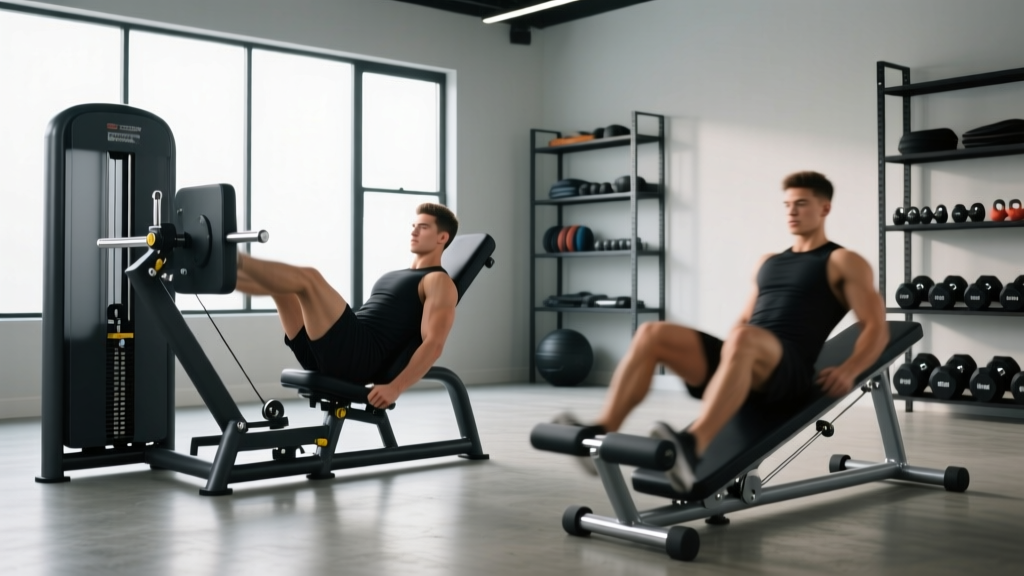
Squat Press Machine vs Leg Press & Calf Raise Errors
Fix lower-body machine mistakes. We troubleshoot calf raise standing vs seated form and the squat press machine vs leg press biomechanics.

Lower-Body Machine Troubleshooting: Distal and Proximal Biomechanics
Walking into a commercial gym in 2026, you are likely to see lifters making the same biomechanical errors on lower-body machines that have plagued the industry for decades. Whether you are trying to isolate the distal lower leg or move maximal loads with your proximal musculature, machine selection and setup dictate your results. Two of the most frequent troubleshooting requests we receive at FitGearPulse involve the calf raise machine standing vs seated debate, and the widespread confusion regarding the squat press machine vs leg press. This guide breaks down the exact failure modes, anatomical realities, and mechanical fixes for both scenarios.
Part 1: The Calf Raise Machine Standing vs Seated Dilemma
The calf complex is primarily composed of two muscles: the gastrocnemius and the soleus. Because the gastrocnemius crosses the knee joint while the soleus does not, the angle of your knee completely alters the force vector and muscle recruitment. Choosing the wrong machine—or using the right machine with poor mechanics—results in zero hypertrophy and high Achilles tendon strain.
Standing Calf Raises: Gastrocnemius Isolation
The standing calf raise machine (such as the Body-Solid Pro Club-Line GSCR348, retailing around $550) keeps the knee fully extended. This places the gastrocnemius in a stretched, active position. The gastrocnemius is heavily composed of fast-twitch Type II muscle fibers, meaning it responds best to heavy loads and explosive concentrics.
- The Mistake: Bouncing out of the bottom position. Lifters drop their heels rapidly, using the stretch reflex of the Achilles tendon to rebound the weight. This removes tension from the muscle belly and shifts it entirely to the connective tissue.
- The Fix: Implement a strict 2-second pause at the bottom of the eccentric phase. Lower the heel until you feel a deep stretch in the upper calf, hold for two seconds to dissipate the elastic energy, and then drive up through the metatarsals (the ball of the foot). Ensure your toes are pointed straight ahead or slightly outward (15 degrees) to align with the natural tracking of the talocrural joint.
Seated Calf Raises: Soleus Isolation
The seated calf raise machine (like the Rogue Fitness Seated Calf Raise, approximately $395) bends the knee to 90 degrees. According to data indexed by the National Institutes of Health (NIH) biomechanics database, this knee flexion places the gastrocnemius in active insufficiency, forcing the underlying soleus to take over the load. The soleus is highly oxidative and responds well to higher rep ranges (15-25 reps) and prolonged time under tension.
- The Mistake: Incorrect thigh pad placement. Many lifters rest the pad directly on the kneecap (patella) or too high on the quadriceps. This causes joint pain or allows the hips to hike up, cheating the movement.
- The Fix: The pad must rest securely on the distal end of the femur, roughly two inches above the patella. Lock your hips into the seat by gripping the handles and pulling yourself slightly downward. This creates a rigid lever system, ensuring the ankle joint does 100% of the work.
Machine Comparison Matrix
| Feature | Standing Calf Machine | Seated Calf Machine |
|---|---|---|
| Primary Target | Gastrocnemius | Soleus |
| Knee Angle | 180° (Fully Extended) | 90° (Flexed) |
| Ideal Rep Range | 8-12 (Heavy Load) | 15-25 (Metabolic Stress) |
| Common Failure Mode | Achilles rebound bouncing | Hip hiking / Patella pressure |
Part 2: Squat Press Machine vs Leg Press - Clearing the Confusion
Moving up the kinetic chain, we encounter the heavy compound movers. The search volume and forum debates surrounding the squat press machine vs leg press reveal a fundamental misunderstanding of axial loading versus closed-chain horizontal pressing. While both machines build massive quadriceps and glutes, their troubleshooting protocols are entirely different.
Expert Insight: A "Squat Press" (often branded as a V-Squat or Hack Squat, like the $3,200 Prime Fitness V-Squat) requires your torso to remain relatively upright, mimicking the spinal loading of a barbell back squat but on a fixed track. A traditional 45-degree "Leg Press" (such as the $4,500 Hammer Strength Linear Leg Press) supports your back entirely against a pad, removing axial spinal compression but altering hip mechanics.Troubleshooting the Squat Press (Hack Squat / V-Squat)
Because the squat press machine forces an upright torso, the shear forces on the knee joint are significantly higher than on a free-weight squat if foot placement is mismanaged.
- The Mistake: Placing the feet too low on the platform. This forces the knees to travel excessively far over the toes, maximizing anterior tibial translation and placing dangerous shear forces on the patellar tendon.
- The Fix: Move your feet up the platform by 2 to 3 inches. This increases hip flexion and engages the gluteus maximus, balancing the load between the knee extensors and hip extensors. Furthermore, ensure your lumbar spine remains flush against the back pad; if your lower back peels off the pad at the bottom of the rep, you have exceeded your active hip mobility and are experiencing posterior pelvic tilt.
Troubleshooting the 45-Degree Leg Press
The leg press is a staple for hypertrophy, but it is notorious for causing lower back issues when executed with an ego-driven range of motion. Research highlighted in PubMed studies on lumbar flexion during pressing movements confirms that excessive depth on a leg press compromises the lumbar discs.
- The Mistake: The "Leg Press Butt Wink." Lifters bring their knees all the way to their chest to achieve maximum depth. Because the hamstrings are shortened at the hip (due to the seated position), pulling the knees to the chest forces the pelvis to rotate backward, rounding the lower back under hundreds of pounds of pressure.
- The Fix: Stop the eccentric descent the exact moment your tailbone begins to lift off the back pad. For 90% of lifters, this occurs when the knees reach a 90-degree angle. Do not sacrifice spinal neutrality for an arbitrary depth standard. To increase glute and hamstring involvement without compromising the spine, widen your stance slightly and point your toes out at a 30-degree angle.
Diagnostic Matrix: Symptom to Solution
Use this rapid troubleshooting guide to identify and fix your specific machine errors based on the physical feedback your body provides during training.
| Symptom / Pain Point | Machine | Biomechanical Cause | Immediate Fix |
|---|---|---|---|
| Sharp Achilles pain | Standing Calf Raise | Rapid eccentric dropping; lack of dorsiflexion control. | Add a 2-second dead stop at the bottom stretch. |
| Kneecap (Patella) bruising | Seated Calf Raise | Thigh pad resting on the joint instead of the bone. | Slide pad 2 inches higher onto the distal femur. |
| Anterior knee shear pain | Squat Press / V-Squat | Feet placed too low; excessive forward knee travel. | Walk feet up the platform to increase hip recruitment. |
| Dull lower back ache | 45-Degree Leg Press | Posterior pelvic tilt at maximum depth. | Reduce ROM by 2 inches; stop before tailbone lifts. |
| Zero calf growth | Both Calf Machines | Failure to train both muscles; ignoring fiber types. | Alternate heavy standing (8 reps) and high-rep seated (20 reps). |
Final Biomechanical Takeaways
Mastering lower-body machines requires treating them as precision instruments rather than mere sleds to push. When deciding between a standing and seated calf raise, remember that you are not choosing between "good" and "bad"—you are choosing between the gastrocnemius and the soleus. A complete 2026 leg day protocol demands both.
Similarly, when navigating the squat press machine vs leg press debate, recognize that the squat press is a superior tool for upright, quad-dominant loading, provided your ankle mobility allows for safe knee tracking. The leg press remains the king of safe, high-volume hypertrophy, but only if you respect the limits of your hip capsule and protect your lumbar spine. For more deep-dives into biomechanics and machine kinetics, we highly recommend reviewing the Stronger By Science research spotlights, which consistently break down the latest kinesiology data for practical gym application. Train smart, respect the leverages, and let the machine work for your anatomy, not against it.
More gear to consider
All reviews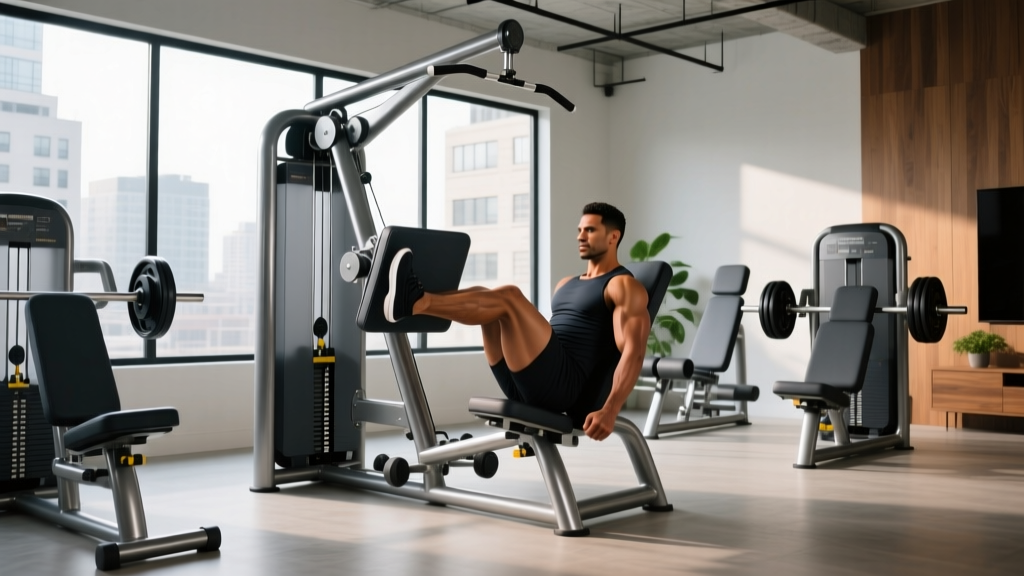
Leg Extension & Curl Machine Buying Guide: Angled Leg Press Machine

Space Guide: Power Cage & 45 Degree Leg Press Machine Layout

How to Use Leg Press Machine Planet Fitness & 2026 Leg Extension/Curl Guide

How Much Does a Leg Press Machine Weigh Without Weights? Home Compare

Hip Thrust Machines vs. Different Leg Press Machines: Budget Guide