
Optimize Your Power Cage: Squat Rack & Calf Machine Leg Press
Maximize your home gym footprint. Learn how to integrate a squat rack, leg press, and calf machine leg press into one optimized power cage layout.

The One-Footprint Leg Day: Space Optimization in 2026
As home gym real estate becomes increasingly premium in 2026, the era of dedicating 150 square feet to a standalone 45-degree leg press, a separate hack squat, and an isolated standing calf machine is over. Modern lifters demand high-yield, space-efficient solutions. The modern power cage has evolved from a simple squat stand into a comprehensive lower-body training hub. By strategically selecting a squat rack and power cage for leg training that supports modular attachments, you can execute heavy squats, sled-like presses, and targeted calf work within a single 48-square-foot footprint.
Designing this layout requires precise spatial awareness, an understanding of attachment biomechanics, and careful selection of rack ecosystems. This guide breaks down exactly how to map out, install, and optimize a multi-functional power cage that handles your heaviest leg days without turning your garage into an obstacle course.
Decoding the Calf Machine Leg Press Hybrid Setup
When space optimization is the primary goal, purchasing three separate machines is a mathematical and spatial failure. Instead, the industry has shifted toward modular rack attachments. When evaluating a calf machine leg press hybrid setup within a power cage, you are typically looking at a linear-bearing carriage system that mounts to the front or side of the rack's uprights.
💡 Layout Insight: The Carriage Dual-Use
A high-quality rack-mounted leg press carriage (typically weighing between 45 lbs and 75 lbs unloaded) serves as the primary resistance mechanism for your leg press. However, to integrate calf training, you utilize a specialized calf block attachment that slides into the uprights' laser-cut holes. This allows you to perform seated calf raises using the leg press carriage's lap pad, or standing calf raises using a barbell resting on the rack's J-cups while standing on the floor-mounted block. This eliminates the need for a standalone seated calf machine, saving roughly 12 square feet of floor space.
According to biomechanical analyses from ExRx.net, the 45-degree angle of traditional leg presses places significant shear force on the lumbar spine if the pelvis tilts posteriorly at the bottom of the movement. Rack-mounted vertical and 60-degree incline leg press attachments mitigate this by allowing a more natural pelvic alignment, making them not just space-saving, but ergonomically superior for many lifters.
Dimensional Blueprint: Mapping Your Power Cage Layout
Before purchasing a squat rack and power cage for leg training, you must calculate the dynamic footprint. The static footprint of a rack is misleading; you need to account for plate loading, carriage travel, and user clearance.
| Layout Zone | Required Dimensions (L x W) | Critical Clearance Notes |
|---|---|---|
| Base Rack (4-Post) | 48" x 48" | Requires 6" rear clearance if using a lat row / low pulley attachment. |
| Front Leg Press Track | + 36" Length | Total length becomes 84". Ensure no walls or doors impede the carriage. |
| Plate Loading Width | + 18" per side | Total width becomes 84". Allows loading of 45lb bumper plates without hitting walls. |
| Calf Block Zone | 24" x 12" (Internal) | Placed inside the rack footprint. No extra square footage required. |
| Total Dynamic Footprint | 84" x 84" (49 sq. ft.) | Replaces ~85 sq. ft. of standalone machine footprints. |
Top Squat Rack Ecosystems for Integrated Leg Training
Not all power cages are engineered to handle the lateral torque and repetitive friction of a leg press carriage. When building a calf machine leg press hybrid layout, you must choose a rack with 11-gauge steel minimum and 3x3" uprights with 1" or 5/8" hole spacing. Here are the top ecosystems in 2026 that support this specific layout.
1. Rep Fitness PR-5000 V3 Ecosystem
The Rep Fitness PR-5000 V3 is currently the gold standard for modular home gym layouts. Its 5x5 uprights (with 1" hole spacing) provide massive rigidity.
- Base Rack Cost: ~$1,099
- Leg Press Attachment: ~$599 (Features a 60-degree incline and UHMW-lined linear bearings)
- Calf Block / Seated Calf Attachment: ~$149
- Edge Case Warning: The PR-5000 V3 leg press carriage has a starting resistance of roughly 55 lbs. If you are rehabbing an injury and need lighter starting weights, you will need to use resistance bands to deload the carriage, as the pin-loaded weight stack does not offset the carriage weight.
2. Titan Fitness T3 Series Power Rack
For those on a stricter budget, the Titan T3 offers a compelling alternative. While the steel is slightly thinner (11-gauge vs Rep's 11-gauge but with different gusseting), it handles heavy leg presses admirably.
- Base Rack Cost: ~$699
- Leg Press Attachment: ~$499 (Note: Titan's attachment uses a cable-and-pulley ratio system on some models, which introduces a 2:1 mechanical disadvantage. This means a 100 lb plate load feels like 50 lbs, but requires you to pull twice the distance).
- Layout Constraint: The T3 leg press extends further out than the Rep model, requiring an additional 6 inches of frontal clearance.
3. Rogue Monster Series RM-3F
If budget is secondary to commercial-grade durability, the Rogue Monster RM-3F paired with the Monster Leg Press Carriage is unmatched. The 3x3" 11-gauge uprights and Rogue's proprietary UHMW plastic liners ensure the carriage glides silently and without binding, even when loaded with 800+ lbs. However, the total cost for the rack, carriage, and specialized calf attachments will easily exceed $3,500.
Flooring, Anchoring, and Safety Clearances
A squat rack and power cage for leg training generates immense downward and outward force vectors, particularly during heavy leg presses. If your rack shifts during a maximal effort set, the linear bearings can bind, potentially trapping the carriage.
- Subfloor Preparation: Your rack must sit on a flat, level concrete surface. A slope of even 1/4" over 4 feet will cause the leg press carriage to track unevenly, accelerating wear on the steel rails.
- Rubber Matting: Use 3/4" thick vulcanized rubber stall mats. Avoid interlocking foam tiles, as the high point-load of a loaded rack will compress the foam, causing the rack to lean and the leg press attachment to misalign.
- Anchoring Protocol: While flat-foot racks are popular, a leg press attachment requires bolting down. Use 3/8" wedge anchors drilled 3" into the concrete. Torque to 60 ft-lbs. If you cannot drill into concrete, you must use a rear weight storage system loaded with at least 400 lbs of plates to act as a counter-balance against the forward tipping moment of the leg press.
⚠️ Safety Warning: Spotter Arm Misuse
Never use standard J-cups or safety spotter arms as the 'stop' mechanism for your leg press carriage. Spotter arms are designed for vertical impact (a dropping barbell). The horizontal/shear force of a 600 lb leg press carriage slamming into a spotter arm can sheer the locking pins or bend the uprights. Always use the dedicated carriage stop-blocks provided by the manufacturer.
Troubleshooting Common Rack-Mounted Leg Press Failures
Even in an optimized layout, mechanical issues can arise. Here is how to troubleshoot the most common failure modes in hybrid rack setups:
- Carriage Binding / Stuttering: This is almost always caused by rail contamination or misalignment. Wipe down the steel rails with a degreaser and apply a dry PTFE (Teflon) lubricant. Never use WD-40 or wet silicone, as these attract dust and chalk, creating a grinding paste that destroys UHMW liners.
- Cable Fraying (Pulley Systems): If your specific calf machine leg press attachment utilizes a cable ratio system, inspect the nylon-coated aircraft cables every 6 months. Look for 'bird-caging' (where the wire strands separate). If the cable rubs against the steel housing at the pulley exit point, the rack is not perfectly level.
- Upright Deflection: If the front uprights visibly bow outward when the leg press is fully loaded, your rack lacks sufficient cross-bracing. Install a front lower cross-member or a sandwich J-cup backing plate to distribute the load across a wider surface area of the upright.
Final Layout Verdict
Integrating a squat rack, leg press, and calf machine into a single power cage footprint is the smartest spatial investment you can make in 2026. By meticulously planning your 84" x 84" dynamic clearance zone, selecting an 11-gauge ecosystem like the Rep PR-5000 V3 or Rogue Monster, and properly anchoring the unit to withstand multi-directional force vectors, you secure a commercial-grade leg training facility in under 50 square feet. Measure twice, bolt down securely, and never compromise on carriage clearance.
More gear to consider
All reviews
Horizontal Leg Press Machine Calf Raises vs Standing & Seated

Sled vs Horizontal Leg Press: Which Builds More Muscle?
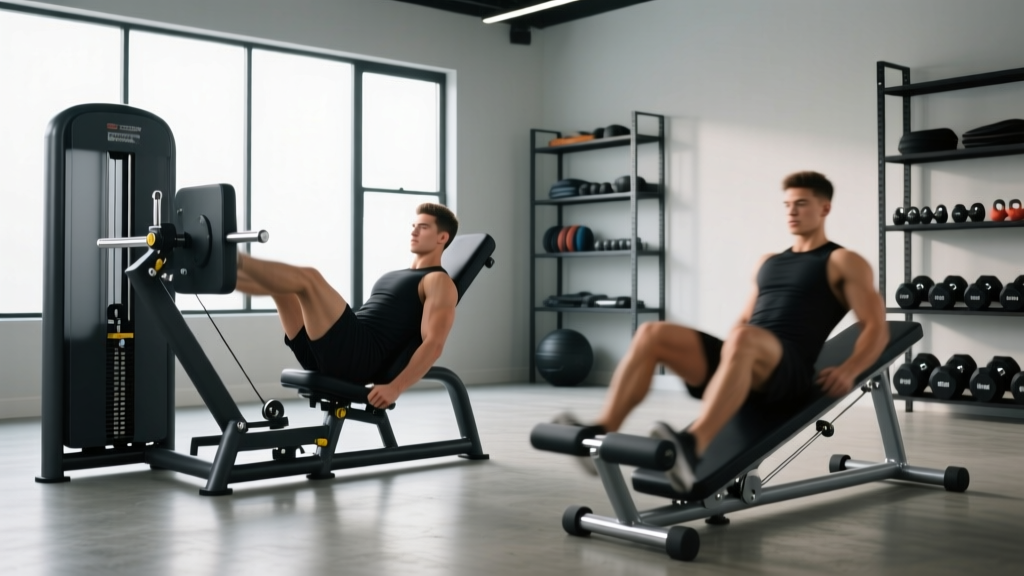
Lying Leg Press Machine vs 45-Degree: 2026 Buyer's Guide

Sled Push Pull: Using Your Leg Press Machine Starting Weight

Which Leg Press Machine Is Better: Horizontal vs 45-Degree?
