
Leg Press Machine Types Compared: Best for Home Gyms
Compare top leg press machine types for home gyms. We break down 45-degree, horizontal, and vertical sleds to find the best fit for your space and budget.

The Home Gym Leg Press Dilemma: Space vs. Biomechanics
Building a comprehensive lower-body training setup in a home gym often hits a critical roadblock: the leg press. Unlike squat racks, which double as rig systems for pull-ups and cable attachments, a dedicated leg press is a single-purpose monolith. When evaluating leg press machine types for a residential garage or basement gym, you are not just comparing biomechanics; you are battling ceiling heights, floor load capacities, and footprint constraints.
As of 2026, the home fitness equipment market has matured significantly. Manufacturers now offer commercial-grade linear bearings and precision cam systems scaled down for residential spaces. However, choosing the wrong machine type can result in a $3,000 piece of steel that either scrapes your drywall or fails under heavy eccentric loads. In this head-to-head comparison, we dissect the three primary leg press machine types—45-degree linear sleds, horizontal lever/cable presses, and vertical presses—to determine which architecture truly earns its footprint in your home gym.
⚠ Structural Alert: The Floor Load RealityA fully loaded 45-degree sled press can exert over 1,200 lbs of downward and shear force. When concentrated on four 2x2-inch rubber feet, this generates roughly 300 PSI per foot. Standard residential garage slabs (usually 4 inches of unreinforced concrete) can crack under repeated dynamic loading. Always place heavy sled presses on a reinforced lifting platform or directly over a structural foundation wall.
45-Degree Linear Sleds: The Heavyweight Contenders
The 45-degree linear sled is the undisputed gold standard for hypertrophy and raw strength. By positioning the user at an incline, gravity loads the sled directly along the track, providing a consistent resistance curve that closely mimics the joint angles of a back squat, albeit with zero axial spine loading. According to biomechanical analyses by ExRx, the 45-degree angle optimally targets the quadriceps while allowing significant gluteus maximus recruitment when foot placement is elevated on the platform.
Head-to-Head: Body-Solid GLPH1100 vs. Rogue Fitness ISO-35
When shopping for a 45-degree press, you generally choose between a budget-friendly tubular steel frame and a premium, laser-cut heavy-gauge chassis.
- Body-Solid GLPH1100 (Approx. $1,199): This is the quintessential entry-level home gym sled. It features a 59-inch length, 34-inch width, and a 105 lb starting resistance. The carriage rides on high-density foam rollers. Failure Mode: Under loads exceeding 600 lbs, foam rollers can develop flat spots, leading to a gritty, uneven carriage travel. Furthermore, the dual safety handles require the user to twist their wrists to disengage the locks, which can be precarious during a maximal failure rep.
- Rogue Fitness ISO-35 (Approx. $3,950): Rogue's answer to the home gym leg press is a commercial-grade beast scaled down to an 83x34x54-inch footprint. It utilizes UHMW (Ultra-High Molecular Weight) polyethylene sled guides and linear bearings, ensuring frictionless travel even with 1,000+ lbs loaded. The 15-degree seat angle reduces lumbar shear compared to steeper 45-degree benches. Edge Case: At 54 inches high, users over 6'2" will need a minimum 8-foot ceiling clearance to avoid their knees striking the crossmembers at full flexion.
Horizontal Leg Presses: The Footprint Optimizers
If your home gym is located in a basement with low ceilings or a spare bedroom with limited length, the horizontal leg press is your primary alternative. These machines position the user parallel to the floor, pushing a carriage away horizontally. They eliminate the need for massive overhead clearance and drastically reduce the floor footprint.
Head-to-Head: Powertec LeverGym vs. TDS 1000 lb Horizontal
Horizontal presses rely on either cable-pulley systems or mechanical lever arms to translate horizontal force into vertical weight stacks or plate-loaded carriages.
'The primary drawback of budget horizontal cable presses is pulley friction and cable stretch. When you load 800 lbs on a cable-driven horizontal press, the initial breakaway force is significantly higher than the actual resistance felt at mid-range due to mechanical inefficiency.' - Home Gym Engineering Analysis, 2025
- TDS 1000 lb Horizontal Leg Press (Approx. $599): A bare-bones, plate-loaded horizontal sled. It uses a simple cable and pulley routing system. While highly affordable and compact (roughly 65 inches long), the cable stretch and pulley stiction make the resistance curve feel jerky. It is best suited for high-rep, blood-flow restriction (BFR) training rather than heavy 1-5 rep max testing.
- Powertec Fitness LeverGym (Approx. $2,499): While technically a multi-station, its dedicated horizontal leg press attachment utilizes a direct mechanical lever arm rather than cables. This provides a buttery-smooth, 1:1 resistance ratio with zero cable stretch. The trade-off is the machine's width; the lever arm swing requires a lateral clearance of at least 6 feet, making it unsuitable for narrow galley-style garage gyms.
Vertical Leg Presses: The Low-Ceiling Compromise
Vertical leg presses require the user to lie supine on the floor and push a carriage straight up toward the ceiling. These are the ultimate space-savers, often occupying a mere 4x4-foot footprint. However, they introduce unique biomechanical challenges.
Head-to-Head: Powerline PVL132X vs. Body-Solid SLP500G
- Powerline PVL132X (Approx. $400): A plate-loaded vertical press. It is incredibly cheap and fits in a closet. Biomechanical Flaw: The back pad is flat and lacks a pelvic tilt accommodation. When bringing the knees to the chest, the user's pelvis is forced into a posterior tilt, causing the lumbar spine to lift off the pad and round dangerously under load.
- Body-Solid SLP500G (Approx. $2,200): A selectorized stack-loaded vertical press. It solves the lumbar issue with an ergonomically contoured pad that supports the natural lordotic curve of the spine. The 500 lb weight stack is sufficient for most home gym users, though advanced lifters may find the max resistance limiting for progressive overload without adding external bands.
Comprehensive Leg Press Machine Types Comparison Matrix
| Feature | 45-Degree Sled (Rogue ISO-35) | Horizontal Lever (Powertec) | Vertical Stack (Body-Solid SLP500G) |
|---|---|---|---|
| Footprint (L x W) | 83' x 34' | 72' x 72' (w/ arm swing) | 48' x 48' |
| Min. Ceiling Height | 8 Feet | 7 Feet | 7 Feet |
| Resistance Mechanism | Plate-Loaded Linear Sled | Plate-Loaded Lever Arm | Selectorized Pin Stack |
| Max Tested Load | 1,000+ lbs | 800 lbs | 500 lbs (Stack limit) |
| Spinal Shear Risk | Low (with proper seat angle) | Very Low | Moderate (requires pad contour) |
| 2026 Price Range | $3,950 | $2,499 | $2,200 |
Biomechanical Realities and Joint Loading
When selecting among the various leg press machine types, understanding joint loading is paramount. The Rogue Fitness ISO-35 specifically engineered a 15-degree back pad to mitigate the shear forces placed on the sacroiliac (SI) joint during deep hip flexion. Cheaper 45-degree models often utilize a steep 45-degree back pad, which forces the lumbar spine into flexion when the knees approach the chest, drastically increasing the risk of herniation under heavy loads.
Conversely, horizontal and vertical presses alter the moment arm at the knee joint. Because the user is pushing horizontally or vertically, the gravitational vector changes relative to the femur. This makes horizontal presses exceptionally joint-friendly for lifters recovering from patellar tendinopathy, as the shear force on the patellofemoral joint is reduced at the bottom of the movement compared to a steep 45-degree sled.
Final Verdict: Matching the Machine to Your Garage
There is no universally perfect leg press; there is only the right machine for your specific spatial and biomechanical constraints.
- Choose the 45-Degree Sled (Rogue ISO-35) if you have a dedicated 2-car garage with 10-foot ceilings, a reinforced concrete slab, and prioritize maximal load capacity and commercial-grade biomechanics.
- Choose the Horizontal Lever (Powertec) if you have low basement ceilings but ample lateral width, and you want to avoid the maintenance and friction issues of cable-driven sleds.
- Choose the Vertical Stack (Body-Solid SLP500G) only if you are strictly limited to a 4x4-foot footprint or a multi-use spare bedroom, and your training focuses on moderate-rep hypertrophy rather than 1-rep max strength testing.
Investing in the correct leg press architecture ensures that your home gym remains a safe, efficient, and highly effective environment for lower-body development for years to come.
More gear to consider
All reviews
Optimize Your Power Cage: Squat Rack & Calf Machine Leg Press
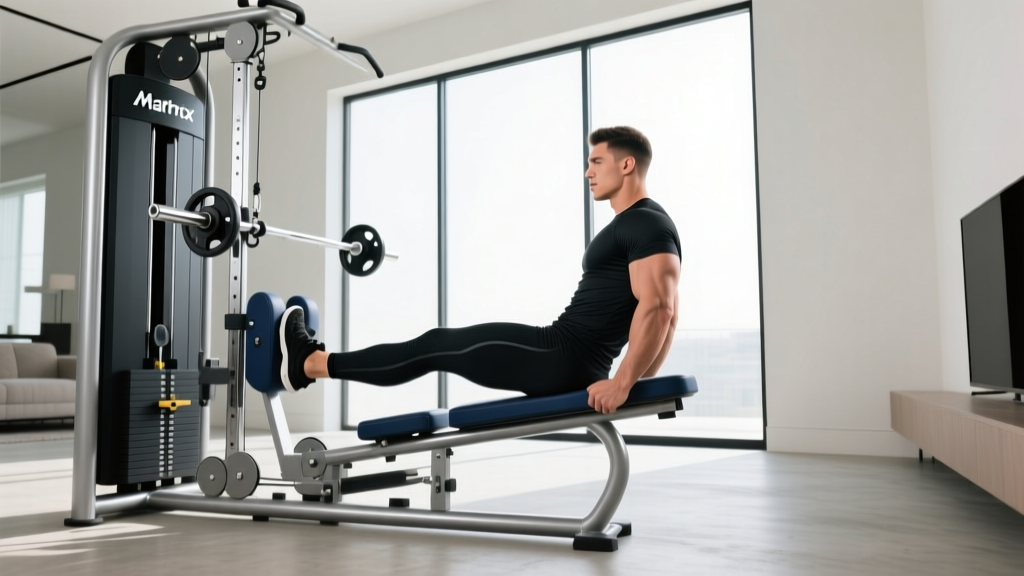
Matrix Leg Press Machine Weight Without Plates & Cable Leg Care
Framework Homegym Compare Essentials Build a Leg-Strong Training Space

How to Adjust Leg Press Machine for Calves: Standing vs Seated

Squat Rack vs Planet Fitness Leg Press Machine: Space Layout Guide
