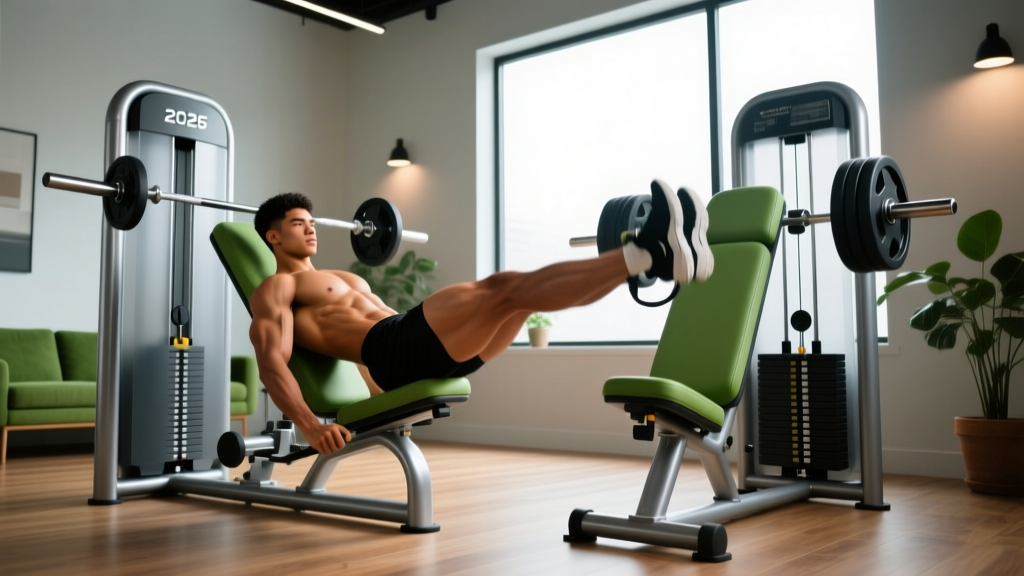
Leg Press Cable Machine Guide: Horizontal vs 45-Degree 2026
Compare horizontal and 45-degree leg press cable machines. Our 2026 buying guide covers biomechanics, top models, pricing, and space requirements.

The Evolution of Lower Body Resistance: Selectorized vs. Plate-Loaded
When outfitting a commercial facility or high-end home gym in 2026, the debate between horizontal and 45-degree leg press configurations remains a cornerstone of equipment planning. However, the modern market has shifted heavily toward the leg press cable machine—a selectorized, weight-stack-driven system that utilizes heavy-duty pulleys and aircraft-grade cables rather than traditional plate-loaded linear bearings. This shift eliminates the need for manual plate loading, reduces floor impact noise, and provides a smoother eccentric phase. But does the cable-driven resistance profile change the biomechanical reality of the horizontal versus 45-degree angle debate? This in-depth buying guide breaks down the exact specifications, spatial requirements, and physiological outcomes of both configurations.
Quick Decision Framework
- Choose Horizontal: If ceiling height is under 84 inches, floor space is limited to a 75-inch length, or your primary demographic includes rehabilitation clients and seniors requiring easier ingress/egress.
- Choose 45-Degree: If you have a 90+ inch ceiling, want to maximize gluteus maximus activation through deeper hip flexion, and cater to athletic performance demographics.
Biomechanics: Hip Flexion and Lumbar Shear Forces
The fundamental difference between horizontal and 45-degree leg press machines lies in the torso-to-femur angle at the bottom of the movement. According to kinesiological principles documented by ExRx, the angle of the torso relative to the floor dictates the degree of hip flexion and the subsequent stretch on the hamstrings and gluteal muscles.
The Horizontal Configuration (90-Degree Torso)
In a horizontal leg press cable machine, the user sits upright with their torso perpendicular to the floor. As the knees draw toward the chest, the femur approaches a 90-degree angle relative to the torso. The Edge Case: For users with tight hamstrings or limited hip mobility, this deep 90-degree flexion often forces the pelvis into a posterior tilt ("butt wink") at the bottom of the stroke. This posterior tilt rounds the lumbar spine, placing dangerous shear forces on the intervertebral discs under heavy loads.
The 45-Degree Configuration (135-Degree Torso)
A 45-degree leg press cable machine reclines the user's backrest. This opens the hip angle to approximately 135 degrees at the bottom of the movement. The National Strength and Conditioning Association (NSCA) frequently notes that this reclined position allows for a deeper range of motion without inducing premature posterior pelvic tilt. Consequently, the 45-degree angle permits greater stretch-mediated hypertrophy in the gluteus maximus while maintaining a neutral lumbar spine.
How Cable-Driven Resistance Alters the Movement Profile
Unlike plate-loaded sleds that rely on gravity and linear bearings, a leg press cable machine transfers the resistance from a vertical or angled weight stack to the footplate via a pulley system. This introduces specific mechanical variables that buyers must understand:
- Pulley Ratios: Most 2026 commercial models utilize a 1:1 or 2:1 cable ratio. A 2:1 ratio means a 200 lb weight stack feels like 100 lbs at the footplate, but the cable must travel twice the distance. This results in a "smoother" feel but requires a massive weight stack (up to 400 lbs) to accommodate advanced lifters.
- Friction and Eccentric Overload: Plate-loaded machines offer minimal friction on the eccentric (lowering) phase. Cable machines introduce slight pulley friction. High-end models use sealed precision bearings to minimize this, ensuring the eccentric phase remains challenging and true to the selected weight.
- Cable Sway and Tension: In horizontal cable models where the cable runs parallel to the floor over a long distance, "cable sway" can occur if tension drops. Premium models mitigate this with mid-point cable guides.
2026 Market Comparison: Top Selectorized Leg Press Models
Below is a comparison matrix of leading commercial-grade leg press cable machines available in 2026, highlighting the distinct differences between horizontal and 45-degree offerings.
| Brand & Model | Angle | Drive System | Max Stack | Footprint (L x W) | 2026 MSRP |
|---|---|---|---|---|---|
| Matrix Magnum Selectorized | 45-Degree | Cable/Pulley (1:1) | 315 lbs | 92" x 36" | $7,899 |
| Hoist ROC-IT Seated Leg Press | Horizontal | Cable/Pulley (2:1) | 250 lbs (500 effective) | 72" x 42" | $5,450 |
| Life Fitness Integrity Series | 45-Degree | Cable/Pulley (1:1) | 400 lbs | 98" x 38" | $9,200 |
| Cybex Eagle NX (Refurb/Reman) | 45-Degree | Cable/Pulley (1:1) | 295 lbs | 89" x 35" | $4,100 |
| Precor Discovery Series | Horizontal | Cable/Pulley (1:1) | 300 lbs | 76" x 39" | $6,750 |
Facility Planning: Spatial and Structural Requirements
Integrating a leg press cable machine into a facility requires precise spatial planning. The physical footprint is only half the equation; you must also account for the operational envelope and structural floor loading.
Ceiling Height and Stack Clearance
45-degree leg press cable machines often feature a weight stack that travels upward at an angle or sits vertically at the rear of the sled. When a user fully extends their legs, the carriage moves up the 45-degree track, and the weight stack rises. Facilities must maintain a minimum ceiling clearance of 96 inches (8 feet) for most 45-degree models to prevent the carriage or stack from striking overhead lighting or HVAC ducts. Horizontal models, by contrast, keep the weight stack entirely vertical and stationary relative to the user's extension, making them ideal for basement gyms with 84-inch ceilings.
Floor Loading (PSF)
A fully loaded 45-degree selectorized leg press can weigh upwards of 900 lbs. Concentrated over a footprint of roughly 22 square feet, this exerts a static load of 40-45 pounds per square foot (PSF). The American Council on Exercise (ACE) facility guidelines recommend placing heavy selectorized equipment on reinforced concrete slabs or directly over floor joists in multi-story residential builds to prevent long-term floor deflection.
Expert Troubleshooting & Maintenance Edge Cases
Cable-driven systems require a different maintenance protocol than plate-loaded linear bearings. Facility managers and home gym owners must monitor the following failure modes:
- Cable Stretch and Turnbuckle Adjustment: Over the first 3 to 6 months, 5/16" aircraft steel cables will experience "constructional stretch" as the strands seat into one another. This results in slack at the bottom of the movement. Fix: Locate the turnbuckle near the weight stack and tighten it by 3-4 turns to restore tension. Do not over-tighten, or the stack will not rest fully on the bumpers.
- Pulley Bearing Seizure: In high-humidity environments, unsealed pulley bearings can corrode, causing the cable to drag and creating a "sticky" eccentric phase. Fix: Inspect pulleys quarterly. Replace any pulley that does not spin freely when flicked by hand with a sealed, precision-bearing nylon pulley.
- Guide Rod Friction: The weight stack itself rides on steel guide rods. If users apply standard WD-40 or petroleum-based lubricants, dust will adhere to the rods, creating an abrasive paste that destroys the stack bushings. Fix: Use only a dry PTFE (Teflon) spray or a dedicated silicone-based gym equipment lubricant, wiping away excess immediately.
Frequently Asked Questions
Is a horizontal leg press cable machine better for bad knees?
Not necessarily. Knee joint stress is dictated by the foot placement on the plate and the depth of the knee flexion, not the torso angle. However, horizontal machines often feel more stable for users with lower back issues, as the upright seated position prevents the lumbar spine from being compressed against a reclined pad under heavy loads.
Can I swap the cable on a 45-degree leg press myself?
While technically possible, replacing the main drive cable on a commercial 45-degree leg press cable machine requires specialized swaging tools and exact tensioning. Because a snapped cable under 400 lbs of tension poses a severe laceration and impact hazard, it is highly recommended to hire a certified fitness equipment technician for cable replacements.
Why do 45-degree machines cost more than horizontal ones?
The premium on 45-degree models (often $1,500 to $2,500 more than horizontal equivalents) is driven by the sheer mass of steel required to build a rigid, inclined track that will not warp under 1,000+ lbs of dynamic force, as well as the complex pulley routing needed to translate vertical weight stack movement into an angled carriage pull.
More gear to consider
All reviews
Space Optimization: Power Cage vs Lifetime Leg Press Machine

Syedee Leg Press Machine vs 45° Sleds: 2026 Buying Guide

Standing vs Seated Calf Raises: LA Fitness Leg Press Machine Mistakes

How to Use Leg Press Machine Planet Fitness & 2026 Leg Extension/Curl Guide

Hack Squat vs Leg Press Setup: Calculating Leg Press Machine Weight