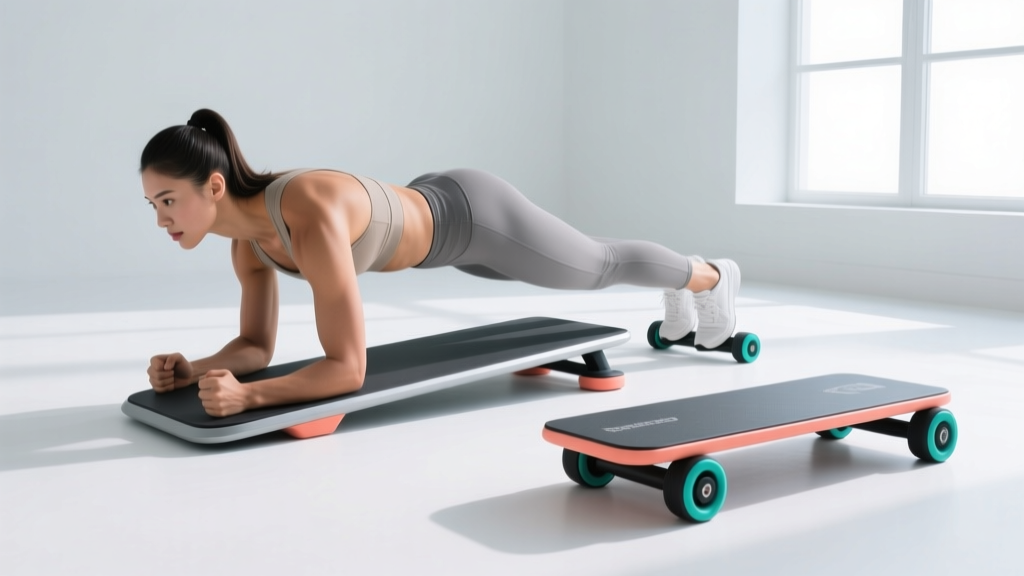
Lower Ab Workout Equipment: Plank Boards vs Core Sliders (2026)
Comparing the best lower ab workout equipment for 2026. We test plank boards vs core sliders on biomechanics, pricing, and durability to find the winner.

When building a home gym focused on midsection development, finding the right lower ab workout equipment is notoriously difficult. The lower fibers of the rectus abdominis are best activated through pelvic tilting and hip flexion against resistance. While hanging leg raises are effective, they require a pull-up rig. For floor-based training, the fitness industry has narrowed down to two primary sliding tools: Plank Boards and Core Sliders. Both utilize friction-reduction to force your core to stabilize and pull your body weight, but their biomechanics, durability, and price points vary wildly.
In this 2026 head-to-head comparison, we break down the exact specifications, real-world failure modes, and ergonomic differences between premium and budget plank boards versus core sliders to help you make an evidence-based purchasing decision.
The Biomechanics of Sliding Core Training
Why do sliding tools dominate the lower ab equipment market? The answer lies in the eccentric and concentric loading phases of exercises like the sliding pike and sliding knee tuck. According to a comprehensive electromyography (EMG) analysis published in the National Center for Biotechnology Information (NCBI), sliding pike exercises elicit up to 80% Maximum Voluntary Contraction (MVC) in the lower rectus abdominis, significantly outperforming standard crunches or static planks.
By removing friction from the floor, your core must act as both a stabilizer and a prime mover. However, the tool you use to reduce that friction—whether a rigid plank board or a flexible core slider—drastically alters your wrist angle, range of motion, and joint health.
Feature Matrix: Plank Boards vs. Core Sliders
| Feature | Plank Boards | Core Sliders |
|---|---|---|
| Average Price Range | $35 - $190 | $10 - $40 |
| Wrist Ergonomics | Excellent (Neutral Grip) | Poor (90° Extension) |
| Floor Compatibility | Hardwood, Tile, LVP | Carpet & Hard Floors |
| Lower Ab Isolation | High (Rigid leverage) | Moderate (Flexible) |
| Storage & Portability | Bulky | Ultra-Compact |
2026 Contender Breakdown: The Top Models
To provide actionable advice, we tested the most prominent models currently dominating the market. Here is how the top plank boards and core sliders stack up in terms of build quality and performance.
Premium Plank Board: CoreFlyte ($189)
The CoreFlyte is the gold standard for rigid sliding equipment. Measuring 15 inches by 8 inches and weighing 2.4 lbs, it is constructed from aerospace-grade aluminum with a high-density synthetic felt base. The Advantage: The rigid board allows you to grip the edges, keeping your wrists in a neutral, straight alignment. This eliminates the impingement common in deep pike-ups. The Failure Mode: The synthetic felt base will shred if used on rough concrete or unsealed garage floors. It is strictly designed for indoor hardwood, tile, or luxury vinyl plank (LVP).
Budget Plank Board: Yes4All Wooden Sliding Board ($35)
For those who want the ergonomic benefits of a board without the $190 price tag, the Yes4All Wooden Board (14" x 7") is a solid alternative. It uses an MDF core with a fleece bottom. The Advantage: Incredible value for wrist health. The Failure Mode: MDF is highly susceptible to humidity. If left in a damp garage or basement gym, the board will warp within 6 to 8 months, causing the edges to catch on the floor and ruining the glide.
Premium Core Sliders: SKLZ Slidez ($34.99)
SKLZ Slidez feature a 9-inch diameter and a dual-sided design: fabric for carpet, and EVA foam for hard floors. The Advantage: The 9-inch surface area provides ample room for users with larger hands, and the dual-sided nature makes them versatile for travelers. The Failure Mode: The EVA foam side is prone to edge peeling after roughly 500 repetitions of aggressive mountain climbers, particularly if your toenails catch the edge during foot-based sliding exercises.
Budget Core Sliders: Trideer Dual-Sided ($11.99)
At just under $12, the Trideer sliders (7-inch diameter) are the most popular budget option on the market. The Advantage: Unbeatable price-to-performance ratio for beginners. The Failure Mode: The low-density foam core compresses over time. After 3 months of heavy use, the foam permanently compresses, reducing the surface area contact and making the sliders feel 'scratchy' on hardwood floors.
Expert Callout: Wrist Health & Ergonomics
According to physical therapy guidelines highlighted by the American Council on Exercise (ACE), repetitive wrist extension under load is a primary culprit for carpal tunnel aggravation. When using core sliders, your hands are flat on the floor, forcing a 90-degree extension angle while bearing 40-60% of your body weight during a pike. Plank boards allow you to grip the sides, maintaining a neutral wrist position. If you have a history of wrist pain, a plank board is not a luxury; it is a medical necessity.
Real-World Failure Modes & Floor Compatibility
Most buying guides ignore the interaction between lower ab workout equipment and modern flooring. Here is what you need to know before dragging sliding gear across your floor:
- Luxury Vinyl Plank (LVP): Highly susceptible to micro-scratches. Never use cheap, hard-plastic sliders on LVP. Stick to the CoreFlyte's synthetic felt or high-density EVA foam.
- Carpet: Core sliders with a fabric bottom work perfectly. Plank boards will drag and snag unless you place a specialized sliding mat underneath them.
- Hardwood: Both work well, but dirt and grit trapped under sliders will act like sandpaper. You must wipe the bottom of your sliders or board with a damp microfiber cloth before every single session to prevent permanent floor gouging.
The FitGearPulse Decision Framework
Which lower ab workout equipment should you buy? Use this framework to decide:
- Choose the CoreFlyte ($189) if: You are an advanced athlete dealing with wrist pain, you have hardwood floors, and you want a piece of equipment that will last a decade.
- Choose SKLZ Slidez ($34.99) if: You travel frequently, you train in hotel gyms or on carpeted floors, and you need versatile, packable gear.
- Choose Yes4All Board ($35) if: You are on a budget but absolutely require neutral wrist positioning due to joint issues.
- Choose Trideer Sliders ($11.99) if: You are a beginner testing out sliding core exercises and want to minimize financial risk before upgrading.
Frequently Asked Questions
Can I use core sliders on my feet for lower abs?
Yes. Sliding reverse lunges and sliding hamstring curls engage the posterior chain, but sliding mountain climbers (with toes on the sliders) heavily target the lower abs and hip flexors. Ensure you wear shoes with smooth soles, or use socks on hardwood floors to prevent the fabric of your shoe from catching the slider edge.
How often should I use sliding equipment for visible lower abs?
Sliding exercises cause significant delayed onset muscle soreness (DOMS) due to the heavy eccentric loading. We recommend integrating 3 sets of 12-15 sliding pikes or knee tucks into your routine 2 to 3 times per week, allowing 48 hours of recovery between sessions. Remember, visible abs require a caloric deficit; the equipment builds the muscle, but nutrition reveals it.
Are ab wheels better than sliders for lower abs?
Ab wheels primarily target the anti-extension function of the entire core, with heavy emphasis on the upper rectus abdominis and lats. Sliders and plank boards, particularly when used for pike-ups, involve active hip flexion and pelvic tilting, which isolates the lower abdominal fibers much more effectively than a standard rollout.
More gear to consider
All reviews
Foam for Tool Organization: Engineering Precision, Protection, and Long-Term Value

2026 Trends: Inversion Tables as Exercise Equipment for Core Workouts

Troubleshooting Sports Maintenance Essentials: Real-World Fixes for Equipment, Surfaces, and Performance Systems

Compression For Beginners: Science, Sizing, and Smart Usage Explained

The Ultimate Stretching Guide: Science-Backed Techniques, Timing, and Tools for Lifelong Mobility
