Ab Coaster Machine Review, Alternatives & Yoga Design Lab Mat Space
Read our Ab Coaster machine review and space-saving alternatives. We compare its 10 sq ft footprint to mat-based layouts for optimal home gym design.

The Spatial Dilemma: Heavy Iron vs. The Mat Boundary
When designing a home gym in 2026, spatial optimization is no longer optional; it is the defining factor between a functional training space and a cluttered storage room. Core training, in particular, presents a unique layout challenge. You are constantly weighing the biomechanical benefits of heavy, guided machines against the minimalist efficiency of floor-based routines. To understand this spatial trade-off, we must look at the extremes. On one end, we have the massive footprint of guided abdominal machines. On the other end, we have the strict spatial boundaries defined by floor work. In our recent yoga design lab mat review, we established that a premium 72-by-26-inch mat defines the absolute baseline boundary for unanchored floor exercises. Today, we are putting the ultimate space-hog—the Ab Coaster—under the microscope, reviewing its real-world value, and exploring high-ROI alternatives that respect your spatial limits.
Ab Coaster Machine Review: Biomechanics and Spatial Reality
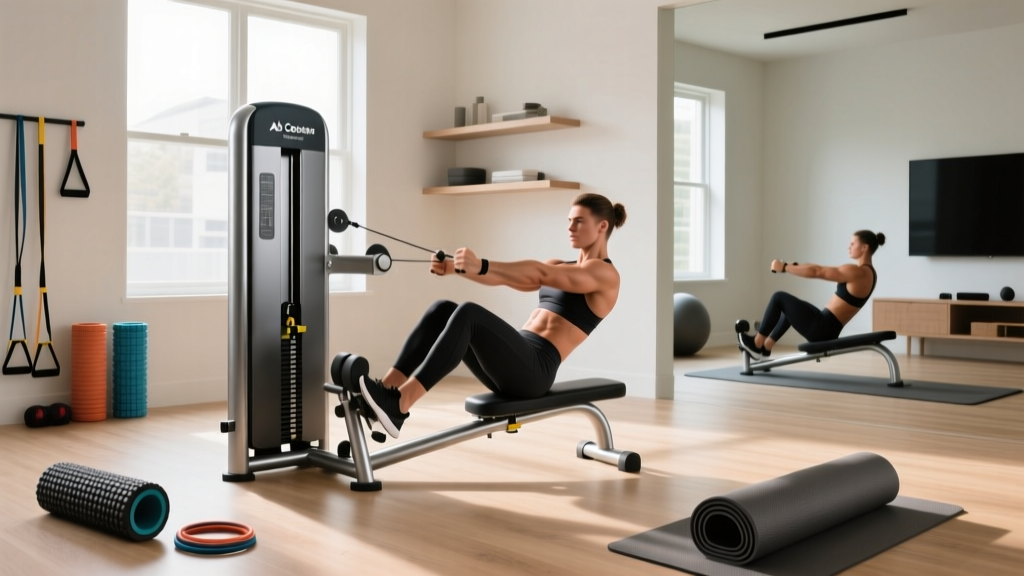
The Ab Coaster (specifically the FreeMotion Ab Coaster Max and its residential clones) operates on a simple but effective premise: a kneeling crunch guided by a curved 42-inch steel track. By forcing the user into a bottom-up pelvic tilt, it isolates the rectus abdominis while minimizing hip flexor dominance—a common flaw in traditional sit-up benches.
⚠️ Spatial & Maintenance Warning: The physical footprint of the Ab Coaster is 55 inches long by 20 inches wide. However, the operational footprint requires an additional 36 inches of clearance at the base for user entry, exit, and loading weight plates onto the dual horns. Furthermore, if stored in a non-climate-controlled garage, the four polyurethane carriage wheels can develop flat spots, causing a jerky, uneven glide along the track.Real-World Pricing and Failure Modes
As of early 2026, a genuine commercial-grade Ab Coaster Max retails between $1,499 and $1,899, while residential versions (like the Bowflex or generic Amazon imports) hover around $199 to $299. The residential models suffer from specific failure modes:
- EVA Foam Knee Pad Compression: Standard 1-inch EVA foam pads compress permanently after 4 to 6 months of daily use, transferring joint stress to the patella. Upgrading to high-density polyurethane pads (usually a $25 aftermarket fix) is mandatory.
- Track Squeaking: The steel-on-steel carriage connection requires monthly silicone lubrication. Failure to do so results in a high-pitched squeak that will ruin any home gym environment.
- Weight Horn Limitations: Most residential models max out at 20 lbs of plate loading per side, which advanced trainees will outgrow within 8 weeks.
Biomechanical Breakdown: Guided Track vs. Free-Floor Tension
Understanding the spatial trade-off requires understanding the muscular trade-off. The Ab Coaster's 42-inch curved track forces a strict posterior pelvic tilt. This is excellent for users with lower back pain who struggle to maintain a neutral spine during hanging leg raises or cable crunches. However, the fixed path eliminates the need for lateral stabilization. The obliques and the deep transverse abdominis act primarily as stabilizers; when you remove the need to stabilize (as the Ab Coaster does), you reduce overall core activation. According to the American Council on Exercise (ACE), exercises that require anti-extension and stabilization—such as suspension pikes or slider body-saws—yield higher overall electromyography (EMG) readings across the entire abdominal wall compared to fixed-path flexion machines. Therefore, sacrificing 10.5 square feet for an Ab Coaster means sacrificing functional, multi-planar core development.
The 2026 Core Equipment Footprint Matrix
How does the Ab Coaster compare to other core equipment when space is the primary constraint? The table below breaks down the exact spatial and financial requirements of popular core tools.
| Equipment | Physical Footprint | Operational Clearance | 2026 Price Range |
|---|---|---|---|
| Ab Coaster (Residential) | 7.6 sq ft (55' x 20') | ~10.5 sq ft total | $199 - $299 |
| Perfect Fitness Ab Carver Pro | 2.6 sq ft (Stores flat) | 12 sq ft (Mat length) | $35 - $45 |
| Dual-Sided Core Sliders | 0.5 sq ft (Pair) | 13 sq ft (Mat length) | $12 - $18 |
| TRX Suspension (Door Anchor) | 0 sq ft (Wall/Door) | 21 sq ft (7' x 3' swing) | $169 - $219 |
Top 3 Space-Optimized Alternatives to the Ab Coaster
If dedicating 10.5 square feet of permanent floor space to a single, isolation-based machine does not align with your layout strategy, consider these high-tension, space-saving alternatives that fit perfectly within the boundaries established in our yoga design lab mat review.
1. Perfect Fitness Ab Carver Pro (The Flat-Storing Roller)
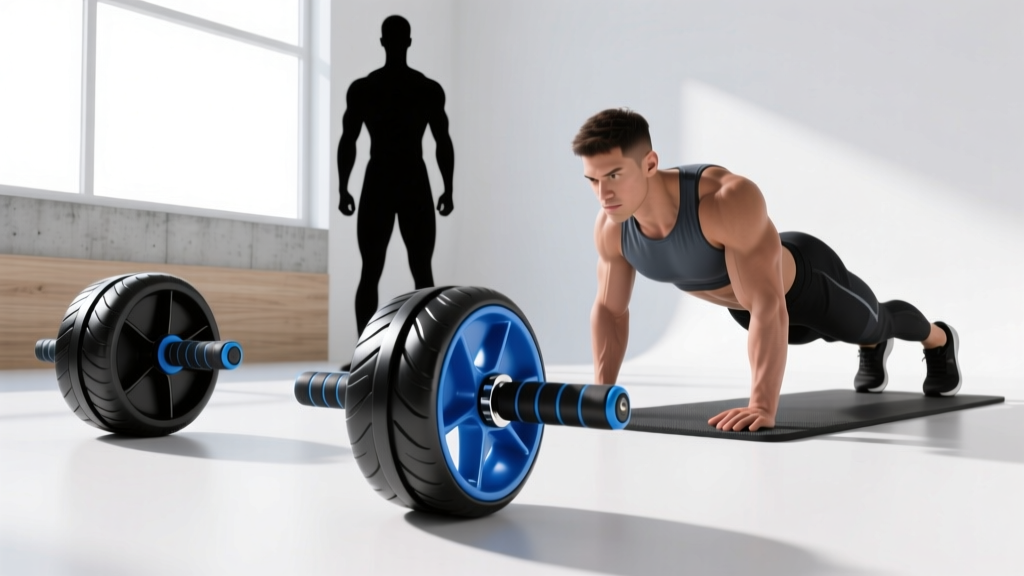
Unlike standard ab wheels that require awkward wall-leaning for storage, the Ab Carver Pro features a wide 23-inch base and an internal carbon steel spring mechanism. The spring provides kinetic resistance on the rollout and assists on the return, mimicking the guided tension of a machine. Layout Tip: It stores completely flat under a bed or behind a door, consuming zero visual space when not in use.
2. Dual-Sided Core Sliders (The Friction-Based Crunch)
Core sliders (such as the Valslide or SKLZ models) utilize friction to create resistance. By placing your feet on the sliders and executing pike-ups or mountain climbers on a hardwood floor or carpet, you generate immense eccentric tension on the lower rectus abdominis. Layout Tip: Sliders require zero dedicated storage space and allow you to transform your existing mat boundary into a high-intensity core zone without moving a single piece of heavy furniture.
3. TRX Suspension Trainer (The Vertical Footprint)
For those who want to eliminate floor clutter entirely, a TRX system mounted to a heavy-duty door anchor shifts your core training to the vertical plane. TRX pikes and suspended crunches require intense stabilizer engagement that the guided track of an Ab Coaster completely bypasses. Layout Tip: Ensure your door opens away from you to prevent the anchor from slipping during high-tension pike movements.
Advanced Mat-Zone Programming
If you choose the space-saving route, you must program your mat-based zone to replicate the progressive overload of the Ab Coaster. Here is a 2026 spatial-efficient core circuit designed to fit entirely within your mat boundary:
- Slider Pikes (3 sets to failure): Replicates the bottom-up flexion of the Ab Coaster.
- Ab Carver Pro Rollouts (3 sets of 12): Replicates the top-down eccentric stretching.
- TRX Suspended Oblique Crunches (3 sets of 15 per side): Adds the lateral flexion missing from the guided track.
This triad provides comprehensive core stimulation while requiring less than 2 square feet of dedicated storage space.
Designing Your Layout: Clearances and Flow
When finalizing your 2026 home gym layout, apply the 'Traffic Flow Rule.' Never place an Ab Coaster in the center of a room or blocking the pathway between your cardio zone and free weights. If you must use an Ab Coaster, tuck it into a corner at a 45-degree angle, allowing the 36-inch entry clearance to face the open room. Conversely, if you opt for the mat-based alternatives, designate a permanent 7-by-3-foot 'Flex Zone' near a window or mirror, keeping your core sliders, ab wheel, and resistance bands in a single wall-mounted mesh bin.
Expert Sources & Biomechanical References
To ensure our layout and equipment recommendations align with current exercise science, we rely on data from leading fitness organizations. According to the American Council on Exercise (ACE), guided abdominal machines like the Ab Coaster effectively isolate the rectus abdominis but often neglect the transverse abdominis and obliques, which are heavily recruited during unstable, floor-based slider and suspension exercises. Furthermore, the National Strength and Conditioning Association (NSCA) emphasizes that spinal flexion under load should be balanced with anti-extension and anti-rotation movements to maintain long-term lumbar health—a balance much easier to achieve with a diverse, space-efficient toolkit than with a single, fixed-track machine.
More gear to consider
All reviews
Storage FAQ Answered: Real-World Answers from 12 Years of Equip Body Core Field Experience

Troubleshooting Sports Maintenance Essentials: Real-World Fixes for Equipment, Surfaces, and Performance Systems

Roman Chair Setup for a Targeted Ab Workout Routine With Equipment

The Ultimate Stretching Guide: Science-Backed Techniques, Timing, and Tools for Lifelong Mobility

Installing Core Workout Equipment: Roman Chair Setup Walkthrough