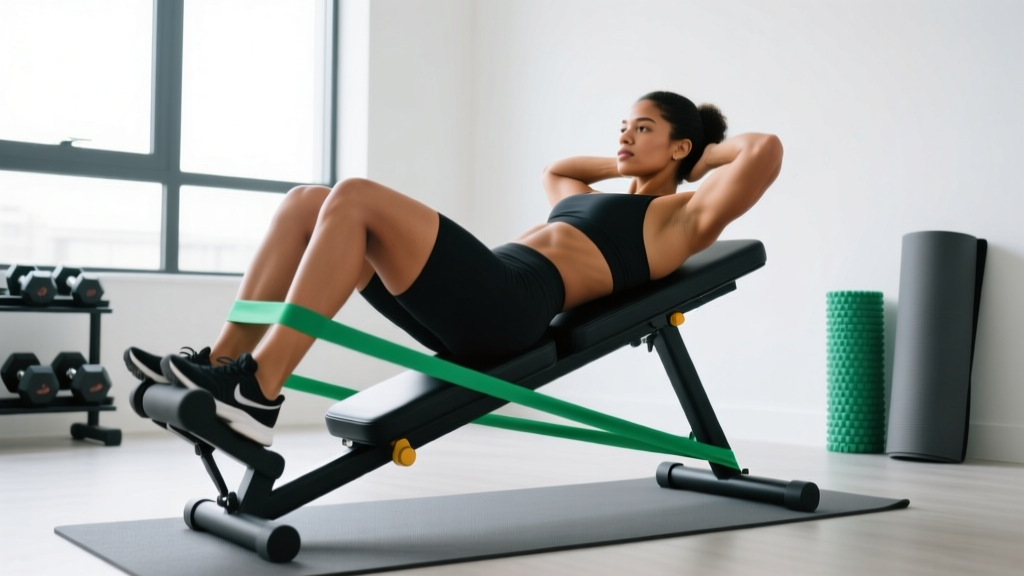
Beginner Ab Workouts With Equipment: Decline Bench Guide
Master ab workouts with equipment using our beginner step-by-step decline bench guide. Build core strength safely with exact angles, routines, and gear specs.

Why the Decline Bench is the Ultimate Starting Point
When you begin exploring ab workouts with equipment, the sheer volume of gadgets can be overwhelming. From motorized ab stimulators to complex cable pulley systems, the fitness industry loves to overcomplicate core training. However, if you want to build a resilient, functional, and aesthetically defined midsection, the traditional sit-up bench—specifically the adjustable decline bench—remains the undisputed champion for beginners.
Unlike floor exercises that limit your range of motion to a flat plane, a decline bench introduces gravitational overload. By elevating your feet above your torso, you increase the eccentric loading on the rectus abdominis. According to landmark biomechanical research published by the American Council on Exercise (ACE), decline crunches consistently rank among the top exercises for peak abdominal muscle activation, provided the hip flexors don't hijack the movement.
This guide will walk you through exactly how to select the right bench in 2026, how to set it up to protect your lower back, and a progressive 4-week step-by-step protocol to master your first ab workouts with equipment.
The Biomechanics: Avoiding the Hip Flexor Trap
The most common failure mode for beginners using a sit-up bench is performing hip flexion instead of spinal flexion. The iliopsoas (hip flexors) attach to your lower lumbar spine. If you anchor your feet and pull your torso up using momentum, your hip flexors do the heavy lifting, pulling on your lumbar vertebrae and causing lower back pain.
'The goal of any abdominal exercise on a decline bench is to curl the spine, bringing the ribcage toward the pelvis. If your back stays perfectly straight as you rise, you are training your hip flexors, not your abs.' — Core Biomechanics Principle
To fix this, you must master the posterior pelvic tilt. Before you initiate the crunch, flatten your lower back against the pad and tuck your tailbone slightly. This disengages the hip flexors and forces the rectus abdominis to move the load.
Gear Specs: Choosing the Right Bench in 2026
Not all decline benches are created equal. A poorly designed bench will bruise your shins, slip during heavy eccentrics, and limit your range of motion. When shopping for your first piece of gear for ab workouts with equipment, look for these specific metrics:
| Feature | Budget / Entry-Level | Mid-Tier (Recommended) | Why It Matters |
|---|---|---|---|
| Model Example | Generic Amazon Brands | Fitness Reality 1000 Super Max / Marcy Pro | Reliable warranty and replacement parts. |
| Price Range (2026) | $60 - $90 | $130 - $180 | Mid-tier offers commercial-grade steel gauge. |
| Roller Diameter | 2.0 inches | 3.5+ inches | Thick rollers prevent shin bruising and nerve compression. |
| Pad Density (ILD) | Soft, bottoms out quickly | High-Density (28-35 ILD) | Prevents tailbone pain during decline reverse crunches. |
| Adjustment Holes | 3 holes (Flat, 30°, 45°) | 5+ holes (0°, 15°, 30°, 45°, 60°) | Beginners need the 15° micro-adjustment for safe progression. |
Step-by-Step: The 4-Week Beginner Decline Protocol
The Cleveland Clinic emphasizes that core training should prioritize controlled tension and spinal stability over sheer repetition volume. Follow this exact 4-week progression to build tendon strength and neuromuscular control.
Week 1: Flat Bench Eccentric Control (0° Angle)
Before you decline the bench, you must prove you can control your spine on a flat plane.
- Exercise: Slow Eccentric Sit-Ups
- Setup: Flat bench (0°), feet securely under the 3.5-inch rollers.
- Execution: Cross your arms over your chest. Sit all the way up, then take a full 4 seconds to lower your torso back to the pad. Do not let your back arch at the bottom.
- Volume: 3 sets of 8 reps. Rest 60 seconds between sets.
Week 2: Introducing the Micro-Decline (15° Angle)
We introduce gravity overload. Adjust the pop-pin to the first decline notch (usually 15°).
- Exercise: Decline Crunches (Not full sit-ups)
- Setup: 15° decline. Hands placed lightly behind your ears (do not pull your neck).
- Execution: Perform a posterior pelvic tilt. Curl only your shoulder blades off the pad, bringing your ribs toward your hips. Hold for 1 second at the top, lower for 2 seconds.
- Volume: 3 sets of 12 reps. Rest 45 seconds.
Week 3: Adding External Load (15° to 20° Angle)
Once you can perform 15 bodyweight reps with perfect form, it is time to add weight.
- Exercise: Weighted Plate Decline Crunches
- Setup: 15° or 20° decline. Hold a 5 lb or 10 lb bumper plate flat against your chest.
- Execution: Keep the plate pinned to your sternum. Exhale sharply as you crunch up, inhale as you lower. The tempo should be 2-1-2 (2 seconds down, 1 second pause, 2 seconds up).
- Volume: 4 sets of 10 reps. Rest 60 seconds.
Week 4: Oblique Integration (30° Angle)
Now we target the internal and external obliques using rotational forces on the decline.
- Exercise: Decline Russian Twists
- Setup: 30° decline. Hold a 5 lb medicine ball or dumbbell.
- Execution: Lean back to a 45-degree torso angle and hold it isometrically. Rotate your shoulders to touch the weight to the left side of the bench pad, then the right. Keep your hips locked forward.
- Volume: 3 sets of 20 total twists (10 per side).
Real-World Failure Modes and Troubleshooting
Even with the best programming, equipment quirks can derail your progress. Here is how to troubleshoot common issues when performing ab workouts with equipment on a decline bench:
- Shin Bruising and Numbness: If your shins turn purple or your feet fall asleep, your bench's foam rollers are too narrow or too hard. Fix: Wrap the rollers in a thick towel or pool noodle, or upgrade to a bench with 4-inch memory foam rollers.
- The Pop-Pin Slip: Cheaper benches use thin, low-grade steel pop-pins that can shear off if you drop your weight heavily onto the back pad. Fix: Always lower yourself with control. Never 'flop' back onto the bench, which generates dynamic forces that exceed the static weight rating of the pin.
- Neck Strain: If you wake up with a stiff neck, you are likely pulling your head with your hands during the crunch. Fix: Try the 'crossed arms' variation, or press your tongue to the roof of your mouth during the exertion phase to stabilize the cervical spine.
- Tailbone Pain: Occurs during decline reverse crunches if the bench pad has a gap near the hinge. Fix: Place a folded yoga mat over the hinge point to create a seamless surface for your sacrum.
Frequently Asked Questions
Can I use a sit-up bench if I have lower back pain?
If you have acute lumbar issues, avoid the decline bench until cleared by a physical therapist. The Mayo Clinic recommends starting with isometric floor exercises like the McGill Curl-Up or bird-dog to build deep stabilizer endurance before introducing spinal flexion under a gravitational load.
How often should I train abs on the decline bench?
Treat your abs like any other muscle group. Train them 2 to 3 times per week on non-consecutive days. The rectus abdominis requires 48 hours of recovery to repair the micro-tears caused by weighted eccentric loading.
Is a Roman Chair the same as a Decline Bench?
No. A Roman Chair (or 45-degree back extension bench) primarily targets the erector spinae, glutes, and hamstrings, though it can be used for side bends. A decline sit-up bench is specifically engineered with ankle rollers and a flat back pad to isolate the anterior core (abs).
What is the best bench for tall users (Over 6'2')?
Tall users often find their knees hit the top edge of the seat pad, restricting their range of motion. Look for 'extended' or 'pro' models, such as the Marcy Pro Utility Bench, which features a 38-inch back pad and an adjustable seat slider to accommodate longer femurs.
More gear to consider
All reviews
Stability Ball & BOSU: Abs Workout Gym Equipment Mistakes Fixed
Ab Coaster Machine Review, Alternatives & Yoga Design Lab Mat Space

Storage FAQ Answered: Real-World Answers from 12 Years of Equip Body Core Field Experience

Maintaining Cable Attachments for Your Abs Workout Home Equipment
