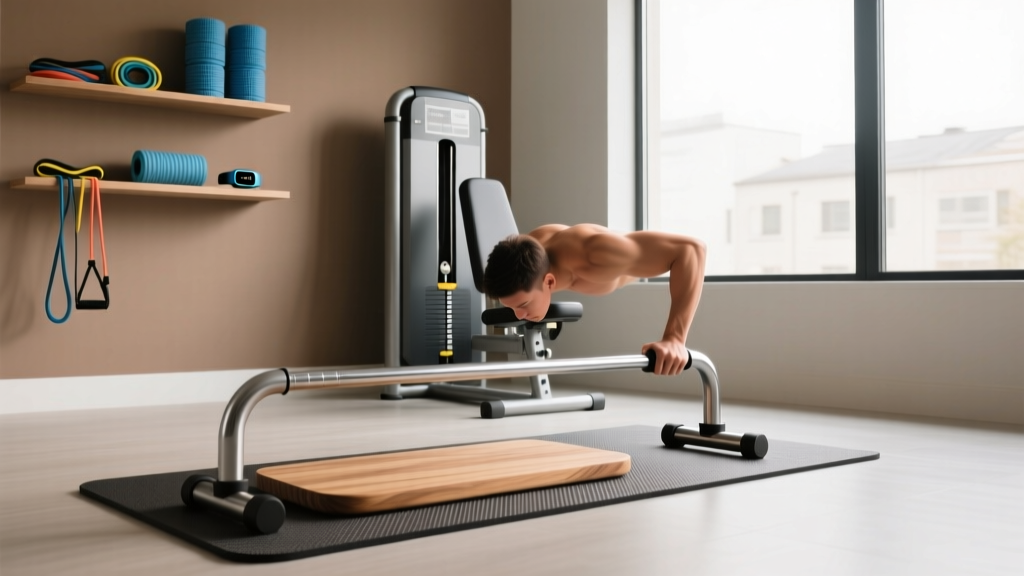
Push-Up Bar Setup & Types: Maximizing Chest Press Machine Benefits
Explore push-up bar and board types, complete setup walkthroughs, and how they compare to chest press machine benefits for your home gym.

The Home Chest-Building Dilemma: Portable Gear vs. Heavy Iron
Designing a dedicated chest-training zone in a home gym often forces a compromise between space, budget, and biomechanics. On one side of the spectrum, you have highly portable, joint-friendly push-up bars and multi-grip boards. On the other, you have heavy, fixed-path cable and Smith machines. In this complete setup and installation walkthrough, we break down the top push-up bars and boards of 2026, detailing their assembly, placement, and real-world performance. Furthermore, we contrast this lightweight approach with the undeniable chest press machine benefits to help you decide which installation path—or combination of both—suits your hypertrophy goals.
Push-Up Bars vs. Boards: 2026 Market Breakdown & Reviews
Before unboxing and assembling your gear, it is critical to understand the mechanical differences between fixed bars, rotating handles, and plug-in boards. According to the American Council on Exercise (ACE), altering your hand position and wrist angle during pressing movements drastically shifts the recruitment ratio between the pectoralis major, anterior deltoids, and triceps brachii.
| Model | Type | Price (2026) | Max Load | Best Application |
|---|---|---|---|---|
| Perfect Fitness Pushup 2 | Rotating | $28.99 | 400 lbs | Joint mobility & deep stretch |
| JFit Hex Push-Up Bars | Fixed Hex | $19.50 | 300 lbs | Heavy weighted vests & stability |
| Elite Sportz Push-Up Board | Multi-Grip | $34.99 | 250 lbs | Targeted angle variations |
Review: Perfect Fitness Pushup 2
The Pushup 2 remains a staple because of its internal steel ball-bearing track. This allows the handle to rotate naturally with your shoulder joint, reducing internal rotation torque. The 4.5-inch elevation provides a deeper eccentric stretch than floor push-ups, mimicking the bottom position of a dumbbell press.
Review: Elite Sportz Multi-Grip Board
This system uses a color-coded ABS plastic base with 14 plug-in holes. The PVC handles snap into place, allowing you to target the upper chest (red zone, narrow/incline grip), lower chest (blue zone, wide/decline grip), and triceps (yellow zone). While highly versatile, the plastic handles lack the knurled steel grip of premium gym equipment, making chalk necessary for high-rep sets.
Step-by-Step Setup: Assembling Your Push-Up Station
While portable gear requires zero heavy installation, proper setup is vital for safety and floor protection. Follow this walkthrough to establish your push-up station.
- Floor Preparation: Place a 3/8-inch thick EVA foam interlocking mat on your workout surface. This prevents the hard plastic or steel bases from scratching hardwood and provides a slight cushion for your toes.
- Assembling the Elite Sportz Board: Unfold the bi-fold ABS base. Ensure the locking latch on the underside clicks securely into place. Insert the PVC handles into your desired color-coded zones, pushing down firmly until you hear the secondary friction-lock snap.
- Calibrating Rotating Handles: If using the Perfect Pushup 2, remove the handles from the base. Check the steel bearing track for any dust or debris. Apply a single drop of silicone-based lubricant (not WD-40, which attracts dust) to the bearing ring, then reseat the handle. Test the rotation; it should spin freely but stop immediately when lateral pressure is removed.
- Spacing and Alignment: Place the bars or board on the mat. For standard chest activation, align the handles directly under your nipples when in the plank position. This ensures a 45-degree angle at the shoulder joint, preventing impingement.
Analyzing the Chest Press Machine Benefits for Home Gyms
While push-up boards offer incredible versatility and core activation, they inherently require you to stabilize your entire body, which can limit pure pectoral overload. This is where understanding the chest press machine benefits becomes crucial for advanced lifters. Machines like the Bowflex PR1000 Home Gym ($649) or a dedicated Marcy Smith Cage ($450) offer distinct physiological advantages that bodyweight gear cannot replicate.
- Fixed-Path Isolation: Machines eliminate the need for stabilizer muscles. According to Mayo Clinic's strength training guidelines, isolating the prime mover allows you to push the pectorals to absolute mechanical failure safely, without your triceps or core giving out first.
- Variable Resistance Curves: High-end home chest press machines utilize cam systems or cable ratios that match the natural strength curve of the pec, providing heavier resistance at the top of the movement where you are biomechanically strongest.
- Spotter-Free Safety: The ability to perform drop-sets or train to failure without a spotter is arguably the greatest of the chest press machine benefits for solo home gym owners.
Installation Walkthrough: Heavy Machines vs. Portable Gear
If you decide that the chest press machine benefits outweigh the portability of push-up boards, you must prepare for a rigorous installation process. Here is what a heavy machine setup entails compared to portable gear.
Space and Load Requirements
A standard push-up board requires a 3x3 foot footprint and weighs under 5 lbs. A home chest press machine requires a minimum 6x8 foot footprint and weighs between 250 and 400 lbs. You must verify that your floor joists can support a dead load of at least 40-50 PSF (pounds per square foot).
The Bolt-Together Process
- Base Assembly: Begin by attaching the rear stabilizer to the main base tube using the provided 1/2-inch hex bolts and nylock nuts. Use a 19mm socket wrench; do not fully tighten until all base bolts are threaded.
- Upright Installation: This is a two-person job. One person must hold the 7-foot upright column while the other secures the bottom gusset plates. Failure to support the column can strip the threads on the base plate.
- Cable Routing: The most complex phase. Follow the manufacturer's pulley diagram exactly. A misrouted cable on a chest press machine will cause the weight stack to bind and the nylon coating to fray prematurely.
- Tensioning: Once assembled, use the tensioner bolt at the base of the cable to remove slack. The weight stack should rest quietly without the pins clanking at the bottom.
Troubleshooting Wrist and Shoulder Mechanics
Whether you are gripping a push-up bar or the steel handles of a chest press machine, joint health is paramount. Wrist extension beyond 15 degrees under heavy load can compress the median nerve, leading to carpal tunnel symptoms.
'Neutral-grip pressing, facilitated by push-up bars or specialized machine attachments, significantly reduces radiocarpal joint stress compared to flat-palm floor push-ups or standard barbell benching.' — Biomechanical Analysis of Upper Extremity Pressing Movements
Troubleshooting Shoulder Impingement: If you feel a pinching sensation in the anterior deltoid while using a wide grip on your push-up board, immediately narrow your stance. On a chest press machine, adjust the seat height so the handles align with your mid-chest, not your collarbone, to maintain optimal scapular retraction.
Final Verdict: Designing Your 2026 Chest Routine
Ultimately, push-up bars and boards are phenomenal tools for warm-ups, core integration, and travel-friendly setups. The Elite Sportz board and Perfect Pushup 2 offer incredible value under $40 and take less than five minutes to set up. However, if your primary goal is maximum muscular hypertrophy and you have the space and budget, the chest press machine benefits—specifically fixed-path isolation and spotter-free failure training—make a heavy machine installation a worthy long-term investment. For the ultimate home gym, utilize push-up bars for dynamic activation and eccentric overload, then transition to the chest press machine for high-volume, isolated mechanical tension.
More gear to consider
All reviews
Push-Up Bars & Boards vs Seated Chest Press Muscles Worked

Gym Layouts: Wide Chest Press Machine vs Incline, Flat, Decline

Space Optimization: Bench Rack & Iso Lateral Chest Press Machine

Push-Up Bars vs Boards: The Best Machine Chest Press Alternative

How To Choose Point: A Precision Guide for Equipment Body Chest Applications
