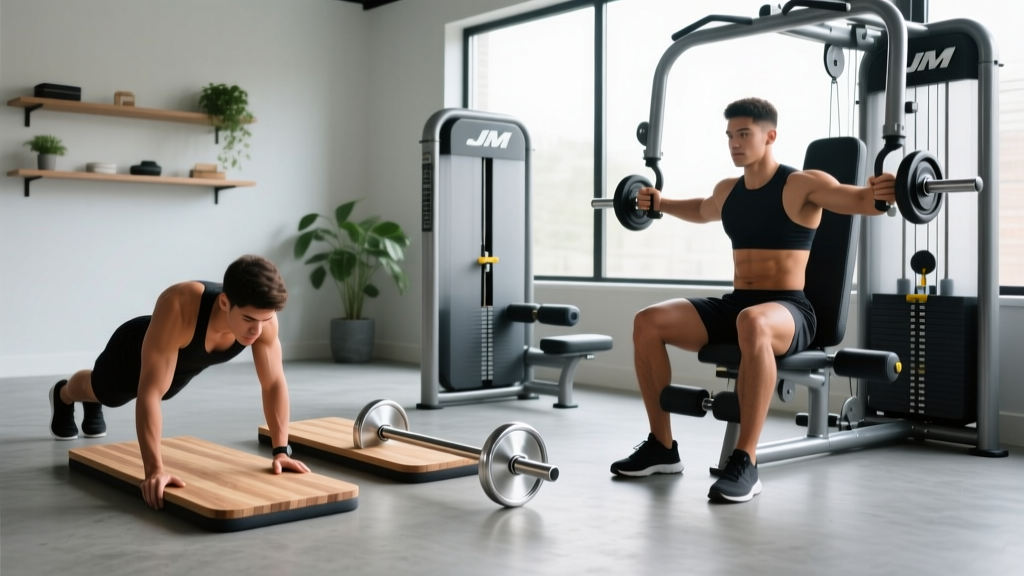
Chest Press Machine Gym Equipment Layouts: Dumbbell vs. Cable Fly
Compare dumbbell vs cable fly setups for space optimization. Learn how to integrate fly movements around your core chest press machine gym equipment layout.

The Spatial Dilemma: Designing the Modern Chest Zone
As home and boutique gym design evolves in 2026, maximizing square footage without sacrificing biomechanical effectiveness is the ultimate challenge. When you anchor your room with a dedicated chest press machine gym equipment unit, you are left with a specific spatial footprint for accessory movements. The chest fly is a non-negotiable staple for pectoral isolation, but choosing between a dumbbell setup and a cable system drastically alters your room's layout, clearance requirements, and overall equipment ROI.
This guide breaks down the exact dimensions, spatial footprints, and biomechanical trade-offs of dumbbell versus cable fly equipment, providing actionable blueprints to optimize your training space.
Quick Decision Matrix:• Choose Dumbbells if: You have wide lateral clearance (8+ feet), low ceilings, and a budget under $800.
• Choose Cables if: You have deep clearance (7+ feet), narrow wall space, and prioritize constant muscle tension over cost.
Dumbbell Fly Setups: Footprint, Clearance, and Layout
A traditional dumbbell fly requires an adjustable bench and a set of free weights. While the equipment itself is compact, the operational footprint is surprisingly massive due to human wingspan.
Equipment Specs & Spatial Requirements
Consider a standard competition-grade adjustable bench like the Rogue Fitness AB-3. The physical footprint of the bench is roughly 52 inches long by 23 inches wide. However, spatial planning must account for the user. A 6-foot-tall male has an average wingspan of 72 inches. When holding 8-inch dumbbell handles, the total lateral clearance required from wall to wall is a minimum of 8.5 feet (102 inches) to prevent knuckle scraping and allow for a full eccentric stretch.
- Equipment Cost (2026 Estimates): High-quality adjustable bench ($350 - $450) + Adjustable Dumbbells like Nuobell 80s ($450) = ~$850 total.
- Physical Footprint: 4.3 sq ft (when stored).
- Operational Footprint: 8.5 ft (width) x 5.5 ft (depth) = 46.75 sq ft.
- Ceiling Requirement: Low. Dumbbell flies are performed horizontally, requiring only standard 8-foot ceiling clearance for seating up.
The Biomechanical Limitation
According to biomechanical analyses outlined by ExRx on the Dumbbell Chest Fly, free weights rely entirely on gravity. This means the resistance vector is strictly vertical. At the peak of the concentric contraction (when the dumbbells are pressed directly over the chest), the pectoral muscles experience near-zero tension, as the skeletal structure of the arms simply supports the weight.
Cable Fly Systems: Functional Trainers vs. Crossovers
Cable systems utilize a pulley and weight stack mechanism, allowing for multi-directional force vectors. For space optimization, you generally have two choices: a freestanding functional trainer or a wall-mounted cable crossover.
Wall-Mounted vs. Freestanding Footprints
A freestanding functional trainer, such as the Body-Solid GFFT-1900, measures approximately 58 inches wide and 33 inches deep. While it consumes more physical floor space when empty, its operational footprint is highly efficient. Because the user faces the machine or stands in the center, the lateral wingspan is naturally contained within the 5-foot width of the machine's frame. You only need an additional 3 feet of depth for the user's staggered stance and forward arm extension.
Alternatively, wall-mounted cable columns (like the Titan Fitness Wall-Mount Functional Trainer) eliminate floor depth entirely. Mounted flush to the wall, they require only 12 inches of physical depth, pushing the operational footprint entirely outward into the room.
- Equipment Cost (2026 Estimates): Freestanding Functional Trainer ($1,800 - $2,500) or Wall-Mounted Cables ($600 - $900).
- Physical Footprint: 13.3 sq ft (Freestanding) or 3.5 sq ft (Wall-Mounted).
- Operational Footprint: 5 ft (width) x 6 ft (depth) = 30 sq ft.
- Ceiling Requirement: High. Functional trainers often stand 84 to 93 inches tall, requiring a minimum 9-foot ceiling for safe overhead pulley adjustments and pull-up attachments.
Constant Tension Advantage
As detailed in ExRx's Cable Crossover guide, cables provide a horizontal or angled force vector. This ensures that the pectoralis major remains under continuous, measurable tension throughout the entire range of motion, particularly at the peak contraction where dumbbells fail. For hypertrophy-focused layouts, cables offer superior time-under-tension metrics.
Head-to-Head: Space & Biomechanics Comparison Matrix
| Metric | Adjustable Dumbbell + Bench | Freestanding Functional Trainer |
|---|---|---|
| Storage Footprint | ~4.5 Sq Ft | ~13.5 Sq Ft |
| Operational Width | 8.5 Feet (High) | 5.0 Feet (Low) |
| Operational Depth | 5.5 Feet | 6.0 Feet |
| Tension Curve | Bell-shaped (Zero at peak) | Constant / Linear |
| Setup Time | 30-60 seconds (dialing weight) | 5-10 seconds (moving pin) |
| Estimated 2026 Cost | $750 - $950 | $1,800 - $2,600 |
Layout Blueprints: 3 Real-World Gym Configurations
Integrating these fly variations into your room requires precise layout planning. Below are three optimized blueprints based on common architectural constraints.
1. The Wide Garage Corner (Low Ceiling, High Width)
Best for: Dumbbell Fly Setups.
Dimensions: 10 ft wide x 8 ft deep.
Layout Strategy: Place your primary chest press machine gym equipment against the back wall. Position the adjustable bench horizontally in the center of the remaining space. Because garages typically have low clearance (often 8 feet) but wide open bays, the 8.5-foot lateral wingspan required for dumbbell flies is easily accommodated. Store adjustable dumbbells on a low-profile rack directly behind the bench headrest to minimize walking distance during drop-sets.
2. The Bedroom Nook (Narrow Width, Standard Ceiling)
Best for: Wall-Mounted Cable System.
Dimensions: 6 ft wide x 7 ft deep.
Layout Strategy: In narrow spaces, a dumbbell bench is impossible due to wall-striking during the eccentric phase. Mount dual cable columns on the side walls, spaced exactly 60 inches apart. The user stands in the center facing outward or inward. This utilizes vertical wall space and keeps the floor entirely clear for yoga, stretching, or storing a folded chest press bench.
3. The High-Ceiling Boutique Studio (Balanced Dimensions)
Best for: Freestanding Functional Trainer.
Dimensions: 8 ft wide x 10 ft deep (9+ ft ceilings).
Layout Strategy: Place an all-in-one functional trainer (which integrates a Smith machine, cable crossovers, and a pull-up bar) against the primary wall. This acts as both your heavy press station and your fly station. Position an adjustable FID (Flat/Incline/Decline) bench directly in front of the cable towers. The user can transition from heavy Smith-machine presses to cable flys in under 10 seconds without moving the bench, maximizing training density and space efficiency.
Pro-Tip for Facility Planning: The National Strength and Conditioning Association (NSCA) recommends a minimum of 36 inches of clearance around all resistance training equipment for safety and accessibility. Always measure your operational footprint, not just the steel footprint, before purchasing.
Final Verdict: Maximizing Your Space
When designing your chest training zone, the choice between dumbbells and cables is less about which is inherently 'better' and more about how your room's geometry accommodates the movement. If your space is wide but shallow, and you are working with a strict budget, a premium adjustable bench and a set of mechanical dial-adjustable dumbbells will serve you exceptionally well. However, if you are dealing with narrow corridors, deep rooms, or you prioritize the biomechanical advantage of constant tension for hypertrophy, investing in a functional cable trainer is the superior 2026 space-optimization play. Align your equipment with your architecture, and your chest press machine gym equipment zone will deliver maximum results per square foot.
More gear to consider
All reviews
Equip Body Back Tools Checklist: A Field-Tested, Ergonomic Readiness Protocol for Industrial and Clinical Settings

Dumbbell vs Cable Fly: Budget & Single Arm Chest Press Machine Value

Chest Press Machine Muscles Worked: Types and Beginner Guide

Space Optimization: Bench Rack & Iso Lateral Chest Press Machine

Incline Chest Press Machine Muscles Worked: Home Gym Guide