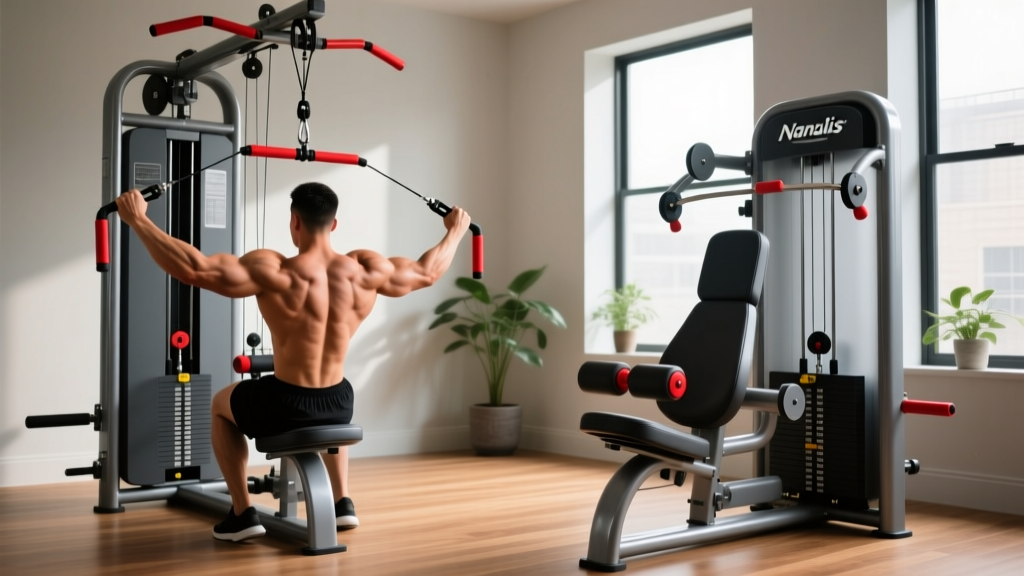
Chest Machine vs Bench Press: Dumbbell Fly vs Cable Fly Setup Guide
Settle the chest machine vs bench press debate and optimize isolation. Expert review of dumbbell fly vs cable fly equipment for 2026.

The primary difference between the cable fly and the chest press lies in the movement pattern and joint involvement. The chest press is a compound pushing movement utilizing the shoulder and elbow joints to move heavy loads for overall pectoralis major strength. The cable fly is an isolation movement focusing purely on shoulder horizontal adduction, maximizing muscle stretch and tension for targeted hypertrophy without triceps brachii involvement.
This guide is designed for intermediate to advanced lifters, bodybuilders, and personal trainers seeking to optimize pectoralis major development and refine their chest day programming.
Key Takeaways
- Chest presses build foundational strength through multi-joint compound mechanics.
- Cable flys isolate the pectoralis major by removing the triceps brachii from the movement equation.
- Combining both movements yields optimal hypertrophy by targeting different regions of the muscle's length-tension relationship.
Core Biomechanical Differences
Understanding the anatomical definitions of these movement patterns clarifies why they produce different training adaptations. Current sports science consensus emphasizes matching the exercise to the specific joint function.
Horizontal Adduction: The anatomical movement of the upper arm across the midline of the body within the transverse plane. This specific action serves as the primary biomechanical function of the pectoralis major muscle during isolation fly exercises, maximizing stretch and tension.
Compound Movement: A resistance training exercise that simultaneously engages multiple muscle groups and requires movement across two or more distinct anatomical joints. These multi-joint actions allow lifters to safely handle significantly heavier external loads compared to single-joint isolation exercises for systemic strength.
The Chest Press Mechanics
The chest press requires simultaneous extension of the elbow joint and horizontal adduction of the shoulder joint. This dual-joint action recruits the anterior deltoid and the triceps brachii as primary synergists. Because multiple muscle groups share the load, lifters can safely handle heavier absolute weights, making it superior for central nervous system adaptation and maximal strength.
The Cable Fly Mechanics
The cable fly isolates the shoulder joint, keeping the elbow locked in a slight flexion angle throughout the entire range of motion. By eliminating elbow extension, the triceps brachii are entirely removed from the movement. This forces the pectoralis major to handle 100 percent of the horizontal adduction load, providing continuous tension from the stretched to the shortened position.
Muscle Activation and Hypertrophy
Electromyography (EMG) research consistently shows that pressing movements elicit higher overall motor unit recruitment due to the heavier loads utilized. However, isolation flys produce higher localized tension in the distal fibers of the pectoralis major.
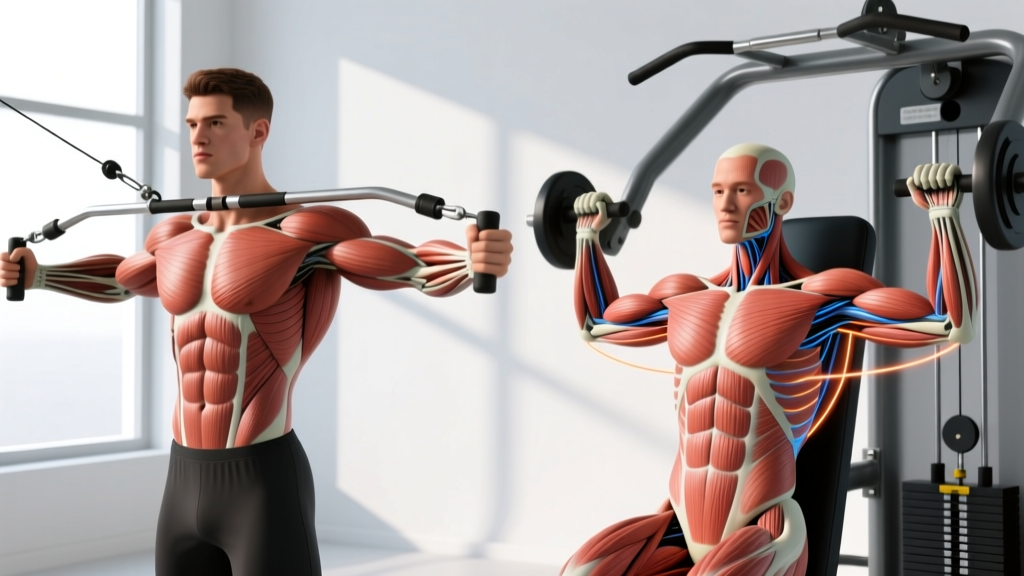
A comprehensive 2025 biomechanical analysis published in the National Center for Biotechnology Information demonstrates that training a muscle at long muscle lengths (the stretched position) yields superior hypertrophic outcomes. The cable fly excels at loading the pectoralis major in this deeply stretched position, whereas the chest press often loses tension at the peak contraction due to joint stacking.
Exercise Comparison Matrix
Use this decision framework to determine which exercise fits your specific training phase.
| Feature | Chest Press (Machine/Barbell) | Cable Fly (Crossover) |
|---|---|---|
| Primary Joint Action | Shoulder Adduction + Elbow Extension | Shoulder Horizontal Adduction Only |
| Triceps Involvement | High | None (Isometric stabilization only) |
| Load Capacity | High (85%+ of 1RM) | Moderate (60-70% of 1RM equivalent) |
| Stretch-Mediated Hypertrophy | Moderate | High |
| Fatigue Generation | High systemic and local fatigue | High local, low systemic fatigue |
Programming Both Movements
To maximize chest development, you must sequence these exercises correctly within your workout. Always prioritize heavy compound movements before isolation exercises to ensure maximum motor unit recruitment while fresh.
Begin your session with a machine or barbell chest press for 3 to 4 sets of 5 to 8 repetitions. Rest for 90 to 120 seconds between sets to allow for full phosphocreatine resynthesis. This builds the foundational mechanical tension required for growth.
Follow the pressing with cable flys for 3 sets of 10 to 15 repetitions. Focus on a 3-second eccentric phase to maximize the stretch across the pectoralis major fibers. Keep rest periods to 60 seconds to induce metabolic stress, a secondary driver of muscle hypertrophy.
Frequently Asked Questions
Cable fly vs machine chest press: Which is better for beginners?
The machine chest press is significantly better for beginners. It provides a fixed movement path that requires less stabilizing muscle coordination, allowing novices to safely learn the pressing pattern and build baseline connective tissue strength before attempting cable flys.
Should I do dumbbell flys or cable flys for chest isolation?
Cable flys are superior to dumbbell flys for hypertrophy. Dumbbells rely on gravity, meaning zero tension is placed on the pectoralis major at the top of the movement when the weights are stacked over the shoulders. Cables provide continuous, linear variable resistance throughout the entire 120 degrees of the range of motion.
Can I build a big chest with only cable flys?
While cable flys stimulate muscle growth, relying solely on them limits your overall strength potential and anterior deltoid development. You need the heavy mechanical overload provided by chest presses to maximize the cross-sectional area of the entire pectoral girdle.
Conclusion and Next Steps
The debate between the cable fly and the chest press is not about choosing one over the other, but understanding their distinct biomechanical roles. The chest press drives systemic strength and heavy mechanical tension, while the cable fly isolates the pectoralis major through stretch-mediated hypertrophy. Both are mandatory for complete chest development.
Your Next Step: Audit your current training split today. If you are currently performing three different pressing variations (e.g., flat barbell, incline dumbbell, machine press), drop the least effective press and replace it with a high-rep cable fly variation to introduce vital stretch-mediated tension to your routine.
More gear to consider
All reviews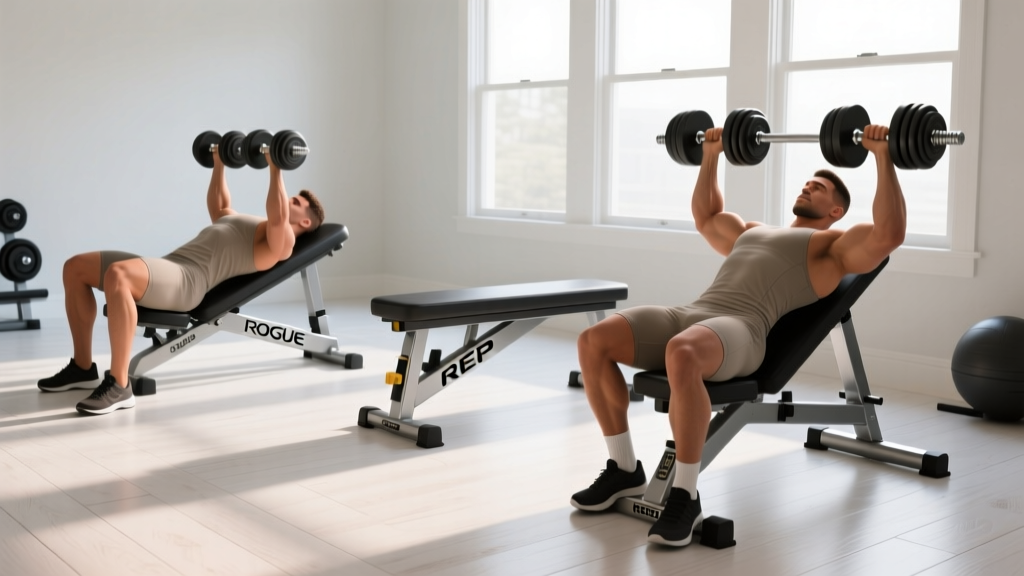
Incline vs Flat Bench: Best Gear for Dumbbell Chest Workouts

Vertical Chest Press Machine: Beginner Home Gym Setup Guide

How To Choose Point: A Precision Guide for Equipment Body Chest Applications

Real For World: How Functional Chest Protection Transforms Real-World Safety Across Industries

Troubleshooting Push-Up Boards & Titan Fitness Plate Loaded Chest Press Machine