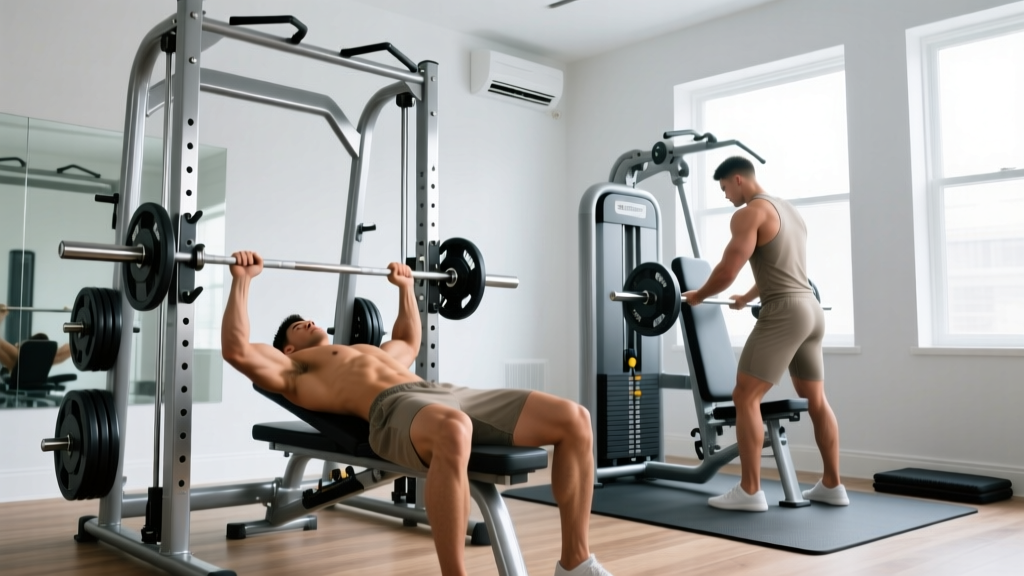
Bench Press Racks vs. Chest Press Machine Weight Without Plates
Analyzing 2026 market trends comparing bench press racks with spotter arms to plate-loaded machines, focusing on carriage starting resistance and buyer preferences.

The 2026 Market Shift: Versatility vs. Isolation in Chest Training
The commercial and high-end home gym equipment market has undergone a significant transformation as we move through 2026. Facility managers, strength coaches, and home gym enthusiasts are increasingly scrutinizing the return on investment (ROI) per square foot of their training spaces. At the center of this debate is the ongoing tug-of-war between dedicated plate-loaded isolation equipment and versatile free-weight stations. Specifically, the purchasing decision often boils down to comparing a traditional bench press rack equipped with safety spotter arms against dedicated leverage machines. To understand this trend, analysts are closely examining the biomechanical and financial implications of the chest press machine weight without plates versus the baseline resistance of a free-weight barbell system.
According to recent facility layout reports from the International Health, Racquet & Sportsclub Association (IHRSA), boutique and mid-sized commercial gyms are expanding their functional free-weight footprints by an average of 18% year-over-year. This shift is largely driven by the versatility of power racks and half-racks, which, when paired with adjustable safety spotter arms, can replicate the safety of a machine while offering superior stabilizer muscle engagement.
Defining the Baseline: Carriage Resistance vs. The Olympic Bar
When evaluating a chest press machine weight without plates, buyers are looking at the starting resistance of the machine's carriage, lever arm, or pivot mechanism. For industry-standard plate-loaded units like the Hammer Strength Iso-Lateral Front Chest, the physical weight of the empty lever arm is approximately 15 to 18 pounds per side. However, due to the mechanical disadvantage at the bottom of the pressing arc (where the lever arm is furthest from the pivot point), the perceived starting resistance can feel significantly heavier, often mimicking a 30-pound free-weight press.
Conversely, a standard men's Olympic barbell resting on the J-cups of a bench press rack weighs exactly 45 pounds (20.4 kg). While this is heavier than the empty machine carriage, the linear force curve of a free-weight barbell provides a more predictable resistance profile. For rehab facilities or senior fitness centers, this 45-pound minimum can be prohibitive, which is why many racks are now being paired with 15-pound aluminum technique bars and specialized safety spotter arms to bridge the gap between machine-level starting weights and free-weight versatility.
Why Safety Spotter Arms Are Capturing Market Share
The primary argument against free-weight bench pressing has always been safety—specifically, the risk of failing a rep without a human spotter. In 2026, the engineering behind safety spotter arms has effectively neutralized this concern, driving massive sales in the rack category.
Market Insight: The UHMW Revolution
Modern safety spotter arms, such as the Rogue Monster Lite Safety Spotter Arms and Titan Fitness Flip-Down Safeties, now feature UHMW (Ultra-High Molecular Weight) polyethylene liners. This high-density plastic protects the barbell's knurling from damage, drastically reduces metal-on-metal noise in commercial settings, and ensures the bar doesn't bounce unpredictably if a lifter fails a rep. This material upgrade has been a major catalyst in convincing commercial gym owners to replace bulky selectorized machines with open-concept rack stations.
The economic argument heavily favors the rack-and-spotter-arm combination. A dedicated commercial chest press machine requires a significant capital expenditure and occupies a permanent footprint. A power rack, however, serves as a squat station, pull-up rig, rack-pull platform, and bench press station, all while utilizing adjustable spotter arms to guarantee solo-lifting safety.
Comparative Cost and Biomechanical Matrix
To provide a clear picture of the 2026 equipment landscape, the following matrix compares the leading bench press rack configurations against top-tier chest press machines. Pricing reflects current direct-to-consumer and commercial B2B averages.
| Equipment Type | Model Example | 2026 Est. Price | Starting Resistance | Space Footprint |
|---|---|---|---|---|
| Half Rack + Spotter Arms | Titan T-3 Series | $750 - $950 | 45 lbs (Olympic Bar) | 48" x 48" |
| Full Power Rack + Safeties | Rogue RM-3 Fort | $3,800 - $4,500 | 45 lbs (Olympic Bar) | 53" x 53" |
| Plate-Loaded Iso-Lateral | Hammer Strength Front Chest | $4,200 - $5,000 | ~15 lbs (Carriage only) | 55" x 65" |
| Selectorized Pin-Loaded | Life Fitness Signature | $5,500 - $6,200 | 10 lbs (Lowest Pin) | 52" x 60" |
Edge Cases and Failure Modes: Where Equipment Breaks Down
As domain experts, we must look beyond the spec sheets and analyze how this equipment performs under real-world stress and edge cases. Both racks with spotter arms and dedicated machines have distinct failure modes that buyers must consider.
Machine Carriage Stiction and Cable Degradation
While the chest press machine weight without plates might be rated at 15 pounds, aging pivot joints and linear bearings can introduce 'stiction' (static friction). In commercial environments where maintenance is deferred, a machine that should require 15 pounds of force to initiate movement might suddenly demand 25 pounds. This unpredictable resistance curve is highly detrimental to physical therapy patients or individuals returning from pectoral tears. Furthermore, selectorized machines rely on internal Kevlar-reinforced belts or aircraft-grade cables. If a facility neglects the biomechanical maintenance schedules recommended by exercise physiologists, these cables can fray and snap under heavy eccentric loads, posing a severe safety hazard.
Spotter Arm Miscalculation and Bench Pad Compression
The primary failure mode of a bench press rack setup is user error regarding spotter arm height. If the safety spotter arms are set too high, the lifter's range of motion is artificially restricted, preventing full pectoral stretch and potentially causing the bar to bounce off the UHMW liners if the lifter loses control. If set too low, the lifter may suffer a sternum injury before the barbell contacts the safeties.
'The efficacy of safety spotter arms is entirely dependent on the compression rate of the bench pad. A heavily worn commercial bench pad that compresses by 2 inches under load will effectively lower the lifter's torso, rendering the spotter arms set 1 inch below the resting barbell height completely useless in a failure scenario.' — NSCA Certified Strength and Conditioning Specialist Guidelines, 2025 Update.
The 'Zero-Weight' Problem in Rehab and Senior Fitness
There is a specific demographic where the bench press rack struggles to compete with machines: early-stage rehabilitation. If a patient cannot yet press the 45-pound Olympic bar, and the facility does not stock 15-pound technique bars, the rack is rendered useless for horizontal pressing. In these scenarios, selectorized machines with a 10-pound starting pin, or pneumatic resistance machines (like Keiser) that offer zero starting inertia, remain the gold standard. However, for the general population, hypertrophy-focused athletes, and powerlifters, the fixed path of a chest press machine fails to engage the rotator cuff and stabilizing musculature required for functional, real-world strength.
Future Outlook for 2026 Buyers
The market data is conclusive: the versatility of the bench press rack paired with high-quality safety spotter arms is outpacing the sales of single-purpose chest press machines in both the home gym and boutique commercial sectors. The initial capital required for a robust rack, a premium flat/incline bench, and a set of calibrated spotter arms is significantly lower than purchasing a commercial-grade plate-loaded chest press.
For facility managers and home gym builders making purchasing decisions this year, the recommendation is clear. Invest in a 3x3 inch 11-gauge steel rack with UHMW-lined safety spotter arms. Supplement the 45-pound barbell with a 15-pound aluminum technique bar to mimic the low starting resistance of a machine carriage. This hybrid approach delivers the safety of a machine, the stabilizer engagement of free weights, and a superior financial ROI that aligns perfectly with modern training methodologies.
More gear to consider
All reviews
Push-Up Boards vs JM Press on Chest Press Machine: Beginner Guide

Converging Chest Press Machine vs. Incline & Flat Benches: 2026 Data

Push-Up Bars vs Sitting Chest Press Machine: Fixing Form Mistakes
Cable Crossover vs Nautilus Chest Press Machine: 2026 Guide

2026 Trends: Horizontal Chest Press Machine & Fly Gear Analysis
