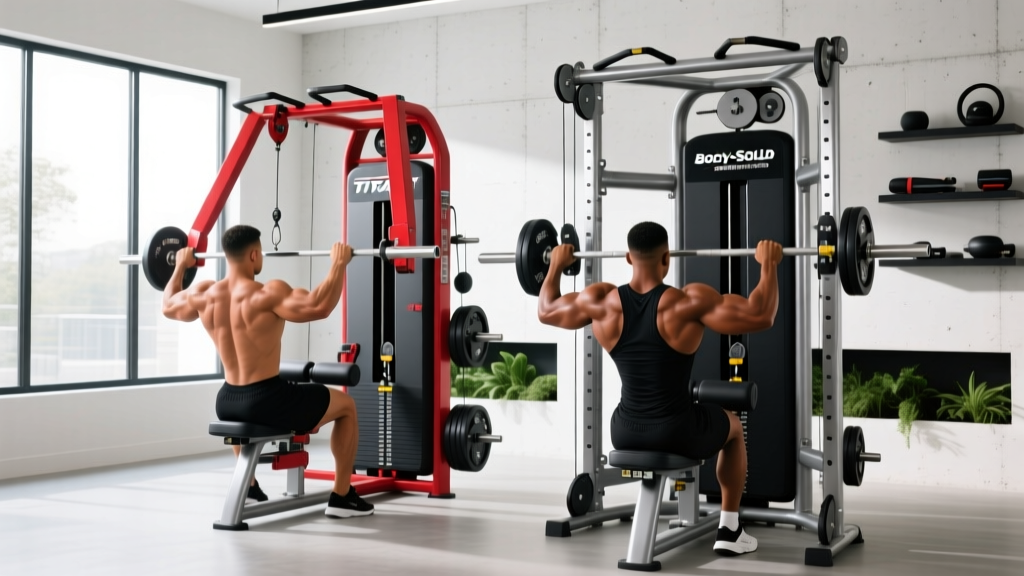
Titan vs Body-Solid Lat Pulldown Machine: 2026 Home Gym Guide
Comparing the Titan Fitness and Body-Solid S2LAT lat pulldown machines for 2026. Find which plate-loaded unit best fits your home gym space and budget.

Building a comprehensive back training setup in a home gym often forces a compromise between available floor space and biomechanical performance. While rack-mounted attachments have improved significantly by 2026, serious lifters and bodybuilders still require the unrestricted cable travel and heavy loading capacity of a dedicated, standalone lat pulldown machine. In this head-to-head comparison, we evaluate two of the most popular plate-loaded units on the market: the Titan Fitness Plate-Loaded Lat Pulldown and Low Row Machine and the Body-Solid S2LAT Pro Club Line Lat Machine.
Both machines target the latissimus dorsi, rhomboids, and biceps, but their engineering philosophies differ drastically. We will break down their spatial footprints, pulley ratios, hardware tolerances, and long-term failure modes to help you decide which unit deserves a permanent spot on your rubber gym flooring.
Quick Specs Snapshot (2026 Models)
- Titan Fitness Lat Pulldown: ~$699 | 1:1 Pulley Ratio | 50" L x 37" W Footprint
- Body-Solid S2LAT: ~$895 | 1:1 Pulley Ratio | 43" L x 24" W Footprint
- Shared Trait: Both utilize plate-loaded horns (Olympic sleeves) rather than selectorized weight stacks, keeping maintenance low and maximum resistance virtually unlimited.
Spatial Geometry and Home Gym Footprints
When integrating a new piece of back training equipment into a home gym, the footprint is usually the primary constraint. The Body-Solid S2LAT was designed with commercial space-efficiency in mind, measuring just 43 inches long and 24 inches wide. Its narrow profile allows it to be tucked into tight corners or placed directly adjacent to a power rack with minimal aisle disruption.
Conversely, the Titan Fitness machine demands more real estate, measuring 50 inches in length and 37 inches in width. The extra width comes from a broader, more stable base and a wider knee-pad adjustment mechanism. While the Titan requires roughly 13 square feet of floor space compared to the Body-Solid's 7.5 square feet, the trade-off is a noticeably more stable platform during heavy, explosive concentric movements where lateral sway can occur.
Pro-Tip for Garage Gyms: If your ceiling height is under 84 inches, the Titan Fitness machine (which peaks at 84" H) will require you to slightly depress the top pulley housing during assembly. The Body-Solid S2LAT stands at a more garage-friendly 81 inches, making it the superior choice for low-clearance basement gyms.
Pulley Biomechanics and Tension Profiles
The effectiveness of any lat pulldown machine hinges on its cable routing and pulley geometry. Both the Titan and Body-Solid utilize a true 1:1 pulley ratio. This means that if you load 100 lbs of plates onto the horn, you are pulling exactly 100 lbs of resistance (plus the weight of the carriage). This raw, unassisted tension profile is highly preferred by strength athletes over the 2:1 ratio found in many commercial selectorized machines, as it provides a more authentic, free-weight-like feel.
However, the vertical cable angle differs between the two. According to research published in the Journal of Strength and Conditioning Research, the angle of the cable relative to the torso significantly alters the activation of the latissimus dorsi versus the teres major and posterior deltoid. The Titan Fitness machine features a top pulley height of 84 inches, allowing taller lifters (6'0" and above) to achieve a full overhead stretch without the cable dragging against the top of their head or neck during wide-grip pulldowns. The Body-Solid S2LAT, with its 81-inch peak, forces taller users to sit slightly further back on the seat to maintain an optimal 15-to-20-degree backward torso lean, which is the ideal angle for maximizing lower lat fiber recruitment.
Carriage Weight and Starting Tension
A frequently overlooked metric in back training equipment is the starting weight of the cable carriage. The Titan carriage weighs approximately 15 lbs, while the Body-Solid carriage is slightly lighter at 12 lbs. For advanced lifters, this 3 lb difference is negligible. However, for physical therapy, rehabilitation, or high-rep metabolic conditioning, the lighter starting tension of the Body-Solid provides a marginally better entry point for micro-loading.
Hardware, Tolerances, and Real-World Failure Modes
To evaluate long-term durability, we must look past the marketing copy and examine the raw materials and moving parts. The National Strength and Conditioning Association (NSCA) frequently highlights the importance of equipment stability in maintaining proper movement mechanics; a machine that wobbles or binds will inherently alter your motor patterns.
- Mainframe Steel: Body-Solid utilizes 11-gauge steel for its mainframe, which is exceptionally rigid and resistant to torsional flex. Titan Fitness uses 12-gauge steel. While 11-gauge is technically thicker, Titan's wider base geometry compensates for the slight difference in material thickness, resulting in comparable real-world stability.
- Guide Rods and Bushings: This is where the machines diverge. The Titan machine uses dual guide rods with UHMW (Ultra-High Molecular Weight) plastic bushings. This dual-rod system prevents the carriage from twisting when you load plates unevenly. The Body-Solid S2LAT relies on a single, oversized guide rod with nylon bushings. While the single rod is easier to clean, it is slightly more prone to lateral carriage binding if the machine is not perfectly leveled on your floor.
- Cables: Both manufacturers use high-tensile, nylon-coated aircraft cables rated for over 2,000 lbs. The most common failure mode in home gym lat pulldown machines is cable fraying at the top swivel pulley. To mitigate this, both Titan and Body-Solid have upgraded their 2026 swivel housings with sealed ball bearings, drastically reducing the friction that shreds outer cable strands over time.
The 2026 Spec Comparison Matrix
| Feature | Titan Fitness Lat Pulldown | Body-Solid S2LAT |
|---|---|---|
| Current Pricing (2026) | $699.00 | $895.00 |
| Footprint (L x W) | 50" x 37" | 43" x 24" |
| Total Height | 84" | 81" |
| Pulley Ratio | 1:1 | 1:1 |
| Guide Rod System | Dual Rod (UHMW Bushings) | Single Rod (Nylon Bushings) |
| Low Row Capability | Yes (Included) | No (Separate Unit Required) |
| Warranty | 1 Year Comprehensive | Lifetime Frame / 3 Yr Parts |
The Verdict: Which Machine Fits Your Home Gym?
Choosing between these two heavyweights comes down to your specific spatial limitations and your requirement for exercise variety.
Choose the Titan Fitness if:
You want a complete vertical and horizontal pulling solution in a single footprint. The inclusion of the low-row footplate and lower pulley system makes the Titan a 2-in-1 powerhouse. If you have the 13 square feet to spare and a ceiling height of at least 86 inches, the Titan's dual guide rods and taller pulley height make it the superior choice for tall, heavy-pulling athletes who demand zero carriage binding.
Choose the Body-Solid S2LAT if:
Space is at an absolute premium and you prioritize long-term commercial-grade warranties. The S2LAT's narrow 24-inch width allows it to slide into spaces the Titan simply cannot fit. Furthermore, Body-Solid's lifetime frame warranty provides peace of mind for lifters who plan to keep the machine in their family's home gym for decades. Just be prepared to purchase a separate seated row machine if you want to train your mid-back horizontally.
Frequently Asked Questions
Can I use resistance bands instead of plates on these machines?
Yes. Both machines feature standard Olympic sleeves. You can loop heavy-duty loop bands around the base of the machine and stretch them over the plate horns to add accommodating resistance. This is an excellent way to increase tension at the peak contraction of the lat pulldown without adding physical weight plates.
How often do the UHMW and nylon bushings need maintenance?
Unlike linear ball bearings, bushings are virtually maintenance-free but require occasional cleaning. In a dusty garage gym environment, wipe down the exposed guide rods with a dry microfiber cloth every 3 to 4 months. Do not use WD-40 or heavy grease, as this will attract dust and create a grinding paste that will eventually degrade the plastic bushings. A light spray of 100% silicone lubricant once a year is sufficient.
Are the included lat bars worth using?
Both machines ship with a standard 48-inch lat bar. While adequate for beginners, the knurling on stock bars is often overly aggressive or poorly positioned. For optimal biomechanics and wrist health, we highly recommend investing in an aftermarket ergonomic lat bar with angled, neutral-grip handles to reduce ulnar deviation during heavy sets.
More gear to consider
All reviews
Best Step Saving: Evidence-Based Strategies to Reduce Daily Steps Without Sacrificing Health or Function

2026 Market Trend: Diverging Lat Pulldown Machine for Lumbar Support

Vibration FAQ Answered: Science, Safety, and Real-World Applications for Fitness Professionals

Chest Supported Row and Lat Pulldown Machine Exercise Space Guide

How To Choose Therapy: A Practical, Evidence-Based Guide for Adults Seeking Effective Care
