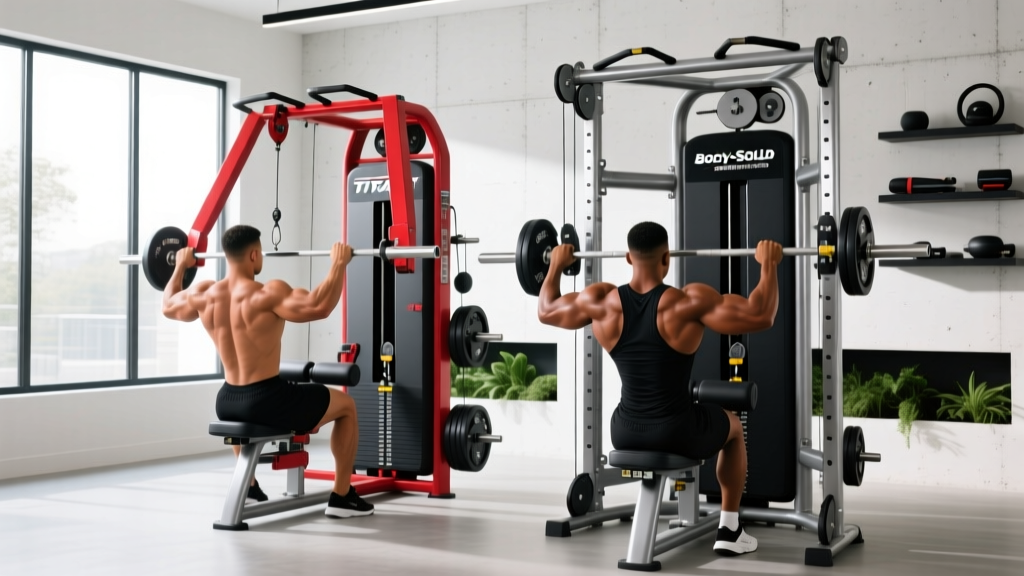
Chest Rows vs Lat Pulldown Machine Muscles Worked: Space Guide
Compare chest supported row options and lat pulldown machine muscles worked to optimize your home gym layout. Discover space-saving back training layouts.

The Spatial Dilemma: Vertical vs. Horizontal Pulling in Compact Gyms
As urban living spaces shrink and garage gym real estate becomes a premium commodity in 2026, fitness enthusiasts are forced to make ruthless decisions about their equipment layouts. The back-training zone is notoriously the most spatially demanding area of any gym. Traditional lat pulldown stations require massive vertical clearances and deep kneeling zones, often consuming up to 35 square feet of usable floor space. This has led to a surge in the popularity of chest-supported row machines, which offer a horizontal pulling alternative with a drastically reduced footprint.
When designing a compact back-training zone, lifters frequently analyze the lat pulldown machine muscles worked to determine if they can swap the towering pulldown station for a more footprint-friendly chest-supported row. The short answer is yes, but achieving identical hypertrophy and spatial efficiency requires a strategic approach to equipment selection and layout design. Below, we break down the biomechanics, spatial requirements, and the best space-optimized chest-supported row options on the market.
Footprint Analysis: Chest-Supported Rows vs. Lat Pulldowns
To understand the spatial advantage of chest-supported rows, we must look beyond the physical dimensions of the machine and calculate the operational footprint—the total square footage required for the machine, the user's body, and plate-loading clearance.
| Equipment Type | Machine Dimensions (L x W x H) | Operational Clearance Required | Total Spatial Zone |
|---|---|---|---|
| Standard Lat Pulldown (Freestanding) | 48" x 50" x 84" | 36" posterior kneeling/seating zone | ~32 sq. ft. |
| Freestanding Chest-Supported Row | 48" x 34" x 52" | 24" posterior entry + 12" lateral plate load | ~22 sq. ft. |
| Rack-Integrated Row Attachment | 24" x 18" x 10" (Attached to uprights) | 24" posterior entry | ~8 sq. ft. (Zero dedicated floor space) |
Layout Pro-Tip: The Z-Axis Advantage
Lat pulldowns dominate the Z-axis (vertical space), which can interfere with overhead pressing movements or low-ceiling basement gyms. Chest-supported rows operate primarily on the X and Y axes, keeping the vertical space clear for wall-mounted storage or functional rig attachments.
Biomechanical Overlap: Lat Pulldown Machine Muscles Worked vs. Chest Rows
Can a chest-supported row truly replace a lat pulldown? To answer this, we have to look at the kinesiology of the movement patterns. According to the ExRx Kinesiology Directory, the primary movers in vertical pulling (pulldowns) are the latissimus dorsi, teres major, and lower trapezius, assisted by the biceps brachii and posterior deltoids.
When evaluating the lat pulldown machine muscles worked, the frontal plane vertical pull emphasizes the upper and outer lats, creating the coveted 'V-taper' width. However, a chest-supported row—specifically one with a 45-degree pad angle and neutral grip handles—targets the exact same musculature but through the transverse and sagittal planes.
The Hypertrophy Trade-Off
- Lower Lat Activation: Chest-supported rows with elbows tucked close to the torso actually provide superior lower-lat stimulation compared to wide-grip pulldowns, as the resistance vector aligns perfectly with the lower latissimus fibers.
- Spinal Erector Fatigue: Unlike bent-over barbell rows, chest-supported rows completely eliminate lower-back stabilization. This matches the isolation benefit of a lat pulldown, allowing you to train the back to true muscular failure without your lumbar spine giving out first.
- Stretch-Mediated Hypertrophy: Modern 2026 biomechanics research, frequently cited by the National Strength and Conditioning Association (NSCA), highlights that training muscles at long muscle lengths yields superior hypertrophy. A well-designed chest row provides a massive loaded stretch at the bottom of the movement, rivaling the overhead stretch of a pulldown.
Top Space-Optimized Chest-Supported Row Options
If you are ready to reclaim 15+ square feet in your gym by ditching the lat pulldown, here are the three best chest-supported row configurations categorized by spatial efficiency and budget.
1. The Zero-Footprint Solution: Rep Fitness PR-5000 V3 Chest Supported Row Attachment
For lifters who already own a 3x3 power rack with 1-inch hole spacing, rack-integrated attachments are the ultimate space hack. The Rep Fitness V3 attachment pins directly into your existing uprights.
- Dimensions: 24" L x 18" W (Protrusion from rack)
- Footprint: 0 sq. ft. of dedicated floor space
- Price: ~$399
- Design Note: The V3 features a multi-grip handle array and an adjustable pad height. Because it relies on the rack's uprights, you must ensure your rack is bolted down or heavily counterbalanced with plate storage on the rear pegs to prevent tipping during heavy rows.
2. The Compact Freestander: Titan Fitness T-Series Sealed Chest Row
If you lack a power rack but need a dedicated, plate-loaded machine that won't dominate the room, the Titan T-Series is a masterclass in compact engineering.
- Dimensions: 43" L x 28" W x 46" H
- Footprint: ~8.3 sq. ft. (Machine only)
- Price: ~$599
- Design Note: Titan utilizes sealed linear bearings on the guide rods, ensuring a friction-free pull even in dusty garage environments. The 28-inch width is narrow enough to fit seamlessly between a squat rack and a wall, leaving just enough room for lateral plate loading.
3. The Commercial-Grade Space Saver: Rogue Monster Series Chest Supported Row
For boutique commercial spaces or high-end home gyms where budget is secondary to biomechanical perfection and durability, Rogue's freestanding unit is the gold standard.
- Dimensions: 48" L x 34" W x 52" H
- Footprint: ~11.3 sq. ft.
- Price: ~$1,499
- Design Note: The converging arc of the handles mimics the natural path of the shoulder joint, reducing impingement risk. While heavier and more expensive, its integrated weight horn stores plates directly on the machine, eliminating the need for adjacent plate trees and further consolidating your layout.
Layout Design: Integrating Back Equipment in a 10x10 Gym
Integrating a chest-supported row into a small layout requires strict adherence to clearance zones. Follow this step-by-step framework to optimize your space:
- Map the Entry Vector: Unlike lat pulldowns where you slide under a pad, chest rows require you to step into the machine and lean forward. Ensure a minimum of 24 inches of clear space directly behind the machine.
- Consolidate Plate Storage: Do not place a standalone plate tree next to a chest row. Instead, choose a machine with integrated weight horns (like the Rogue Monster) or mount a wall-based plate cradle exactly 36 inches to the side of the machine's loading pins.
- Utilize Dead Corners: Freestanding chest rows are relatively low-profile (under 55 inches high). Slide them into the 'dead corners' of your gym where overhead clearance is obstructed by HVAC ducts or garage door tracks—spaces where a lat pulldown could never fit.
- Mirror Placement: Mount a mirror on the wall directly in front of the row pad. This not only aids in form correction (checking for shoulder elevation during the pull) but creates an optical illusion that doubles the perceived depth of your compact gym space.
Warning: Rack Tipping Hazards
If you opt for a rack-integrated row attachment, the leverage created by a 200lb rowing motion can easily tip an unanchored power rack forward. Always bolt your rack to the floor, or load the rear vertical uprights with heavy bumper plates to act as a counterweight before performing heavy horizontal pulls.
Final Verdict on Space and Hypertrophy
The obsession with vertical pulling often leads lifters to sacrifice valuable square footage for a lat pulldown station they use twice a week. By analyzing the lat pulldown machine muscles worked and comparing them to the biomechanical output of modern chest-supported rows, it becomes clear that horizontal pulling can deliver 90% of the hypertrophic stimulus with 50% of the spatial demand.
For the ultimate space-saving setup in 2026, pair a rack-integrated chest row attachment with a simple wall-mounted pull-up bar. This combination hits the lats through both the transverse and frontal planes, maximizes stretch-mediated hypertrophy, and leaves you with enough floor space to actually perform deadlifts. Reclaim your square footage, optimize your layout, and let the chest-supported row become the anchor of your back-training zone.
Frequently Asked Questions
Can I completely remove my lat pulldown if I buy a chest row?
Yes, provided you supplement with a basic pull-up bar. The chest row will handle the heavy, isolated mid-back and lat work, while the pull-up bar covers the vertical, bodyweight stretching component.
Do chest-supported rows work the rear delts as well as pulldowns?
Chest-supported rows actually allow for greater rear delt isolation if you use a wide, pronated grip and pull the handles toward your upper chest, flaring the elbows out to 60 degrees.
More gear to consider
All reviews
Pull-Up Bar Types vs Lat Pulldown Machine Biceps (2026)

Machine Row vs Lat Pulldown: Home Gym Setup & Install Guide

Blanket Homegym Setup Essentials: Building a Functional, Space-Smart Strength Training System

World Sports Specific Essentials: Precision Gear for Global Athletic Excellence

T-Bar Row vs. Reverse Grip Lat Pulldown Machine: Budget Breakdown