Yoga Mat Thickness Guide & Exercise Ball Sizing for Small Spaces
Optimize your home gym layout with our yoga mat thickness guide and exercise ball sizing tips. Maximize space, safety, and comfort in small rooms.

Designing a functional home gym in a compact space requires more than just buying foldable equipment; it demands a strategic approach to volumetric and floor-level spatial planning. While most space optimization guides focus on wall-mounted racks and fold-down benches, true layout efficiency begins at the floor and extends into your vertical clearance. By understanding how foundational layers interact with dynamic equipment, you can transform a cramped 10x10 spare room into a highly functional training zone.
When consulting a standard yoga mat thickness guide, most resources focus solely on joint support and cushioning. However, from a spatial design perspective, mat thickness dictates your storage footprint, under-bed clearance, and multi-use floor viability. Pair this with the volumetric challenge of stability balls—which require both physical storage space and active swing radii—and you have a complex layout puzzle. This guide bridges the gap between floor-level foundations and vertical equipment sizing to help you optimize your home gym layout in 2026.
The Foundation: Applying a Yoga Mat Thickness Guide to Floor Plans
Before you can calculate the clearance needed for an exercise ball, you must establish your floor zone. The thickness of your yoga or fitness mat directly impacts how it stores when not in use, which is critical in multi-purpose rooms (like a living room or home office that converts into a gym).
Storage Footprint Matrix: Rolled Mat Dimensions• 4mm (Standard): Rolls to a ~4.5-inch diameter. Fits easily into standard closet cubbies, narrow umbrella stands, or under low-profile bed frames.
• 6mm (Joint Support): Rolls to a ~6-inch diameter. Requires dedicated shelf space or wide under-bed clearance.
• 1/2-inch / 12mm+ (Extra Thick): Rolls to a 10+ inch diameter. Highly restrictive for small spaces; best left permanently unrolled in a dedicated corner or hung on specialized wide-loop wall hooks.
If your space optimization strategy relies on sliding your mat under a standard sofa or bed (which typically offers 4 to 6 inches of clearance), you must cap your purchase at a 4mm or 5mm mat. A 6mm mat like the Manduka PRO ($104) offers incredible density but rolls to roughly 6.5 inches, which will fail to clear most standard furniture. Conversely, a 4mm option like the Gaiam Essentials mat ($25) rolls tightly, preserving your floor plan's flexibility. Furthermore, thick 1/2-inch foam mats are prone to peeling and permanent creasing if forced into tight, humid closet spaces, representing a common failure mode in small apartment gyms.
Volumetric Planning: The Exercise Ball Size Guide
Once your floor layer is established, you must account for the exercise ball. Unlike resistance bands or dumbbells, stability balls command three-dimensional space. Sizing an exercise ball is traditionally based on user height, but for space optimization, you must also calculate the active swing radius and the deflated storage volume.
According to American College of Sports Medicine (ACSM) equipment guidelines, proper joint alignment (knees at a 90-degree angle) is non-negotiable for injury prevention. However, in small rooms, a larger ball might violate your ceiling clearance or wall proximity limits during dynamic movements like roll-outs or pikes.
| User Height | Ideal Ball Diameter | Minimum Active Radius | Deflated Storage Volume |
|---|---|---|---|
| Under 5'0" | 45 cm | 2.5 ft clearance | Fits in a 1-gallon bin |
| 5'1" - 5'6" | 55 cm | 3.0 ft clearance | Fits in a 2-gallon bin |
| 5'7" - 6'1" | 65 cm | 3.5 ft clearance | Requires a dedicated shelf |
| 6'2" and Over | 75 cm | 4.0 ft clearance | Bulky; best stored inflated |
Edge Cases: Under-Desk Ergonomics vs. Active Workout Balls
If your home gym doubles as your home office, you might be considering using a stability ball as a desk chair. OSHA's guidelines on workplace ergonomics emphasize the importance of proper lumbar support and screen height. If you are swapping a standard desk chair for a ball, you must downsize by one tier (e.g., choosing a 55cm ball instead of a 65cm ball) to account for the compression of the PVC or TPE material under your body weight. A 65cm ball will compress by 2 to 3 inches under a 160 lb load, leaving your knees too high and straining your lower back. For dedicated desk use, purchasing a 55cm ball with a specialized anti-slip base ring prevents it from rolling into drywall and scuffing your paint.
Buying Tips for Space-Constrained Environments
When shopping for an exercise ball in 2026, material science and valve technology have improved significantly, but budget options still pose spatial and safety risks.
1. Prioritize Honeycomb Anti-Burst Ratings
In a small room, the distance between your ball and hard surfaces (coffee tables, TV stands, doorframes) is minimal. If a ball punctures, a standard PVC balloon will pop instantly, dropping you onto your 4mm mat and potentially causing injury. You must buy an anti-burst ball with a honeycomb internal structure. These slowly deflate when punctured. Look for a minimum burst rating of 2,000 lbs. The Trideer Extra Thick Yoga Ball (~$24.99) features this honeycomb matrix and is highly reliable for tight spaces where accidental contact with sharp furniture corners is likely.
2. Material Shift: PVC vs. TPE Blends
Historically, heavy-duty balls were made of thick PVC, which off-gasses and can feel sticky in humid, un-air-conditioned spare rooms. In 2026, premium brands are shifting toward TPE (Thermoplastic Elastomer) blends. TPE is lighter, easier to wipe down, and grips hardwood floors better without requiring a textured mat underneath. The Gaiam Classic Balance Ball ($29.98) now utilizes advanced eco-friendly composites that reduce the 'bouncing' effect on slick floors, keeping the ball contained within your designated workout zone.
3. The Quick-Deflate Valve Factor
If your layout requires you to deflate the ball after every workout to reclaim your living space, the valve type is critical. Avoid cheap plug-only valves that require a metal tool to extract. Look for models with a twist-and-release quick-deflate valve. This reduces the deflation and rolling process from 15 minutes of frustration to under 90 seconds, ensuring you actually stick to your space-saving routine.
The 10x10 Room Layout Blueprint
To synthesize the mat thickness data and ball sizing metrics, here is a practical layout framework for a standard 10x10 foot spare bedroom:
- Zone 1: The Anchor (Floor Layer) - Lay a 5mm TPE yoga mat in the center. This thickness provides adequate joint support for floor work while rolling down to a 5-inch diameter, allowing it to slide under a standard queen bed frame (which usually offers 6 inches of clearance).
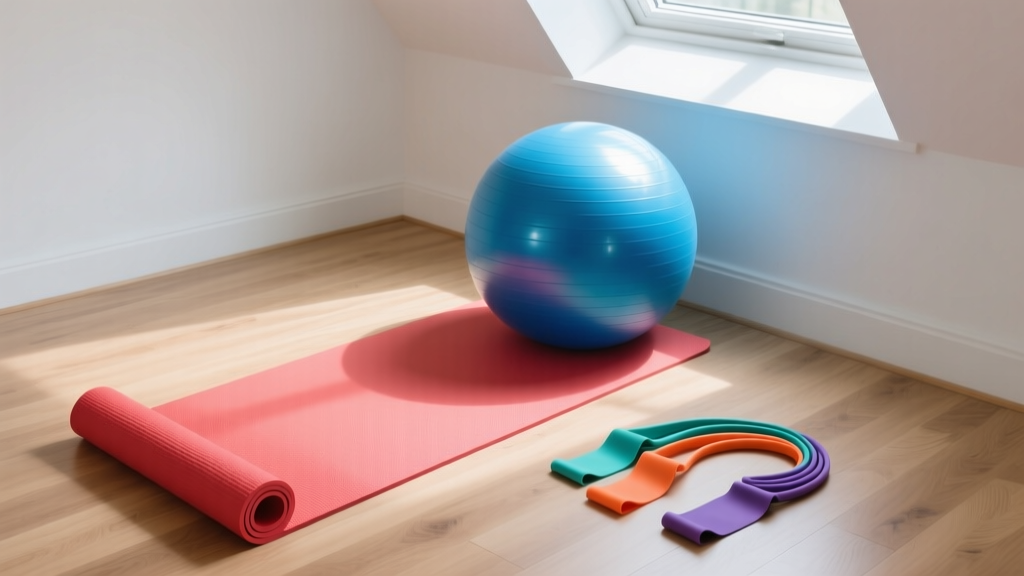
- Zone 2: The Active Radius - Place your 55cm or 65cm anti-burst exercise ball on the mat. Keep the ball at least 3 feet away from ceiling fans and 2 feet from walls to prevent scuff marks during roll-outs.
- Zone 3: Vertical Storage - Install a heavy-duty bungee cord system or a wide-loop wall hook in the corner. When the ball is deflated (or if you prefer to leave it inflated), secure it vertically in the corner. Never store an inflated ball in direct sunlight from a nearby window, as UV degradation weakens the anti-burst honeycomb structure over time.
Frequently Asked Questions
Can I leave my exercise ball inflated if I have a small room?
Yes, but you must treat it as a permanent piece of furniture. If your room is under 120 square feet, an inflated 65cm ball consumes roughly 10% of your usable floor space. Utilize vertical corner storage or under-desk placement to keep it out of the primary walking path.
Does a thicker yoga mat prevent the exercise ball from slipping?
Not necessarily. Thick 1/2-inch foam mats actually compress unevenly under the concentrated point-load of a stability ball, which can cause the ball to roll unpredictably during planks or pikes. A denser 4mm to 5mm natural rubber or TPE mat provides a much more stable, slip-resistant base for ball exercises.
How often should I replace my exercise ball in a home gym?
Even with minimal use, the plastics in stability balls degrade due to oxidation and UV exposure. Replace your ball every 12 to 18 months. If you notice the material becoming excessively glossy, sticky, or developing micro-stretch marks near the valve, it has lost its structural integrity and is a burst hazard.
More gear to consider
All reviews
Exercise Ball Size Guide & NBR vs TPE Yoga Mat Budget Breakdown

Battle Rope Sizing & Budget: Gaiam Yoga Mat Pink Value

Yoga Mat Thickness Guide & Mini Gym Bag With Yoga Mat Holder Tips
Best Fitness Accessories: Yoga Mat Thickness, Grip & Setup Walkthrough

Home Gym Layouts: Exercise Ball Sizing & How Much Is a Yoga Mat