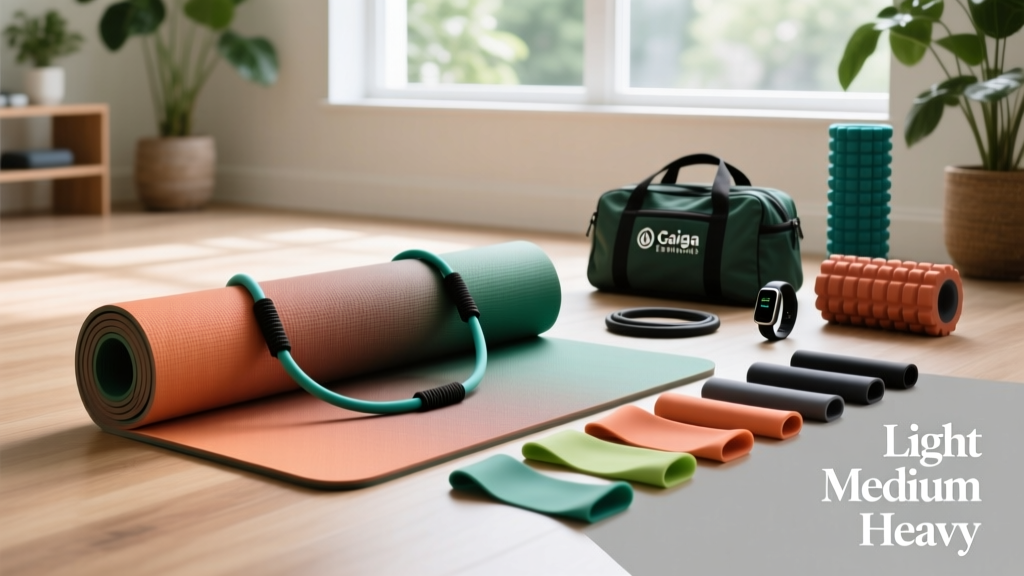
Resistance Band Set Guide: Levels & Gaiam Essentials Thick Yoga Mat
Master resistance band levels and types with our beginner buying guide, featuring floor routines optimized for the Gaiam Essentials thick yoga mat.

The Ultimate Beginner's Resistance Band Set Buying Guide
Building a home gym does not require a massive financial investment or a dedicated spare room. For beginners, the combination of a versatile resistance band set and a high-quality foundational mat is the most efficient way to build strength, improve mobility, and establish a consistent workout habit. According to Harvard Health Publishing, regular strength training is essential for bone density, metabolic health, and functional independence, and elastic resistance provides a joint-friendly alternative to heavy iron.
However, walking into the fitness aisle or browsing online can be overwhelming. What do the different colors mean? Should you buy tube bands or flat loops? And perhaps most importantly, how do you protect your joints during floor-based band exercises? This step-by-step guide breaks down resistance band levels and types, and explains why pairing your equipment with the Gaiam Essentials thick yoga mat is a game-changer for beginner floor routines.
Step 1: Choosing the Right Type of Resistance Band
Before worrying about tension levels, you must select the right style of band for your intended workouts. Most beginner sets fall into three distinct categories, each with specific biomechanical use cases.
1. Tube Bands with Handles
These consist of hollow rubber or latex tubes with carabiners that attach to plastic or foam handles. They are designed to mimic traditional cable machines and dumbbells.
- Best For: Bicep curls, shoulder presses, seated rows, and chest presses.
- Price Range: $20 to $35 for a comprehensive 11-piece set (e.g., Whatafit or VEICK).
- Edge Case Warning: The carabiner clips are common failure points. Always inspect the metal clasps for micro-fractures before pulling the band under tension near your face.
2. Flat Loop Bands (Therapy Bands)
These are continuous, flat strips of latex or TPE (Thermoplastic Elastomer) without handles. They offer a wider surface area, reducing the risk of the band snapping or rolling up.
- Best For: Physical therapy, Pilates, assisted pull-ups, and wrapping around sturdy poles for rotational core work.
- Price Range: $12 to $25 (e.g., TheraBand CLX or standard flat loops).
3. Mini Loop Bands
Short, continuous loops (usually 10 to 12 inches in circumference) designed to be placed around the thighs, calves, or wrists.
- Best For: Glute activation (lateral band walks), hip stabilization, and adding resistance to bodyweight squats.
- Price Range: $10 to $18 for a pack of 5.
Step 2: Decoding Resistance Band Levels (The Color Code)
Unlike dumbbells, bands do not have weight stamped on the side. Instead, the industry relies on a standardized color-coding system to denote tension. Note that tension is variable; a band rated at '20 lbs' means it requires 20 pounds of force to stretch it to roughly 100% of its resting length. The further you stretch it, the heavier it feels.
| Color | Estimated Tension (lbs) | Thickness (mm) | Beginner Application |
|---|---|---|---|
| Yellow | 5 - 15 lbs | 0.35mm | Joint rehab, rotator cuff warm-ups, elderly mobility. |
| Green / Red | 15 - 35 lbs | 0.50mm - 0.75mm | Standard beginner strength training, bicep curls, lateral raises. |
| Blue | 35 - 50 lbs | 1.1mm | Intermediate leg work, compound rows, assisted pull-ups. |
| Black / Gold | 50 - 80+ lbs | 1.5mm+ | Advanced powerlifting assistance, heavy deadlifts, strongman training. |
According to guidelines from the Mayo Clinic, beginners should start with a band that allows them to complete 12 to 15 repetitions with proper form, feeling muscle fatigue only on the final two reps. Always buy a set with at least three different tension levels so you can progressively overload your muscles as you gain strength.
Step 3: Setting Up Your Foundation (The Mat Factor)
Many beginners make the critical mistake of performing resistance band routines on hard floors or thin, cheap travel mats. When you perform supine (lying on your back) or seated band exercises, your body weight is concentrated on your spine, tailbone, and shoulder blades while simultaneously fighting the upward pull of the elastic tension.
Why the Gaiam Essentials Thick Yoga Mat is the Ideal Base
If you are searching for the perfect foundation, the Gaiam Essentials thick yoga mat (specifically the 14mm NBR foam version) is widely considered the gold standard for home resistance training. Here is the exact breakdown of why this specific mat outperforms standard 3mm PVC mats for band work:
- Joint Damping (14mm NBR Foam): The extra-thick nitrile butadiene rubber (NBR) provides a 14-millimeter cushion that prevents tailbone bruising during seated banded rows and spinal compression during supine chest presses.
- Surface Traction: When anchoring a tube band under your feet for standing bicep curls, the textured, non-slip surface of the Gaiam mat prevents your feet from sliding outward, which is a major cause of groin strains and band-snap injuries.
- Closed-Cell Structure: High-rep band circuits induce sweating. The closed-cell NBR foam repels moisture, preventing the mat from harboring bacteria or degrading from salt exposure over time.
- Dimensions & Pricing: Measuring a standard 71 inches by 24 inches, it accommodates most adult heights for full-body stretches. It typically retails between $28 and $35, making it an incredibly cost-effective piece of protective gear.
Step 4: Your First 4-Exercise Beginner Band Routine
Now that you have your resistance band set and your Gaiam Essentials thick yoga mat unrolled, follow this step-by-step full-body routine. Perform this circuit 2 to 3 times a week, resting 48 hours between sessions.
1. Supine Chest Press (Chest & Triceps)
- Setup: Lie flat on your back on the mat. Wrap the center of a Green or Red tube band behind your upper back, holding a handle in each hand.
- Action: Press the handles straight up toward the ceiling until your arms are fully extended. Slowly lower them back down until your elbows lightly tap the mat.
- Volume: 3 sets of 12 reps.
2. Seated Banded Row (Back & Biceps)
- Setup: Sit on the mat with your legs extended straight in front of you. Loop the center of the band around the arches of your feet.
- Action: Keeping your spine neutral and core braced, pull the handles toward your ribcage, squeezing your shoulder blades together at the peak of the movement.
- Volume: 3 sets of 15 reps.
3. Banded Glute Bridges (Glutes & Hamstrings)
- Setup: Lie on your back with knees bent and feet flat on the mat. Place a mini-loop band just above your knees.
- Action: Press through your heels to lift your hips toward the ceiling while actively pushing your knees outward against the band's resistance. Hold for 2 seconds at the top.
- Volume: 3 sets of 15 reps.
4. Pallof Press (Core Anti-Rotation)
- Setup: Anchor a tube band to a sturdy door hinge or heavy furniture at chest height. Kneel sideways on your mat.
- Action: Hold the handle with both hands at your chest. Press your hands straight out in front of you, resisting the band's pull to twist your torso. Return to the chest.
- Volume: 3 sets of 10 reps per side.
Troubleshooting & Edge Cases
Even with the best gear, beginners encounter specific friction points. Here is how to solve them:
Problem: The Mat Slides on Hardwood Floors
Solution: NBR foam can sometimes glide on polished hardwood during aggressive lateral band walks. Place a microfiber yoga towel under the edges of the mat, or use the mat on a low-pile carpet. Avoid using sticky yoga sprays on NBR foam, as they can break down the synthetic material over time.
Problem: Band Snapping or Micro-Tears
Solution: UV light and ozone are the enemies of latex and TPE. Never store your bands in direct sunlight or near a heating vent. Before every workout, run your fingers along the entire length of the band. If you feel any nicks, sticky spots, or thinning areas, discard the band immediately. A snapping band under 40 lbs of tension can cause severe welts or eye injuries.
Problem: Handles Digging into Palms
Solution: Cheap plastic handles lack ergonomic contouring. If you experience nerve compression in your palms, wrap the handles in athletic tape or wear lightweight weightlifting gloves to distribute the pressure evenly across your metacarpals.
Frequently Asked Questions (FAQ)
Can I use a thin travel mat instead of the Gaiam Essentials thick yoga mat?
While you can use a 3mm travel mat for standing exercises, it is highly discouraged for seated or supine band work. The upward tension of the bands forces your spine and tailbone into the hard floor, which can lead to bruising and spinal discomfort. The 14mm thickness of the Gaiam Essentials mat acts as a necessary shock absorber.
How long do resistance bands typically last?
With regular use (3-4 times a week) and proper storage away from heat and sunlight, a high-quality tube or loop band set will last between 6 to 12 months. Once the rubber loses its elasticity and fails to snap back to its original resting length, it is time to replace the set.
Are fabric mini-bands better than rubber ones?
For lower body work (like squats and glute bridges), fabric-wrapped bands are superior because they grip the skin and clothing, preventing the 'roll-up' effect that plagues bare rubber mini-bands. However, fabric bands offer less granular tension progression and are not suitable for upper-body rehabilitation.
Final Verdict: A well-chosen resistance band set paired with a supportive, thick foundation like the Gaiam Essentials thick yoga mat provides a safe, scalable, and highly effective entry point into strength training. Focus on mastering your form with lighter tensions before progressing to heavier bands, and always prioritize joint protection during floor-based movements.
More gear to consider
All reviews
Jump Rope Types Compared & How to Clean Liforme Yoga Mat

Stability Ball vs BOSU Ball Value Analysis & DIY Yoga Mat Bag Pattern

Jump Rope Types: Speed, Beaded, Weighted & Yoga Mat PNG

Yoga Blocks, Straps & Sanuk Yoga Mat Flip Flops: 2026 Space Guide

Loop vs Tube Bands: Longevity & Jade Yoga Harmony Mat Care
