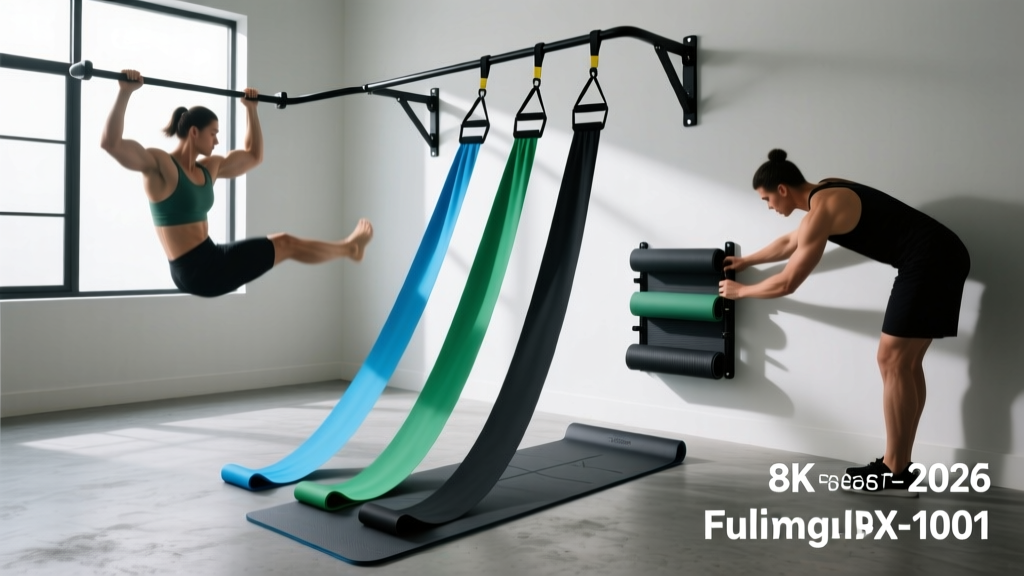
Pull-Up Assist Band Sizing & Yoga Mat Holder Floor Setups
Master pull-up assist band sizing with our 2026 brand comparison. Plus, optimize home gym safety with the best yoga mat holder floor storage setups.

The Biomechanics of Variable Resistance: Why Sizing Matters
Selecting the correct pull-up assist band is not merely about guessing your body weight; it requires an understanding of elastic modulus and variable tension curves. Unlike free weights, which provide constant resistance, continuous loop bands offer accommodating resistance. According to research published in the Journal of Physical Therapy Science, elastic resistance training increases muscle activation at the peak of the concentric phase due to the band's elongation properties. A standard 41-inch loop band stretched to a typical 7.5-foot pull-up rig achieves roughly 115% elongation, meaning the assistance provided at the bottom of your pull-up (where you are weakest) is significantly higher than the assistance at the top.
Pro Tip: Never base your purchase solely on the 'maximum resistance' printed on the band. A heavy-duty 1.75-inch orange band might claim 150 lbs of resistance, but that figure is only accurate at 200%+ elongation. At a standard pull-up stretch, it provides roughly 60-80 lbs of actual assistive force.Head-to-Head: 2026 Elite Band Brand Comparison
The market is saturated with cheap TPE (Thermoplastic Elastomer) bands that suffer from rapid hysteresis loss and snapping. For serious training, natural layered latex is the industry standard. Below is a head-to-head comparison of the top three manufacturers dominating the home and commercial gym space in 2026.
| Brand & Model | Material Composition | Price Range (USD) | Durability & Edge Cases |
|---|---|---|---|
| Rogue Fitness Monster Bands | 15-Layer Natural Latex | $24.50 - $68.00 | Exceptional tensile strength. Resists micro-tearing at the anchor point. Best for heavy daily use. |
| Serious Steel Assisted Bands | Continuous Layered Latex | $21.00 - $55.00 | Slightly wider tolerance on tension ranges. Excellent for mobility work and heavy assisted pull-ups. |
| REP Fitness Pull-Up Bands | Molded Natural Latex | $18.00 - $45.00 | Great budget option, but molded (not layered) edges can develop stress fractures if rolled on knurled bars. |
The Sizing Matrix: Match Your Band to Your 1RM
To progress toward an unassisted strict pull-up, you must systematically deload the band assistance. Use the following matrix to select your starting band based on your current body weight and unassisted pull-up capacity. Data aligns with standard 41-inch loop lengths anchored to a 7.5-foot bar.
- 1/8" (Red) - 5 to 15 lbs assist: Ideal for warming up the rotator cuff, band pull-aparts, and advanced athletes bridging the gap to weighted pull-ups.
- 1/4" (Black) - 10 to 35 lbs assist: The 'finisher' band. Use this when you can already perform 3-5 unassisted pull-ups and need help squeezing out the last two reps of a hypertrophy set.
- 1/2" (Purple) - 20 to 55 lbs assist: The intermediate workhorse. Perfect for athletes who can do 1 unassisted rep but need assistance for volume sets of 8-10.
- 3/4" (Green) - 30 to 75 lbs assist: The beginner standard. If your body weight is over 180 lbs and you have zero unassisted pull-ups, start here.
- 1 1/8" (Blue) - 40 to 100 lbs assist: Heavy assistance for athletes over 220 lbs or those recovering from latissimus dorsi strains.
- 1 7/8" (Orange) - 60 to 150 lbs assist: Maximum assistance. Primarily used for heavy mobility stretches, inverted rows, or rehabilitation protocols.
Optimizing the Drop Zone: Yoga Mat Holder Floor Integration
When outfitting a home gym, managing the space beneath your pull-up rig is critical for safety and workflow. A cluttered floor leads to compromised footing and tripping hazards, especially when dismounting from high-bar muscle-ups or assisted pull-ups. Investing in a dedicated, freestanding yoga mat holder floor unit keeps your 5mm mobility mats, cork mats, and stretching straps organized vertically.
By utilizing a weighted steel yoga mat holder floor caddy positioned just outside the rig's drop-zone, you ensure that your landing area remains clear of rolled gear. This is particularly vital when performing eccentric pull-up negatives, where a slipped grip or band snap could result in an uncontrolled drop. Furthermore, keeping your mobility mats upright in a floor holder prevents the compression damage and edge-curling that occurs when heavy gym equipment is repeatedly stacked on top of them.
"The safest home gyms treat the floor space with the same respect as the rack itself. A vertical yoga mat holder floor stand isn't just an organizational tool; it's a critical safety boundary that keeps high-density EVA foam and PVC mats out of the dynamic movement zone."
— Marcus Vance, CSCS, Home Gym Architect
Edge Cases, Failure Modes, and Maintenance
Even premium layered latex bands are subject to material fatigue. Understanding failure modes will prevent catastrophic snaps that can cause severe facial or ocular injuries. The ExRx kinesiology database emphasizes the importance of inspecting elastic resistance tools prior to every session.
1. Anchor Point Friction
Wrapping a band directly around a heavily knurled pull-up bar or a rough steel gusset will shave microscopic layers of latex with every rep. Over 4 to 6 weeks, this creates a stress concentration point. Solution: Always loop the band through itself (a girth hitch) around a smooth, powder-coated sleeve or use a dedicated nylon band anchor strap.
2. UV and Ozone Degradation
Natural latex is highly susceptible to ultraviolet light and ozone. If your home gym is in a garage with direct sunlight or poor ventilation near electrical motors (which generate ozone), your bands will dry rot, turning chalky and brittle. Solution: Store bands in an opaque, airtight container with a silica gel packet to control humidity and block UV rays.
3. Delamination
Cheaper bands are made by gluing strips of latex together. Under high tension, the adhesive fails before the latex does, causing the band to split down the middle. Always inspect the inner layers of the loop. If you see white, powdery residue or separation between layers, retire the band immediately.
Summary Checklist for Your Next Session
- Calculate your required assistance based on your current body weight and max unassisted reps.
- Select a layered natural latex band from a reputable manufacturer (Rogue, Serious Steel, or REP).
- Inspect the band for micro-tears, chalky residue, or delamination before anchoring.
- Use a girth hitch on a smooth, powder-coated section of the pull-up bar.
- Ensure your landing zone is clear by storing mobility gear in a vertical yoga mat holder floor rack.
More gear to consider
All reviews
CorePower Yoga Mat Rental vs Exercise Ball: Budget & Size Guide
Are Cork Yoga Mats Good for Medicine Balls? Weight Guide

Exercise Ball Size Guide & NBR vs TPE Yoga Mat Budget Breakdown

Pilates Accessories Guide: Large Yoga Mat Bag Care & Longevity
Battle Rope Guide: What Thickness Yoga Mat Do I Need?
