Beyond Standard Yoga Mat Thickness: Pilates Space & Layout Guide
Discover how to design a compact home Pilates studio. We contrast standard yoga mat thickness with Pilates needs and map out space-saving accessory storage.

Designing a dedicated home Pilates studio requires a radical departure from general fitness space planning. Unlike a traditional home gym where the focus is on load-bearing clearance and heavy equipment anchoring, a Pilates zone prioritizes the kinetic envelope, spinal articulation, and the seamless flow between movement and props. When optimizing a small room or a multi-use living area for Pilates, the foundational layer and the storage of specialized accessories dictate the success of the space.
The Biomechanical Reality: Why Standard Yoga Mat Thickness Fails for Pilates
When outfitting a compact movement space, the most common error is defaulting to a standard yoga mat. The standard yoga mat thickness hovers between 3mm and 5mm (1/8 to 3/16 of an inch). While this provides the necessary proprioceptive feedback and grip for standing asanas, it is biomechanically insufficient for classical and contemporary Pilates floor work.
Pilates heavily features spinal articulation and supine weight-bearing. Exercises like the Hundred, Rolling Like a Ball, and Teaser place direct pressure on the spinous processes and ischial tuberosities. According to equipment guidelines from Balanced Body, a dedicated Pilates mat must feature a thickness of 10mm to 15mm (approx. 1/2 to 5/8 inch) constructed from high-density NBR (Nitrile Butadiene Rubber) or closed-cell TPE.
Spatial Trade-off Warning: A 15mm NBR mat (like the Balanced Body EcoSmart Mat, ~$89) takes up 3x the storage volume of a 3mm PVC yoga mat when rolled. In a space-optimized layout, you cannot store these in a standard 6-inch diameter umbrella stand; you will need a dedicated horizontal rack or a 10-inch diameter woven basket.Spatial Blueprint: Mapping the Compact Pilates Zone
Space optimization is not just about storage; it is about preserving the kinetic envelope required for safe movement. A standard Pilates mat measures 68 inches by 24 inches. However, the functional footprint is significantly larger.
Calculating Your Kinetic Clearance
- Longitudinal (Y-Axis): You need a minimum of 84 inches of clear length. This accommodates the 68-inch mat plus 8 inches of overhead arm extension (e.g., Arm Circles) and 8 inches for plantar flexion at the feet.
- Lateral (X-Axis): You need a minimum of 60 inches of width. The mat is 24 inches, but exercises like the Saw or Side Kick Series require lateral limb extension that easily spans an additional 18 inches on either side.
If your room is constrained, position the mat diagonally. A 10x10 foot room yields a diagonal clearance of roughly 141 inches, providing ample kinetic envelope for full-body extensions without requiring wall-mounted folding furniture.
The 2026 Pilates Accessory Arsenal & Storage Matrix
Unlike heavy gym equipment, Pilates accessories are numerous, oddly shaped, and prone to creating visual clutter. Merrithew education protocols emphasize the seamless transition between props to maintain the mind-body flow. If you are digging through a closet for a ring, the flow is broken.
| Accessory | Dimensions & Profile | Avg. Cost | Space-Optimized Storage Solution |
|---|---|---|---|
| Soft Fitness Circle | 14" diameter, 2" thick | $25 - $35 | Wall-mounted vertical tension rod or specialized S-hook on a slatwall. |
| Mini Stability Ball | 9" diameter (inflated) | $12 - $18 | Deflate to 1" flat profile; store in a shallow acrylic drawer bin. |
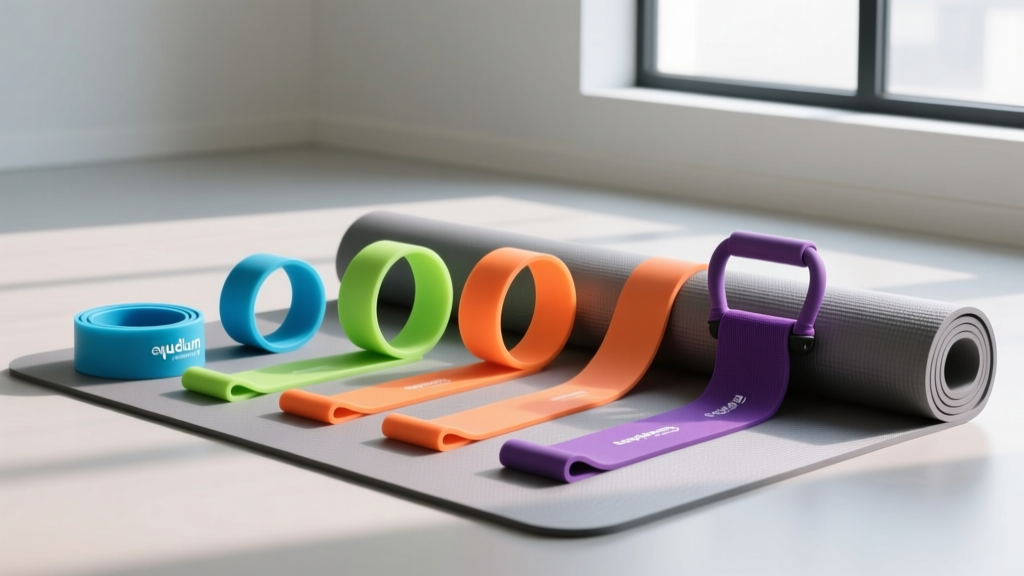
| Resistance Bands (Loop) | 12" x 2" (flat) | $15 - $25 (set) | Rolled and secured with velcro straps; hung on a multi-peg wall rack. |
| Sliding Discs | 4" diameter, 0.5" thick | $15 - $22 | Stacked and stored inside a hollow mini stability ball or small mesh pouch. |
Vertical Space Optimization: Wall-Mounted & Over-Door Solutions
When floor space is at a premium, the vertical plane becomes your primary storage real estate. However, Pilates accessories require specific mounting solutions to prevent material degradation.
The Slatwall vs. Pegboard Debate
While standard metal pegboards are cheap, the thin metal hooks can crease and damage high-density resistance bands or foam rollers over time. For a premium, space-optimized layout, install a PVC slatwall system (e.g., Tractor Supply Pro slatwall panels, ~$80 per 4x2 ft section). Slatwalls accept heavy-duty acrylic bins and wide, flat hooks that support the broad surface area of a 14-inch Pilates ring without bending the foam.
"The integration of a home studio should feel like a sanctuary, not a cluttered garage. Utilizing vertical acrylic dividers allows practitioners to see their props at a glance, reducing the friction of transitioning between exercises." — Studio Design Ergonomics Insights, ACE Fitness
Lighting and Spatial Perception in Compact Studios
Space optimization is as much about visual perception as it is about physical dimensions. In a compact 8x10 foot Pilates zone, harsh overhead lighting creates stark shadows that make the room feel claustrophobic and visually cluttered, especially when wall-mounted storage is fully loaded with accessories.
Implementing Indirect Illumination
Instead of relying on a single central ceiling fixture, utilize LED strip lighting behind your slatwall panels or beneath floating shelves. This technique, known as wall-washing, pushes the visual boundaries of the room outward. For task lighting, a floor lamp with a dimmable, warm-white bulb (2700K-3000K) positioned in the corner opposite your primary movement axis reduces glare on mirrors and prevents the space from feeling like a clinical gym.
Edge Cases & Troubleshooting Small Layouts
Failure Mode: The Carpet Compression Effect
Many home studios are built in carpeted spare bedrooms. When you place a 10mm Pilates mat over a thick carpet pad, the combined squish creates an unstable base. This is a critical failure mode for standing Pilates work or exercises requiring precise pelvic stability, like the Single Leg Stretch. The ankle stabilizers overcompensate, leading to fatigue or strain.
The Fix: Lay down interlocking EVA foam subfloor tiles (3/8 inch thick, high-density, approx. $1.50 per sq. ft.) beneath your mat. This creates a firm, unified kinetic surface that neutralizes the carpet's variable compression while protecting your hardwood perimeter.
Failure Mode: Humidity and Closed-Cell TPE
If your optimized space is a converted garage or basement, ambient humidity can cause closed-cell TPE mats to develop a slick, dangerous surface film. Unlike open-cell natural rubber mats that absorb moisture (and odors), TPE repels it, leaving a microscopic water layer on top.
The Fix: Integrate a compact, wall-mounted dehumidifier into your layout, and keep a microfiber towel treated with a 50/50 water and witch hazel solution in an accessible wall-bin to wipe the mat between sets.
Summary: Designing for Flow and Function
Optimizing a home Pilates space requires looking past the aesthetics and focusing on biomechanical reality. By acknowledging that the standard yoga mat thickness is inadequate for spinal articulation, you force a necessary recalculation of your storage footprint. Pairing a 10mm-15mm high-density mat with a meticulously planned vertical slatwall for your rings, balls, and bands transforms a cramped spare room into a highly functional, flow-oriented movement sanctuary.
More gear to consider
All reviews
Speed, Weighted & Beaded Jump Ropes for Circle Yoga Mats

BOSU vs Stability Ball: Skip the 'I Miss Drugs' Yoga Mat Gimmicks
Mobility Zone Setup: Foam Roller Density & Yoga Mat Dimensions

Jump Rope Types & Types of Yoga Mats: A Beginner's Guide

Pilates Accessories: How to Make Yoga Mat Less Slippery