Medicine Ball Weight Selection & Standard Yoga Mat Measurements
Master medicine ball weight selection for power and MetCon. Plus, map ball diameters against standard yoga mat measurements for safe home gym spacing.

The Biomechanics of Load vs. Velocity
Selecting the correct medicine ball weight is not about maxing out; it is about optimizing the force-velocity curve for your specific training adaptation. According to guidelines from the National Strength and Conditioning Association (NSCA), plyometric and rotational power training requires a load light enough to maintain maximum acceleration through the entire range of motion. If the ball is too heavy, your deceleration phase begins too early, robbing you of peak power output and increasing shear stress on the rotator cuff and lumbar spine.
Conversely, if you are training for muscular endurance or core hypertrophy (like weighted Russian twists or V-ups), a heavier load moved at a slower, controlled tempo is required. The most common mistake athletes make in 2026 is using a 30lb wall ball for rotational throws, which fundamentally shifts the stimulus from power development to slow-twitch endurance.
Expert Rule of Thumb: For upper-body power throws, the ball should weigh between 4% and 15% of your body weight. For lower-body and core-dominant movements, you can safely scale up to 10% - 25% of your body weight.2026 Weight Selection Matrix by Training Goal
Below is a comprehensive comparison matrix detailing the optimal weight ranges, recommended shell types, and current market pricing for top-tier models. Data sourced from current manufacturer specs and Rogue Fitness product lines.
| Training Goal | Optimal Weight Range | Recommended Shell Type | Top Model (2026) | Price Range |
|---|---|---|---|---|
| Rotational Power | 4 lbs - 10 lbs | Soft-shell / Leather | Dynamax Elite (4-8lb) | $95 - $115 |
| MetCon / Wall Balls | 14 lbs - 30 lbs | Soft-shell (14' dia) | Dynamax Pro / Rogue Wall Ball | $115 - $155 |
| Max Force Slams | 15 lbs - 50 lbs | Hard Rubber / Sand-filled | Rogue Echo Slam Ball | $55 - $135 |
| Core Isolation | 10 lbs - 20 lbs | Textured Rubber | TRX HexGrip Medicine Ball | $60 - $90 |
| Rebound / Plyo | 6 lbs - 12 lbs | Bouncy Rubber | SPX Bounce Medicine Ball | $40 - $75 |
Spatial Mapping: Ball Diameter and Standard Yoga Mat Measurements
When designing a multi-use home gym or organizing a commercial functional fitness floor, spatial awareness is critical for safety. Cross-referencing your equipment footprint with standard yoga mat measurements is the most effective way to map out safe drop-zones and rebound radii.
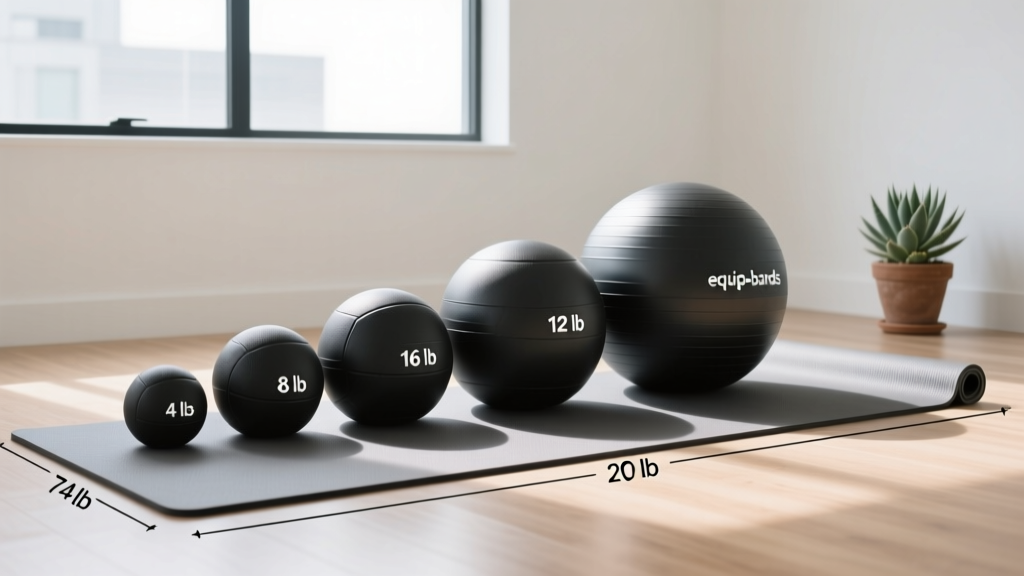
The industry standard yoga mat measurements are exactly 24 inches wide by 68 inches long (61 cm x 173 cm), with thicknesses ranging from 3mm to 6mm. Here is how medicine ball dimensions interact with that spatial grid:
- The Width Constraint (24 inches): A standard Dynamax wall ball has a uniform diameter of 14 inches. When performing supine chest passes or floor-based slams while lying on a standard mat, the ball occupies nearly 60% of your lateral workspace. If your arms fatigue and the ball deflects off your chest, it will easily roll off the 24-inch width, potentially striking nearby equipment or toes.
- The Length Constraint (68 inches): For standing slam ball exercises, your athletic stance and the ball's overhead extension will span roughly 60 to 70 inches. Using standard yoga mat measurements as a floor marker ensures you have identified a 3-foot by 6-foot 'safe zone' free of hard plastic dumbbells or kettlebells that could puncture a rubber slam ball upon a missed drop.
- Storage & Stacking: Understanding the 24x68 inch grid allows you to build custom shelving. A 14-inch wall ball requires a shelf depth of at least 16 inches, whereas smaller 10lb slam balls (typically 9 inches in diameter) can be stored in shallow 12-inch bins aligned with the short edge of a yoga mat rack.
Shell Material & Failure Modes
Not all medicine balls are created equal. Choosing the wrong shell material for your intended exercise will lead to rapid equipment failure. Here are the primary material categories and their specific edge-case vulnerabilities:
1. Sand-Filled Hard Rubber (Slam Balls)
Best for: Overhead slams, rotational throws into concrete walls.
Failure Mode: Sand settling and micro-fractures. Over time, the internal sand shifts and packs tightly at the bottom of the ball, creating an off-center center of gravity. This causes the ball to bounce unpredictably off the floor. Furthermore, cheap PVC shells will develop micro-fractures along the equator seam when dropped from overhead onto raw concrete in cold temperatures (below 50°F), eventually bursting and leaking sand.
2. Soft-Shell Nylon/Kevlar (Wall Balls)
Best for: High-repetition MetCon wall balls, squats, and carrying.
Failure Mode: Seam blowout and moisture retention. If used outdoors or in high-humidity garage gyms, the internal cotton/poly-fill can absorb ambient moisture, adding unintended weight and fostering mold. Repeated high-velocity impacts against rough brick or unfinished concrete will shred the exterior stitching.
3. Solid Rubber / Leather (Rebound Balls)
Best for: Plyometric rebound throws, partner passes, single-arm snatches.
Failure Mode: Surface slickness. As the rubber oxidizes or the leather wears smooth from hand oils and chalk, the grip degrades. Attempting heavy rotational throws with a worn leather ball is a primary cause of accidental releases and wrist sprains.
Expert Troubleshooting & Edge Cases
Even with the correct weight and material, athletes frequently encounter operational issues. Use this step-by-step troubleshooting guide to resolve them:
- The 'Dead Bounce' Issue: If your slam ball feels like it is bottoming out and vibrating your joints upon impact, the internal sand has compacted. Fix: Vigorously shake and rotate the ball for 30 seconds before your workout to redistribute the aggregate. Store the ball on its side rather than upright.
- Grip Fatigue on Heavy Wall Balls: When scaling up to a 30lb or 40lb wall ball, grip strength often fails before the legs or shoulders. Fix: Avoid using chalk on soft-shell wall balls, as it degrades the nylon. Instead, wipe the ball with a damp microfiber cloth to remove hand oils, and focus on cradling the ball on the 'equator' seam rather than palming the poles.
- Uneven Rotational Drag: If a medicine ball feels heavier on one side during Russian twists, the internal filler has separated from the outer shell. Fix: This is common in low-end gel-filled or water-filled balls. Upgrade to a sand-and-air hybrid fill model (like the Rogue Echo) which maintains structural integrity under torsional stress.
'The medicine ball is a tool for velocity, not just load. If your bar speed slows down by more than 10% during a set of rotational throws, the ball is too heavy, regardless of what your ego tells you.' — Functional Fitness Biomechanics Review, 2025
Frequently Asked Questions
Can I use a slam ball for wall balls?
No. Slam balls are designed with a thick, non-bouncy rubber shell meant to absorb impact. Throwing a heavy slam ball against a drywall or even reinforced concrete wall will result in severe wall damage and potential wrist injuries due to the lack of shock absorption. Always use soft-shell wall balls for vertical tosses.
How do I clean a soft-shell medicine ball?
Use a mild solution of water and white vinegar. Avoid harsh chemical cleaners like bleach or ammonia, which will break down the nylon fibers and cause the exterior stitching to become brittle and snap under pressure.
Does the diameter change as the weight increases?
It depends on the brand and type. Premium wall balls (like Dynamax) maintain a uniform 14-inch diameter across all weights from 4lbs to 30lbs to ensure consistent catching mechanics. However, sand-filled slam balls increase in diameter as weight increases; a 10lb slam ball may be 9 inches wide, while a 50lb slam ball can exceed 14 inches.
More gear to consider
All reviews
How To Match Therapy With Trigger: A Precision Framework for Equip Bands Users
Jade Extra Yoga Mat vs Pull Up Assist Bands: Sizing Guide

2026 Foam Roller Guide: Density, Size & Yoga Mat en Espanol Upgrades

Best Mini Yoga Mat, Block & Strap Travel Guide 2026
Battle Rope Guide: What Thickness Yoga Mat Do I Need?