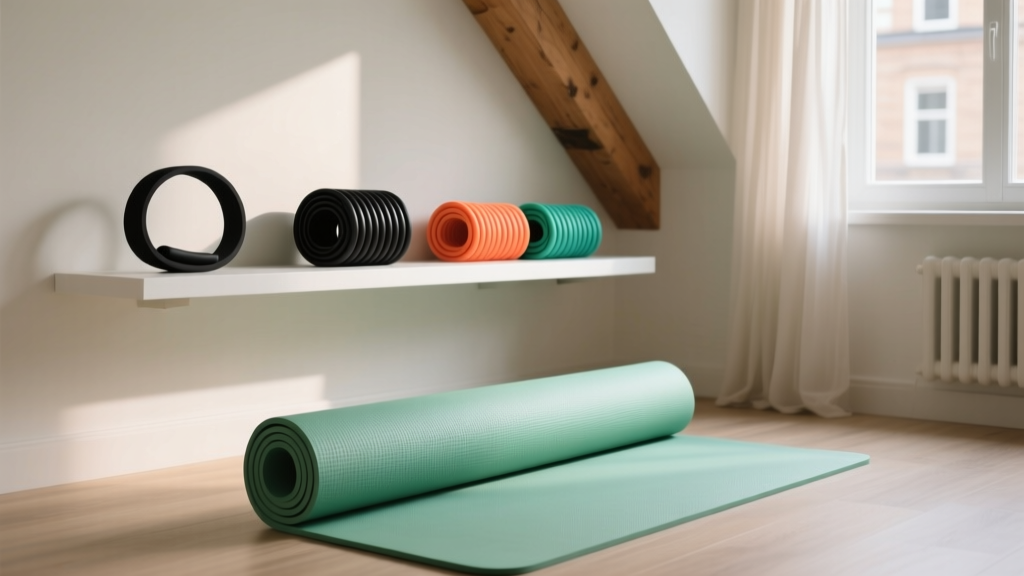
Exercise Ball Size Guide & Care: Match Your Stackt Yoga Mat
Master the exercise ball size guide and buying tips. Learn anti-burst specs, inflation protocols, and maintenance to pair with your Stackt yoga mat.

The Ergonomic Imperative: Sizing Your Exercise Ball
Integrating a stability ball into your core and mobility routines is one of the most effective ways to engage deep stabilizer muscles. However, selecting the wrong diameter compromises your biomechanics and increases injury risk. According to the American Council on Exercise (ACE), the golden rule of exercise ball sizing is achieving a 90-degree angle at both the hips and knees when seated with your feet flat on the floor.
When pairing your ball with premium floor gear like the Stackt yoga mat, you must also consider the spatial footprint. A standard 24-inch by 68-inch mat provides a defined boundary for your floor work. If you are performing supine rollouts or seated crunches, your ball's contact patch and rolling radius must align with your mat's dimensions to prevent slipping onto hard flooring.
2026 Exercise Ball Size Chart
| User Height | Recommended Ball Diameter | Approximate Inflation Size | Best Use Case |
|---|---|---|---|
| Under 5'0' (152 cm) | 45 cm | 17.7 inches | Desk seating, light Pilates |
| 5'1' - 5'8' (155-173 cm) | 55 cm | 21.6 inches | Core crunches, mat-bound stretches |
| 5'9' - 6'2' (175-188 cm) | 65 cm | 25.6 inches | Heavy squats, full-body rollouts |
| 6'3' - 6'7' (190-200 cm) | 75 cm | 29.5 inches | Advanced stability, physical therapy |
| Over 6'7' (200+ cm) | 85 cm | 33.5 inches | Tall-user desk seating, deep stretches |
Buying Guide: Anti-Burst Ratings and Material Density
Not all PVC is created equal. When shopping for an exercise ball in 2026, ignore marketing fluff and look directly at the static load rating and burst-resistance certification. High-quality balls from brands like Trideer or URBNFit utilize multi-layer, honeycomb-structured PVC.
- Static Load Limit: This is the maximum weight the ball can hold while stationary. Look for a minimum of 600 lbs (272 kg), with premium models rated up to 2,000 lbs.
- Dynamic Load Limit: This is the safe weight capacity during active movement (bouncing, lifting weights). A safe threshold is 300 lbs (136 kg).
- Anti-Burst Technology: If punctured, an anti-burst ball will slowly deflate rather than explode. This is non-negotiable if you plan to use the ball for weighted exercises or near sharp objects.
Expect to pay between $25 and $45 for a high-density, anti-burst PVC ball. Avoid bargain-bin options under $15, as they typically use single-layer, recycled PVC that lacks structural integrity and off-gasses harmful phthalates.
The 24-Hour Inflation Protocol: Preventing Seam Failure
The most common point of failure for a new exercise ball is not during use, but during the initial inflation. PVC is stiff and compressed during shipping. Forcing it to 100% capacity immediately causes micro-tears along the equatorial seam, leading to slow leaks or catastrophic blowouts weeks later.
💡 The Pro Inflation Method:- Day 1 (Acclimation): Unbox the ball and let it sit at room temperature (68°F - 72°F) for 2 hours. Cold PVC is brittle and prone to cracking.
- Day 1 (First Fill): Inflate the ball to exactly 80% of its recommended diameter. Use a tape measure to verify the circumference. Insert the plug and leave it alone.
- Day 2 (Expansion): Wait 24 hours. The PVC will naturally stretch and relax.
- Day 2 (Final Fill): Remove the plug and inflate to the final 100% target diameter. Insert the plug securely.
Cross-Material Maintenance: PVC Balls vs. The Stackt Yoga Mat
When integrating core work into your floor routine, pairing your stability ball with a premium surface like the Stackt yoga mat requires an understanding of cross-material care. The Stackt yoga mat (retailing around $138) is highly regarded for its natural tree rubber base, microfiber or cork top layer, and proprietary alignment stacking system. However, the chemical cleaners that are safe for synthetic PVC can destroy natural rubber.
'The biggest mistake practitioners make is using a single, harsh chemical cleaner for all their studio gear. What sanitizes PVC will degrade the cellular structure of natural rubber and cork.' — Equipment Maintenance Guidelines, Yoga Journal
Safe Cleaning Protocols for Combined Gear
To maintain the longevity of both your anti-burst PVC ball and your Stackt yoga mat, you must use a pH-neutral, oil-free cleaning solution.
- The Safe Solution: Mix 1 part unscented liquid castile soap with 10 parts distilled water in a spray bottle. Lightly mist a microfiber cloth (never spray directly onto the mat or ball) and wipe down the surfaces.
- The Stackt Mat Specifics: Natural tree rubber is porous. Wipe the mat in the direction of the grain or alignment lines. Allow it to air dry completely in a shaded area before utilizing the Stackt strap system to store it. Rolling or stacking a damp mat traps moisture, leading to mold growth within the rubber pores.
- The PVC Ball Specifics: Wipe the ball down after every use to remove sweat and body oils. Sebum buildup makes the PVC surface slick, negating the slip-resistance required for safe floor-to-ball transitions.
Storage and Environmental Degradation
Longevity is heavily dictated by how you store your equipment post-workout. Both PVC and natural rubber share a common enemy: UV radiation and ozone.
According to physical therapy and ergonomics research published via the American Physical Therapy Association (APTA), improper storage of clinical stability balls leads to a 40% reduction in material lifespan. If you leave your exercise ball in direct sunlight near a window, the UV rays will oxidize the PVC, causing it to yellow, stiffen, and eventually crack under pressure.
Optimal Storage Configurations
- Temperature Control: Store your gear in a climate-controlled room. Extreme cold makes PVC rigid; extreme heat causes the air inside the ball to expand, putting undue stress on the seams.
- Mat Stacking vs. Ball Placement: The Stackt yoga mat features an innovative stacking and strap system designed to keep your mat edges perfectly aligned and free from creases. Do not rest your heavy, fully inflated 65cm exercise ball on top of your stacked mats. The concentrated point-load will permanently compress the natural rubber base, leaving a permanent indentation that ruins the mat's uniform density.
- Use a Ball Base or Hammock: Invest in a $15 silicone or wooden stability ball ring to keep the ball anchored in the corner of your room, away from direct sunlight and safely separated from your mat storage zone.
Final Thoughts on Gear Synergy
Treating your fitness accessories as an interconnected ecosystem rather than isolated tools is the hallmark of a seasoned practitioner. By meticulously matching your exercise ball size to your biomechanics, adhering to the 24-hour inflation protocol, and utilizing pH-neutral cleaners that protect both PVC and the premium materials of your Stackt yoga mat, you ensure your equipment remains safe, hygienic, and structurally sound for years to come.
More gear to consider
All reviews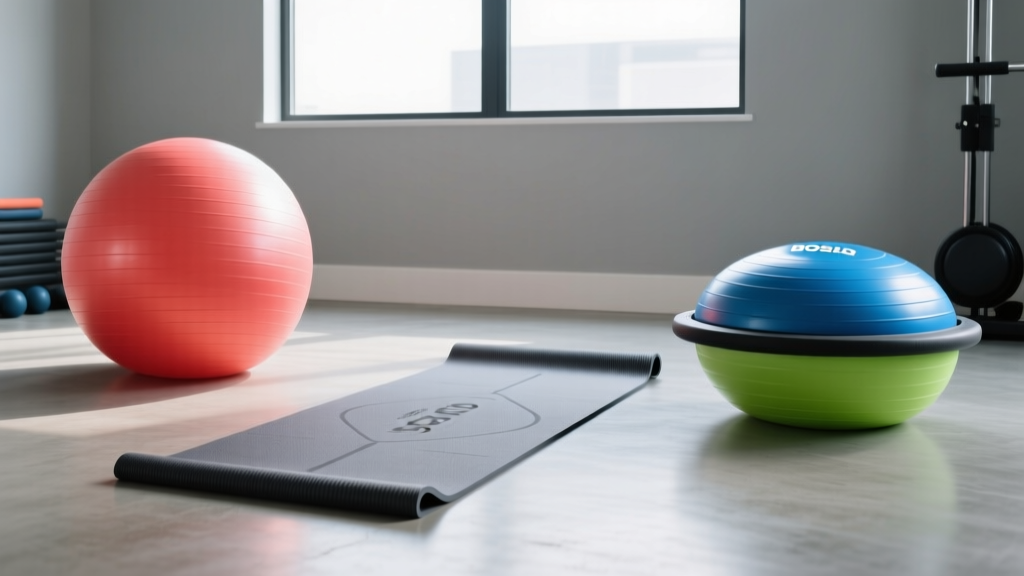
Yoga Mat Sizes & Space: Stability Ball vs BOSU Ball 2026 Trends

Medicine Ball Weight Selection: Setup With Jade Harmony Yoga Mat 74

Exercise with Yoga Mat: 2026 Thickness & Grip Guide

Beyond the Yoga Mat Towel: 2026 Block & Strap Guide

Jump Rope Types: Speed, Beaded, Weighted vs. Average Yoga Mat Length