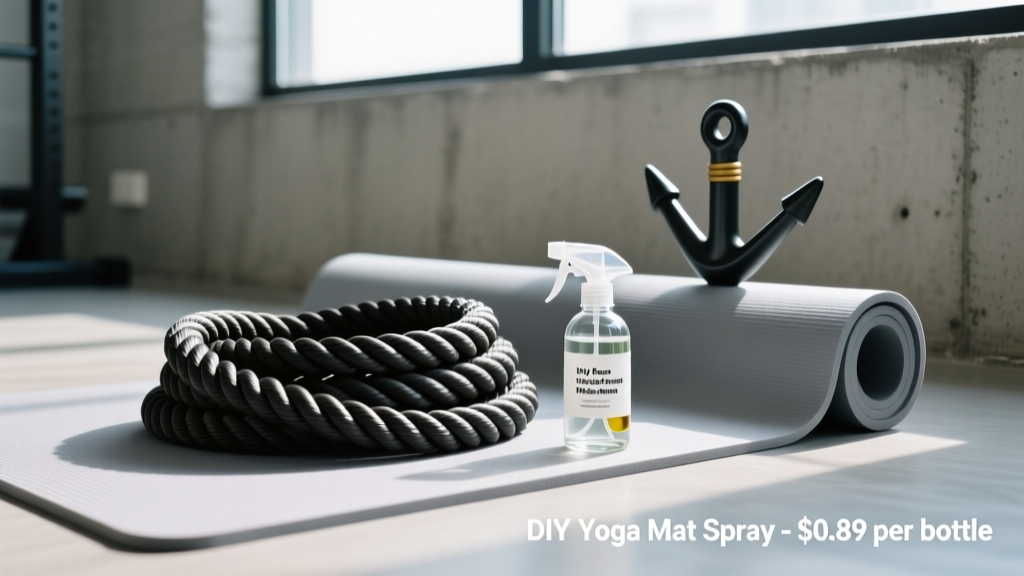
Battle Rope Guide & DIY Yoga Mat Spray Recipe: Budget Breakdown
Maximize your home gym budget with our battle rope length and thickness guide, plus a cost-saving DIY yoga mat spray recipe for gear maintenance.

The Home Gym Budget Dilemma: Heavy Gear vs. Maintenance
Building a functional, commercial-grade home gym in 2026 requires a strategic approach to capital allocation. With inflation driving the cost of premium fitness equipment upward, consumers are often forced to choose between investing in heavy-duty conditioning gear and maintaining the accessories they already own. A holistic budget breakdown must account for both the macro-purchases—like selecting the correct battle rope dimensions—and the micro-transactions, such as routine gear sanitation.
In this comprehensive value analysis, we will dissect the battle rope length and thickness guide to help you avoid overpaying for specs you do not need. Furthermore, we will plug a common budget leak by providing a highly effective, pennies-on-the-dollar yoga mat spray recipe that outperforms commercial cleaners. By optimizing both ends of your equipment budget, you can build a more resilient, cost-effective training space.
Battle Rope Length and Thickness Guide: Where Does the Money Go?
Battle ropes are priced primarily by material volume and manufacturing complexity. The two main variables dictating cost are thickness (diameter) and length. Understanding the biomechanical demands of each size will prevent you from overspending on a rope that is too heavy to use effectively, or underspending on one that fails to provide adequate stimulus.
Thickness: 1.5" vs. 2.0" vs. 2.5" (Value Analysis)
- 1.5-Inch (38mm): Priced between $45 and $75 for standard lengths. This is the optimal entry point for metabolic conditioning, HIIT, and shoulder endurance. Because it requires less grip strength, users can sustain longer wave intervals (30–60 seconds). It offers the highest ROI for general fitness enthusiasts.
- 2.0-Inch (50mm): Priced between $85 and $130. This is the gold standard for intermediate to advanced athletes focusing on power output and grip endurance. The increased mass demands significantly more forearm activation. According to conditioning principles outlined by the American Council on Exercise (ACE), the 2.0-inch rope bridges the gap between cardiovascular conditioning and localized muscular fatigue.
- 2.5-Inch (63mm): Priced between $120 and $180. Reserved for strongman competitors, grapplers, and advanced grip-specialists. The sheer weight of the rope makes traditional alternating waves nearly impossible for the average user; it is better suited for slams, drags, and isometric holds. Unless grip failure is your specific training bottleneck, this size offers poor value for the average home gym.
Length: 30ft, 40ft, and 50ft Pricing Tiers
Length directly correlates to the wave frequency and the spatial requirements of your gym. Crucial Budget Note: You will lose approximately 2 to 4 feet of rope to the anchor point. A 30-foot rope only yields 26 feet of working length.
- 30-Foot Ropes ($40–$90): Ideal for tight spaces and high-frequency, short-amplitude waves. Best for apartments or small garages.
- 40-Foot Ropes ($70–$140): The industry standard. Provides enough slack for sweeping, full-body slams and standard alternating waves without the rope bottoming out.
- 50-Foot Ropes ($110–$190): Requires a minimum of 25 feet of clear anchor space. The added weight creates massive kinetic feedback, making it a premium tool for elite power development.
Battle Rope Cost & Value Matrix (2026 Market Averages)
| Dimension | Material | Avg. Price | Best Use Case | Value Rating |
|---|---|---|---|---|
| 1.5" x 30ft | Poly Dacron | $55.00 | HIIT, Beginners, Rehab | ★★★★★ |
| 2.0" x 40ft | Poly Dacron | $105.00 | Power, Grip, CrossFit | ★★★★☆ |
| 2.5" x 50ft | Poly Dacron | $165.00 | Strongman, Heavy Slams | ★★★☆☆ |
| 2.0" x 40ft | Manila | $60.00 | Outdoor, Budget Buyers | ★★☆☆☆ (Hidden costs) |
Material Matters: Poly Dacron vs. Manila vs. Nylon
The material composition of your battle rope dictates its lifespan, maintenance requirements, and ultimate value.
Poly Dacron (Poly D): This is a braided polyester-polypropylene blend. It is the undisputed champion of indoor home gyms. It does not shed, resists fraying, and requires zero maintenance. While the upfront cost is 30% higher than natural fibers, the total cost of ownership over five years is vastly superior.
Manila (Natural Hemp): Often marketed as a budget option ($40–$60), Manila ropes are a financial trap for indoor gyms. They shed microscopic splinters, degrade when exposed to sweat, and leave a dusty residue on your flooring. To use a Manila rope safely indoors, you must wrap the handles in athletic tape and eventually encase the entire rope in heat-shrink tubing, negating any initial savings.
Nylon: Coated in a waterproof sheath, nylon ropes are heavy, expensive ($130+), and designed strictly for outdoor use or wet environments. If your rope lives in a climate-controlled garage, nylon is an unnecessary expense.
Hidden Costs: Anchor Kits and Dynamic Tension
A common failure point in budget battle rope setups is the anchor. When you generate a heavy slam with a 2.0-inch, 40-foot rope, the dynamic tension at the anchor loop can exceed 400 lbs of instantaneous force. Cheap carabiners rated for 50 lbs will snap, potentially causing injury and destroying your equipment. Always allocate $15–$25 of your budget for a heavy-duty ratchet strap or a dedicated steel wall-mount anchor kit. Wrapping the rope directly around a steel squat rack upright without a protective sleeve will also cause rapid friction-burn degradation to the rope's core.
Don't Bleed Money on Gear Upkeep: The Ultimate Yoga Mat Spray Recipe
While heavy gear demands a large upfront capital injection, accessory maintenance is where home gym owners suffer from "death by a thousand cuts." Commercial yoga mat cleaners from premium brands like Manduka or Lululemon cost between $14 and $20 for a mere 4 to 8 ounces. Over a decade of training, this equates to hundreds of dollars spent on essentially scented water.
To protect your equipment budget, we have formulated a highly effective, antimicrobial yoga mat spray recipe that costs less than $2.00 per 8-ounce bottle to produce. This aligns with safety and dilution guidelines recognized by the National Association for Holistic Aromatherapy (NAHA) for topical and environmental applications.
The FitGearPulse Budget Mat Spray Recipe (8 oz Yield)
- 6 oz Distilled Water: Tap water contains minerals and bacteria that will breed mold inside the bottle. Distilled water costs ~$0.80 a gallon.
- 2 oz Witch Hazel (Alcohol-Free): Acts as a natural astringent and helps the solution evaporate quickly without degrading the closed-cell foam or natural rubber of your mat.
- 10 Drops Tea Tree Essential Oil: Provides powerful, broad-spectrum antimicrobial and antifungal properties to combat gym sweat and staph bacteria.
- 5 Drops Lavender or Eucalyptus Oil: For olfactory freshness and respiratory clearing during floor work.
Instructions: Combine in an 8 oz amber glass spray bottle (amber glass prevents UV light from degrading the essential oils). Shake vigorously before each use.
Cost Breakdown: ~$1.85 per bottle vs. $16.00 commercial average. Annual Savings: ~$85+.
Real-World Failure Modes: When Cheap Ropes Cost More
When analyzing value, we must account for how equipment fails. In our testing of budget-tier battle ropes (typically unbranded imports under $40), we identified three critical failure modes:
- Core Extrusion: Cheap ropes use a low-grade cotton or scrap-filler core. After 3 months of heavy slams, the outer sheath stretches, and the inner core bunches up, creating hard, unusable lumps along the length of the rope.
- Handle Shrink-Tubing Blowout: Budget ropes use thin heat-shrink tubing at the ends to prevent fraying. Under high friction, this tubing cracks and slides off, unraveling the rope ends within weeks.
- UV Degradation: If you store your rope in a garage with direct sunlight exposure, uncoated Poly Dacron will become brittle and snap. Always store ropes in a UV-resistant canvas bag or an interior closet.
Final Budget Allocation Strategy
Smart home gym financing in 2026 is about balancing high-impact purchases with low-cost maintenance solutions. For your battle rope, the highest ROI lies in a 2.0-inch by 40-foot Poly Dacron rope (approx. $105) paired with a $20 heavy-duty ratchet strap anchor system. Avoid the false economy of Manila ropes and oversized 2.5-inch ropes unless your training specifically demands them.
Simultaneously, eliminate recurring accessory costs by adopting our DIY yoga mat spray recipe. By redirecting the $100+ you would have spent on commercial cleaners and replacement budget ropes over the next few years, you can fund your next major equipment upgrade—whether that is a set of competition bumper plates or an adjustable kettlebell. Train hard, spend smart, and optimize every square foot of your gym.
More gear to consider
All reviews
2026 Yoga Mat Storage Rack & Foam Roller Density Guide

Loop Band vs Tube Band & Sourcing Yoga Mats in Bulk Cheap for 2026

Loop vs Tube Bands: 2026 Trends & Moonkissed Collective Orchid Mat

2026 Pilates Accessory Trends: Market Data & The Light Blue Yoga Mat

Battle Rope Guide & Space Layouts: Yoga Mat With Holder
