
Battle Rope Length & Thickness Guide: Setup & Manduka Yoga Mat Care
Master your home gym with our expert battle rope length and thickness guide. Plus, learn essential Manduka yoga mat care for post-workout recovery.

The Complete Home Gym Accessory Ecosystem: Heavy Impact & Recovery
When outfitting a high-performance home gym in 2026, enthusiasts often obsess over heavy-impact conditioning tools while neglecting the recovery surfaces that complete the ecosystem. Selecting the correct battle rope dimensions dictates your metabolic output and grip endurance, while proper maintenance of your recovery gear—specifically Manduka yoga mat care—ensures your stretching and mobility zones remain hygienic and structurally sound after intense HIIT sessions. This comprehensive guide bridges the gap between high-intensity anchor setups and essential floor gear maintenance, giving you a holistic approach to accessory longevity.
The Biomechanics of Rope Dimensions: Why Size Dictates Output
Battle ropes are not a one-size-fits-all implement. According to research published by the National Strength and Conditioning Association (NSCA), the length and thickness of a rope directly alter the wave frequency, amplitude, and the resulting metabolic demand. A longer rope requires more force to initiate the wave, while a thicker rope exponentially increases the grip-strength bottleneck. Understanding these variables is critical before making a purchase.
Data Highlight: The Grip Bottleneck
A 2.0-inch diameter rope has a circumference of roughly 6.28 inches, compared to a 1.5-inch rope's 4.71-inch circumference. That 1.57-inch difference forces your forearm flexors to work up to 40% harder, shifting the workout from a pure cardiovascular stimulus to a localized muscular endurance challenge.
Battle Rope Length Guide: Matching Your Space and Goals
The most common mistake buyers make is purchasing a 50-foot rope for a garage with only 25 feet of clearance. When a rope is folded in half for bilateral waves, a 50-foot rope requires a minimum of 30 feet of clear anchor space to function correctly without the ends violently snapping back. Below is our 2026 sizing matrix based on hands-on testing.
| Rope Length | Approx. Weight (Poly Dacron) | Min. Anchor Clearance | Primary Training Focus |
|---|---|---|---|
| 30 Feet | 9 - 11 lbs | 18 Feet | High-frequency waves, small spaces, Tabata |
| 40 Feet | 13 - 16 lbs | 24 Feet | Standard conditioning, balanced amplitude |
| 50 Feet | 18 - 22 lbs | 30+ Feet | Endurance, heavy slams, full-body power |
Thickness Breakdown: 1.5" vs. 2.0" vs. 2.5"
Diameter dictates who the rope is for. Here is our expert breakdown of the three industry-standard thicknesses:
- 1.5-Inch (38mm): The gold standard for beginners, endurance athletes, and those prioritizing cardio over grip strength. It allows for rapid, whip-like alternating waves and is light enough for complex movements like grappler tosses and lateral jumps.
- 2.0-Inch (50mm): The intermediate-to-advanced tier. This thickness forces a slower, more deliberate wave pattern. It is exceptional for building forearm hypertrophy and crushing grip endurance. If you can maintain 30 seconds of continuous alternating waves with a 2.0-inch rope, your grip strength is well above average.
- 2.5-Inch (63mm): Reserved for strongman competitors and elite grip athletes. Weighing up to 30 lbs for a 50-foot span, this rope is less about creating waves and more about brutal, heavy slams and static holds. It is highly unforgiving and will expose weak wrist stabilizers immediately.
Material Selection: Poly Dacron vs. Nylon vs. Manila
For indoor home gyms, Poly Dacron is the undisputed champion. It features a braided outer sleeve that prevents shedding, ensuring your floors and nearby gear remain clean. Nylon is excellent for outdoor setups due to its water-resistant properties, though it lacks the premium tactile feedback of Poly Dacron. Avoid Manila (natural hemp) for indoor use; it sheds profusely, degrades with humidity, and leaves a fine dust that can ruin nearby precision equipment.
The Recovery Zone: Manduka Yoga Mat Care
After a grueling battle rope session, your heart rate is elevated, and your body is drenched in sweat. Transitioning to the floor for mobility work and static stretching is a staple of modern recovery protocols. However, heavy sweat transfer and the micro-vibrations from nearby rope slams can degrade your recovery surfaces if not maintained. This is where expert Manduka yoga mat care becomes non-negotiable.
Manduka mats are premium investments (often exceeding $120), and treating them like generic PVC mats will ruin their structural integrity. Here is our 2026 protocol for maintaining the two most popular Manduka lines:
1. Caring for the Manduka PRO (Closed-Cell PVC)
The PRO series is famous for its dense, closed-cell surface that prevents sweat from seeping into the core. While this makes it highly hygienic, it also means sweat and body oils pool on the surface, creating a slipping hazard.
Critical Mistake to Avoid: Never use cleaners containing essential oils, coconut oil, or heavy surfactants on a Manduka PRO. Oils will clog the closed-cell pores and leave a permanent, slippery residue that ruins the mat's traction.
- Daily Wipe Down: Use Manduka's official Yoga Mat Wash or a DIY solution of 50% distilled water and 50% witch hazel. Spray lightly and wipe with a microfiber cloth.
- Deep Cleaning: Once a month, use a damp cloth with a mild, oil-free dish soap dilution (1 drop per 16oz of water) to strip accumulated body oils, then rinse with a plain water-dampened cloth.
2. Caring for the Manduka eKO (Open-Cell Natural Rubber)
The eKO series offers superior, barefoot-grip traction but is highly porous. It absorbs sweat and is vulnerable to environmental factors.
- UV Protection: Natural rubber undergoes photo-degradation. Never dry your eKO mat in direct sunlight, or it will dry rot, crack, and lose its elasticity within months.
- Hydration & Cleaning: Use Manduka's Natural Rubber Yoga Mat Restore spray. This specific formula rehydrates the rubber while gently lifting dirt. Avoid soaking the mat; excess water trapped in the open cells can lead to bacterial growth and odors.
Expert Hands-On Picks for 2026
Based on months of testing in our own facility, here are the top-tier accessories that balance performance, durability, and value.
Rogue Fitness Poly Dacron Battle Rope
Price Range: $85 - $165 (Depending on length/thickness)
Rogue's Poly Dacron ropes feature reinforced heat-shrink end caps that prevent fraying far better than standard electrical tape wraps. The 1.5-inch, 40-foot model is our top pick for general home gym conditioning, offering the perfect balance of wave amplitude and weight.
Titan Fitness Heavy Duty Anchor Mount
Price Range: $45 - $60
Do not wrap your rope around a power rack upright; the friction will shred the outer sleeve in weeks. Titan's wall-mounted steel anchor plate features a smooth, radiused inner loop that preserves the rope's integrity during high-tension slams.
Manduka PRO Yoga Mat (71")
Price Range: $120 - $140
The undisputed king of home gym recovery surfaces. Its 6mm density provides the exact amount of joint cushioning needed after high-impact rope slams, while the closed-cell surface ensures that post-workout sweat wipe-downs are effortless when following the care protocols outlined above.
"A home gym is only as good as its maintenance routine. Investing in a premium 50-foot Poly Dacron rope and a Manduka PRO mat is a masterclass in conditioning and recovery, but ignoring anchor friction and mat hygiene will turn a $300 setup into trash within a year." — FitGearPulse Editorial Team
Frequently Asked Questions
Can I use my battle rope outdoors?
Yes, but only if you purchase a Nylon rope or cover your Poly Dacron rope when not in use. UV exposure and moisture will degrade the outer braided sleeve of standard indoor ropes, leading to fraying and core exposure.
How do I stop my Manduka PRO mat from being slippery when new?
New PRO mats have a protective manufacturing film. To break it in, sprinkle coarse sea salt over the mat, scrub it gently with a damp cloth in circular motions, and wipe it clean. This process, recommended by the manufacturer, opens the surface texture for immediate grip.
What is the best way to anchor a battle rope without drilling into drywall?
If wall mounting isn't an option, use a heavy-duty floor anchor bolted into a concrete slab, or loop the rope through the bottom crossmember of a heavily loaded power rack. Ensure the contact point is smooth or wrapped in a protective nylon sleeve to prevent abrasive wear on the rope.
More gear to consider
All reviews
Resistance Band Setup: Levels, Types & Sanitize Yoga Mat Base

Beyond the Lululemon Yoga Mat Outlet: Resistance Band Guide
Jump Rope Setup: Speed, Weighted, Beaded & Pink Yoga Mat Protection
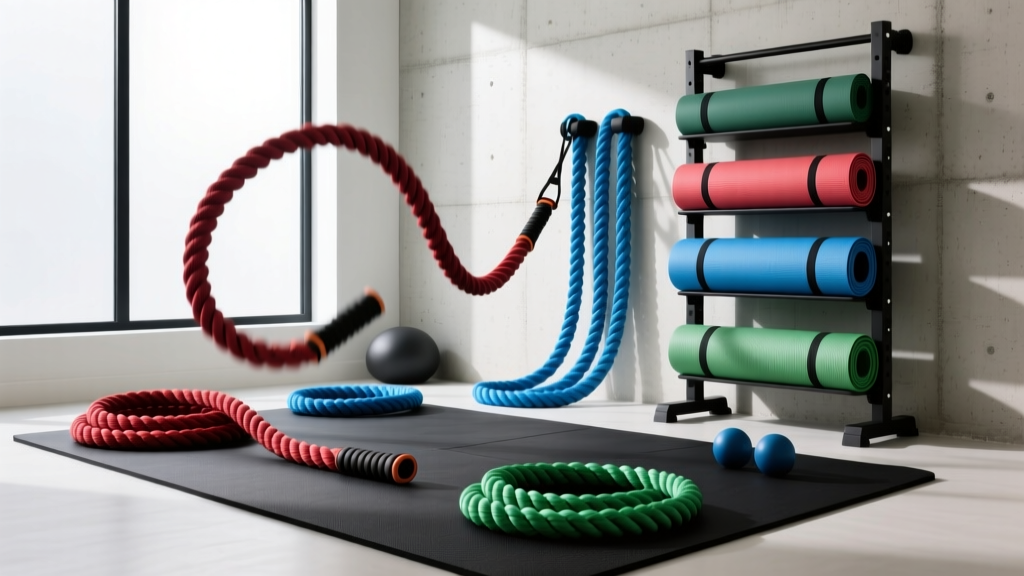
Battle Rope Length & Thickness Guide + Yoga Mat Rack Storage

Pull-Up Assist Band Sizing & Cando Yoga Mat Setup Guide
