Home Gym Layout: Stability Ball vs BOSU & 3mm vs 5mm Yoga Mat
Optimize your home gym layout with our spatial guide comparing stability ball vs BOSU storage and 3mm vs 5mm yoga mat footprint for compact spaces.

The Spatial Dilemma: Large Balance Trainers in Compact Rooms
As urban living spaces shrink and garage conversions become the standard for fitness enthusiasts in 2026, spatial geometry is just as critical as the workout itself. Designing a functional micro-gym requires a ruthless evaluation of every piece of equipment's physical footprint. Nowhere is this more apparent than in the proprioceptive and balance training zone, where bulky, awkwardly shaped tools dominate the floor plan.
When mapping out a compact home gym, you are inevitably forced into a stability ball vs BOSU ball comparison. Both tools offer immense core and stabilizer benefits, but their spatial demands are radically different. Furthermore, the foundational layer of your gym—the matting you choose—dictates both joint health and shelf-space efficiency. Understanding the nuances of the 3mm vs 5mm yoga mat debate from a storage perspective is the secret to a clutter-free training environment.
Stability Ball vs BOSU Ball Comparison: Footprint & Storage Geometry
To optimize your layout, we must look beyond the marketing claims and examine the raw dimensional data of the two most popular balance trainers on the market: the traditional Swiss-style stability ball and the half-dome BOSU trainer.
The Geometry of the Sphere vs. The Hemisphere
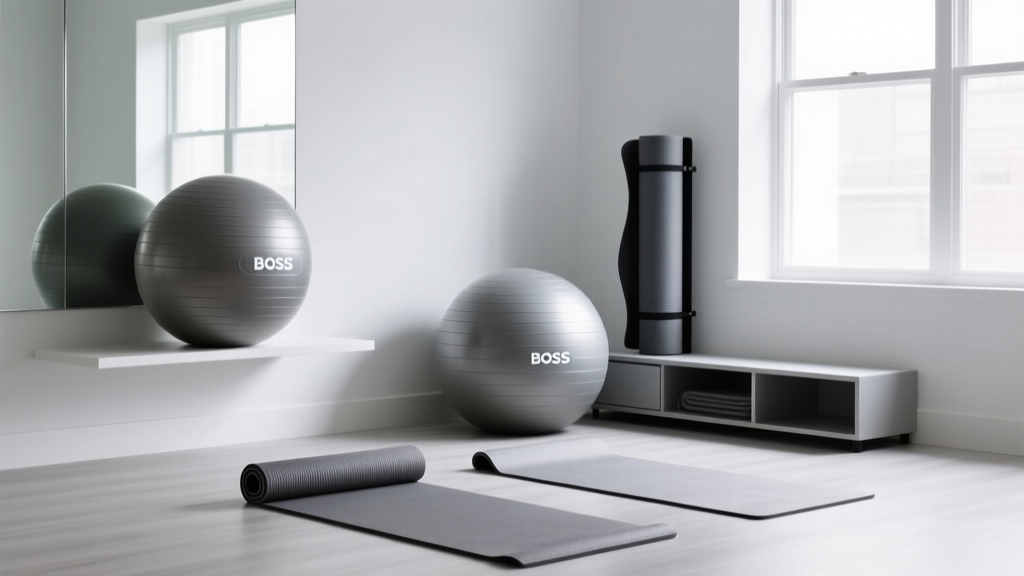
A standard 65cm stability ball (such as the TheraBand Pro Series SCPB, priced around $35) is a perfect sphere. When inflated, it demands a 25.6-inch by 25.6-inch cubic volume. Because it cannot be compressed or stacked, it creates massive "dead space" in a room. You cannot slide it under a standard weight bench, and leaving it in the corner of a 10x10 room eats up nearly 5 square feet of usable walkway.
Conversely, the BOSU NexGen Pro Balance Trainer (retailing at $169) features a 25.5-inch diameter dome mounted on a flat, rigid platform. While its surface area footprint is nearly identical to the stability ball, its vertical profile is only 8.5 inches high when placed dome-up. This asymmetrical design unlocks a massive spatial advantage: under-furniture storage.
Spatial Footprint Matrix
| Equipment Model | Dimensions (D x H) | Storage Volume | Under-Bench Fit? |
|---|---|---|---|
| BOSU NexGen Pro | 25.5" x 8.5" | ~2.5 cu ft | Yes (Flat-side down) |
| TheraBand 65cm Ball | 25.6" x 25.6" | ~8.8 cu ft | No (Requires vertical rack) |
Layout Insight: According to American Council on Exercise (ACE) facility guidelines, dynamic balance training requires a minimum 6-foot clearance radius to prevent injury from falls. If your room is narrower than 12 feet, the BOSU's ability to slide under a 14-inch high weight bench when not in use makes it the undisputed champion of compact room layouts.
Foundational Layers: 3mm vs 5mm Yoga Mat Spatial Impact
Once you have solved the bulky equipment puzzle, you must address the floor layer. The debate between a 3mm vs 5mm yoga mat is usually framed around joint cushioning versus ground-feel stability. However, from a space optimization perspective, the thickness of your mat dictates your storage hardware requirements and shelf-space consumption.
The Roll-Radius Math: Shelf Space Optimization
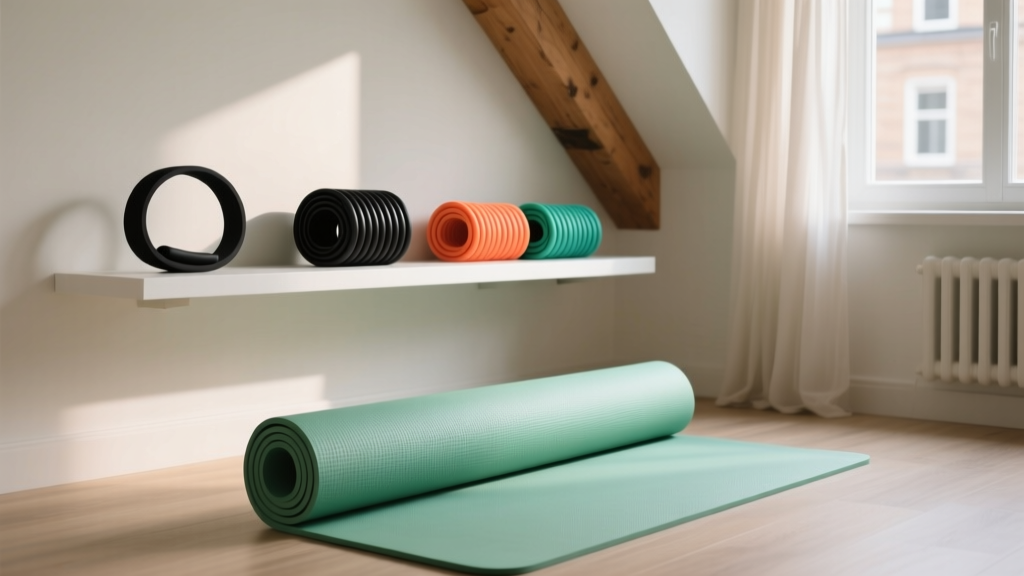
Let us look at the cylinder volume math. When rolled tightly, a standard 68-inch long 3mm mat (like the JadeYoga Harmony 3mm, $84) forms a cylinder roughly 3.5 inches in diameter. A 5mm mat (like the Manduka PROlite, $92) rolls to approximately 5.5 inches in diameter.
- 3mm Mat Storage: Fits perfectly inside standard 4-inch PVC pipe wall holsters or narrow closet shelves. You can stack three 3mm mats in the same vertical space required for one 5mm mat.
- 5mm Mat Storage: Requires heavy-duty, wide-hoop wall hangers (minimum 6-inch clearance) or dedicated 6-inch shelving. Standard tension hooks will fail, causing the mat to unroll and create floor clutter.
Blueprint: Zoning Your 10x10 Home Gym Layout
To harmonize your balance trainers and matting, divide your 100-square-foot space into distinct functional zones. This prevents equipment overlap and maximizes usable square footage.
- Zone A: The Dynamic Perimeter (6x6 ft)
Place your BOSU or Stability Ball here. Keep this zone completely clear of dumbbells or kettlebells. If using a stability ball, install a ceiling-mounted cargo net ($25) to hoist the ball upward when not in use, reclaiming the 8.8 cubic feet of floor space. - Zone B: The Static Core (4x10 ft)
This is your mat zone. If you opted for 3mm mats to save space, lay down interlocking 3/4-inch horse stall mats underneath. This hybrid approach gives you the joint protection of a 20mm+ setup with the tight roll-radius storage of a 3mm travel mat. - Zone C: The Vertical Storage Wall
Dedicate one 10-foot wall to slat-wall panels. Use specialized wide-bracket hooks for your 5mm mats and shallow wire baskets for resistance bands and yoga blocks.
Storage Hardware & Edge Cases
Do not rely on cheap, plastic tension rings to store a 15lb stability ball. Over time, the dynamic shifting of the ball's air pocket will snap standard wall anchors. Always use heavy-duty steel wall cradles rated for at least 50 lbs, anchored directly into wall studs. For BOSU owners, the best space-saving hack is the "flat-side stack." If you own multiple BOSU trainers for family workouts, they can be stacked flat-side to flat-side, creating a stable, space-efficient pillar in the corner of the room.
Frequently Asked Questions
Can I use a 5mm yoga mat on top of a BOSU ball?
It is not recommended. The 5mm thickness creates a micro-shift layer between your foot and the BOSU dome, reducing proprioceptive feedback and increasing the risk of ankle rollovers during single-leg balances. Stick to barefoot or grip-sock training on the dome, and reserve the 5mm mat for Zone B floor work.
Which is better for a studio apartment: Stability Ball or BOSU?
The BOSU NexGen Pro is vastly superior for studio apartments. Its rigid flat base allows it to slide under a sofa or bed (provided you have 9 inches of clearance), whereas a stability ball must remain in the room or be fully deflated, which ruins the lifespan of the PVC material over time.
Final Verdict: Maximizing Usable Square Footage
Designing a compact home gym in 2026 is an exercise in 3D Tetris. By choosing the BOSU over the traditional stability ball, you immediately reclaim critical under-furniture dead space. Pairing this with a strategic approach to the 3mm vs 5mm yoga mat decision—utilizing PVC wall holsters for thinner mats or ceiling hoists for thicker ones—ensures your training space remains open, safe, and primed for performance. According to BOSU official specifications and spatial design principles, respecting the geometry of your equipment is the first step toward building a sustainable, lifelong home fitness habit.
More gear to consider
All reviews
Jump Rope Types Guide: Speed, Beaded, Weighted & Gaiam Yoga Mat
Foam Roller Sizing Guide & How to Clean LifeForm Yoga Mats
Loop Band vs Tube Band & Lululemon Take Form Yoga Mat Budget

Beyond the Pelaton Yoga Mat: Foam Roller Density Mistakes

2026 Pilates Accessory Trends: Market Data & The Light Blue Yoga Mat