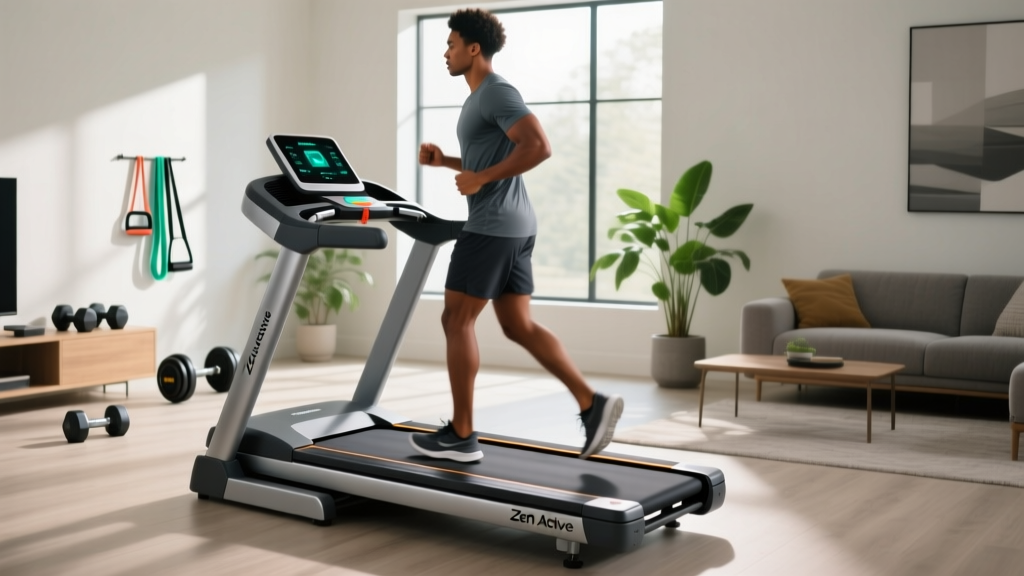
Zen Active Treadmill: 2026 Beginner Feature Comparison Guide
Compare Zen Active treadmill features with our step-by-step beginner buying guide. Learn motor specs, belt sizes, and console tech to make the right choice.

Introduction: Decoding the Zen Active Treadmill
Stepping into the world of home cardio can feel like learning a new language. When you are browsing budget-friendly and compact fitness equipment, the Zen Active treadmill frequently pops up as a top contender. Priced typically between $199 and $279 in 2026, it promises an accessible entry point into daily cardiovascular health. But how do its specifications actually translate to real-world performance when compared to standard entry-level treadmills?
According to the American Heart Association, adults should aim for at least 150 minutes of moderate-intensity aerobic activity per week. A home treadmill is an excellent tool to hit this mark, provided you choose a machine that aligns with your biomechanics and fitness goals. This step-by-step beginner guide will break down the Zen Active's core features, compare them against industry benchmarks, and highlight the exact failure modes and edge cases you need to watch out for.
⚠️ Beginner Warning: The 'Peak HP' TrapMany budget treadmills, including base models of the Zen Active, advertise a '2.0 HP Motor.' Beginners often confuse this with gym-quality power. In reality, this is Peak Horsepower—the maximum output the motor can hit for a few seconds before overheating. What you actually need to look for is Continuous Horsepower (CHP), which is the power the motor can sustain during a 45-minute workout.
Step 1: Evaluating Motor Power and Speed Ceilings
Continuous vs. Peak Horsepower
The standard Zen Active foldable treadmill utilizes a 2.0 HP peak motor, which translates to roughly 1.0 to 1.25 CHP. For context, a premium entry-level treadmill like the Horizon T101 offers a 2.5 CHP motor. What does this mean for your daily routine?
- Walking (2.0 - 4.0 mph): The Zen Active's 1.25 CHP motor handles walking effortlessly for users under 200 lbs. The motor will run cool and quiet.
- Jogging/Running (5.0+ mph): If you plan to run, the motor will draw excessive amperage to keep the belt moving under the impact of your footfalls. Over time, this excess heat degrades the motor windings and can fry the lower control board.
Actionable Advice: If your primary goal is running intervals, the Zen Active is not the right fit. It is engineered specifically for power-walking, light jogging, and under-desk use. Keep your sustained speed under 5.5 mph to maximize the motor's lifespan.
Step 2: Belt Dimensions and Biomechanical Realities
One of the most critical—yet overlooked—features in any treadmill buying guide is the running surface. The Zen Active features a compact belt measuring approximately 40 inches long by 16 inches wide. Let us compare this to the industry standard for full-size home treadmills, which is 55 inches by 20 inches.
The 'Tightrope' Effect
A 16-inch width requires a highly deliberate walking gait. You cannot let your arms swing naturally or allow your feet to drift laterally. According to physical therapy frameworks, walking on a narrow surface can alter your natural pelvic rotation and increase friction on the IT (iliotibial) band. If you are taller than 5'9", the 40-inch length means your stride will naturally exceed the belt during a brisk walk, forcing you to unconsciously shorten your steps, which can lead to shin splints over time.
"When using compact treadmills, focus on posture. Keep your gaze forward, not down at the console, and actively engage your core to maintain a centered stride on narrower belts."
Step 3: Feature Comparison Matrix
To give you a clear picture of where the Zen Active stands in the 2026 market, here is a direct feature comparison against a standard entry-level full-size treadmill and a commercial gym model.
| Feature | Zen Active (Compact) | Standard Entry-Level (e.g., Horizon) | Commercial Gym Treadmill |
|---|---|---|---|
| Motor (CHP) | ~1.25 CHP (2.0 Peak) | 2.5 - 2.75 CHP | 4.0+ CHP (AC Motor) |
| Belt Size | 40" x 16" | 55" x 20" | 60" x 22" |
| Max User Weight | 220 - 240 lbs | 300 - 325 lbs | 350 - 400 lbs |
| Incline | Fixed 0% or Manual 3% | 0% - 10% Auto | -3% to 15% Auto |
| Shock Absorption | Basic Elastomer Pucks | Multi-Zone Cushioning | Orthopedic Belt + Flex Deck |
| Price Range (2026) | $199 - $279 | $599 - $899 | $3,500+ |
Step 4: Incline, Shock Absorption, and Joint Health
The Centers for Disease Control and Prevention (CDC) emphasizes that consistent, moderate aerobic activity is vital for long-term cardiovascular and joint health. However, the impact forces generated by walking or running must be managed.
Shock Absorption Mechanics
The Zen Active relies on four small elastomer rubber pucks placed between the deck and the frame. This provides a marginal reduction in impact compared to walking on concrete, but it lacks the variable-durometer cushioning found in pricier models. If you have pre-existing knee or lower back issues, you must wear high-quality, thick-soled running shoes (like Hoka or Brooks) to compensate for the deck's firmness.
The Incline Limitation
Most Zen Active models feature a fixed flat deck or a manual pin-adjust incline of roughly 3%. You cannot adjust the incline mid-workout. If your fitness regimen relies on heart-rate zone training via incline walking (e.g., the popular '12-3-30' workout), the Zen Active will limit your progression, as you cannot achieve the 12% grade required for high-calorie-burn, low-impact routines.
Step 5: Console Technology and App Integration
In 2026, smart connectivity is a standard expectation. The Zen Active console is decidedly analog-basic. It features an LCD screen displaying time, speed, distance, and estimated calories. While some newer iterations include basic Bluetooth data transmission, it does not natively support FTMS (Fitness Machine Service) protocols required to control resistance/speed in apps like Zwift or Kinomap.
The Workaround: To track your workouts accurately, bypass the Zen Active's console entirely. Use an Apple Watch, Garmin, or a dedicated chest strap heart rate monitor, and log your sessions in Apple Health or Stride. The calorie estimates on budget treadmill consoles are notoriously inaccurate, often overestimating burn by up to 25% because they use generic weight-to-speed algorithms rather than actual biometric data.
Step 6: Maintenance and Avoiding Common Failure Modes
The number one reason budget treadmills end up in landfills is not motor failure—it is lower control board burnout caused by belt friction. When the walking belt dries out, the friction coefficient increases. The motor draws more amps to pull the belt, and the resulting electrical surge melts the MOSFETs on the control board. Replacing this board costs between $60 and $90, often negating the budget savings of the machine.
Step-by-Step Maintenance Protocol
- Check Belt Tension Monthly: Reach under the center of the belt and lift. It should rise exactly 2 to 3 inches off the deck. If it is tighter, use the included Allen wrench to loosen the rear roller bolts by a quarter-turn.
- Lubricate Every 45 Days: Purchase a bottle of 100% pure silicone treadmill lubricant (avoid petroleum-based products like WD-40, which will destroy the PVC belt). Apply exactly 10ml of silicone in a zig-zag pattern under the center of the belt.
- Run the Distribution Cycle: Turn the treadmill on to 3.0 mph and let it run empty for 3 minutes. This spreads the silicone evenly across the deck.
- Keep the Motor Hood Clean: Vacuum the front motor hood every 3 months. Dust acts as an insulator, trapping heat inside the motor casing and accelerating winding degradation.
Final Verdict: Who is the Zen Active For?
The Zen Active treadmill is an excellent, space-saving solution for apartment dwellers, remote workers wanting an under-desk walking pad, and beginners whose sole focus is daily low-impact walking. Its sub-$300 price point and foldable footprint make it highly accessible. However, if you are a dedicated runner, weigh over 230 lbs, or want to perform high-incline interval training, you will quickly outgrow its 1.25 CHP motor and 16-inch belt. By understanding these exact feature boundaries and maintaining the belt rigorously, you can extract years of reliable, heart-healthy cardio from this compact machine.
More gear to consider
All reviews
Beyond Treadmill Memes: Stair Climber Home Guide
Curved vs Motorized: Cardio Load & Treadmill Stress Test Cost

ProForm Crosswalk 400e Treadmill & Cardio Machine Noise Comparison

Curved Self Propelled Treadmill Buying Guide & Comparison 2026
Escaping the Hedonistic Treadmill: Motor Size & HP Guide
