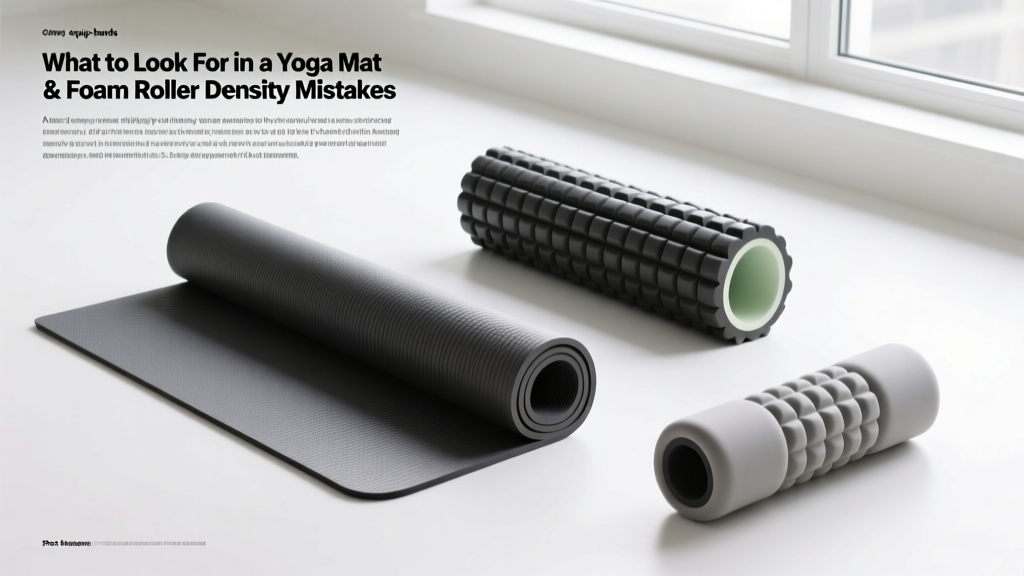
What to Look for in a Yoga Mat & Foam Roller Density Mistakes
Discover what to look for in a yoga mat vs. recovery gear. Avoid common foam roller density and size mistakes with our 2026 troubleshooting guide.

The Recovery Gear Blindspot: Beyond the Yoga Mat
When outfitting a home gym or studio, most fitness enthusiasts spend hours researching what to look for in a yoga mat—weighing TPE versus natural rubber, analyzing 4mm versus 6mm thickness, and testing dry-grip textures for hot yoga. Yet, when it comes to myofascial recovery gear, those same buyers often blindly grab the cheapest foam cylinder on the shelf. This discrepancy leads to ineffective recovery, wasted money, and in severe cases, nerve compression or bruised tissue.
While understanding yoga mat traction and joint cushioning is vital for your practice, your recovery routine demands equal precision. Self-myofascial release (SMR) is a biomechanical intervention, not just a passive stretch. In this 2026 troubleshooting guide, we dissect the most common mistakes buyers make regarding foam roller density, material composition, and dimensional sizing—and how to fix your current setup.
Mistake #1: Misjudging Density and Material Composition
The most frequent error in recovery gear selection is assuming all foam rollers provide the same tissue deformation. Density is measured in kilograms per cubic meter (kg/m³) and Shore A hardness. Using a roller that is too soft results in 'bottoming out,' where the foam compresses entirely before reaching the fascial threshold required to trigger autogenic inhibition via the Golgi tendon organ. Conversely, using a roller that is too hard for your tissue tolerance can cause localized bruising and defensive muscle guarding.
The Material Breakdown
| Material Core | Density (kg/m³) | Shore Hardness | Best Use Case | Avg. Price (2026) |
|---|---|---|---|---|
| Soft EVA Foam | 30 - 40 | 25A - 35A | Pilates, Rehab, Beginners | $25 - $45 |
| EPP (Expanded Polypropylene) | 45 - 60 | 40A - 50A | Daily SMR, Athletes, General Use | $20 - $35 |
| ABS Core + EVA Shell | 60+ (Core) | 55A+ | Deep Tissue, Heavy Lifters | $45 - $75 |
| Solid Polyurethane | 80+ | 60A+ | Extreme Trigger Point, Calves | $60 - $90 |
According to guidelines published by the National Academy of Sports Medicine (NASM), effective SMR requires sustained pressure on trigger points for 30 to 60 seconds. If you are using a soft EVA roller (like the standard white rollers found in big-box stores) and weigh over 170 lbs, your body weight will flatten the foam, rendering the 60-second hold useless. For heavier athletes or those with dense muscle bellies, an ABS-cored roller like the TriggerPoint GRID X ($55) or a high-density EPP roller is mandatory to achieve actual tissue deformation.
Mistake #2: Sizing Errors Based on Anatomy and Intent
Foam rollers generally come in three primary sizes: 36x6 inches, 18x6 inches, and 12x4 inches (or smaller). The mistake lies in buying a single size for all applications, or worse, buying a 36-inch roller for targeted trigger point work.
The 36-Inch Myth: Many beginners buy a 36-inch roller thinking 'bigger is better.' While a 36x6 inch roller (such as the OPTP PRO-ROLLER Standard, $42) is exceptional for full thoracic spine extensions, vertical lat sweeps, and Pilates alignment work, it is incredibly cumbersome for targeting the IT band, calves, or glutes. Furthermore, storing a 36-inch roller in a standard apartment gym or bedroom is a spatial nightmare.
Dimensional Troubleshooting Guide
- 36' x 6' (Full Length): Strictly for spinal extension, postural correction, and broad fascial sweeping. Do not use for deep, localized limb work.
- 13' to 18' x 5.5' (Mid-Size): The versatile sweet spot. Perfect for quads, hamstrings, lats, and travel. The TriggerPoint GRID 13' ($35) remains the industry benchmark here due to its multi-density EVA zoning.
- 12' x 4' or Smaller (Targeted): Necessary for navigating around bony prominences, targeting the TFL (tensor fasciae latae), or working the suboccipital muscles at the base of the skull.
Mistake #3: Texture and Vibration Overkill
In 2026, the market is flooded with aggressively textured rollers (like the RumbleRoller, $75) and high-frequency vibrating rollers (like the Hyperice Vyper 3, $229). The mistake? Using these advanced tools on acute muscle soreness or superficial nerves.
Research indexed by the National Center for Biotechnology Information (NCBI) demonstrates that while vibration can temporarily alter pain perception via the gate control theory of pain, it does not necessarily 'break up' scar tissue. Aggressive knobs on a textured roller can cause micro-trauma to already inflamed muscle fibers. If you are experiencing DOMS (Delayed Onset Muscle Soreness) within 24 hours of a heavy eccentric loading session, a smooth, medium-density EPP roller is vastly superior to a hard, knobby roller, which will only exacerbate the inflammatory response.
⚠️ Troubleshooting Warning: The IT Band FallacyNever roll directly over the lateral femoral epicondyle (the bony protrusion on the outside of the knee) or the greater trochanter (hip bone). The IT band is a thick fascial sheet, not a muscle; compressing it against bone with a high-density roller causes severe bursitis and nerve impingement. Instead, target the TFL and gluteus medius muscles that pull on the IT band.
Troubleshooting Your Current Setup: A Step-by-Step Diagnostic
If you are currently experiencing pain, lack of progress, or discomfort during your SMR routine, run through this diagnostic checklist to identify your equipment failure.
- The 'Bottom Out' Test: Lie on your roller and target a dense muscle group (like the mid-thigh). If the foam compresses to less than half its original diameter and you feel the hard floor beneath it, your roller's density is too low. Fix: Upgrade from soft EVA to EPP or an ABS-core model.
- The Bruising Check: Inspect your skin after rolling your calves or lats. If you see petechiae (small red/purple dots) or deep bruising, your roller is too hard, or you are spending too much time on one localized capillary bed. Fix: Downgrade to a medium-density EPP roller and limit localized holds to 45 seconds.
- The Nerve Tingling Audit: If rolling your glutes or outer thigh results in a 'falling asleep' sensation or sharp electrical tingling down the leg, you are compressing the sciatic or lateral femoral cutaneous nerve against a hard surface. Fix: Switch to a softer, larger diameter (6-inch) roller to distribute the load, or switch to a pneumatic massage ball.
- The Spinal Alignment Check: When performing thoracic extensions, does your lower back (lumbar spine) hyperextend and pinch? Fix: You are likely using a roller that is too large in diameter (over 6 inches) or placing it too low on the spine. Keep the roller strictly above the T12 vertebra.
Final Verdict on Recovery Gear Selection
Just as you wouldn't use a thin, slippery PVC mat for a vigorous Ashtanga practice, you shouldn't use a soft, low-density foam tube for heavy myofascial release. The American Council on Exercise (ACE) consistently advises matching the tool's firmness to the user's tissue tolerance and specific recovery goals. By understanding the exact metrics of density, respecting anatomical boundaries, and choosing the correct dimensions for your target muscles, you can transform your foam roller from a dusty closet accessory into a precision recovery instrument.
More gear to consider
All reviews
Medicine Ball Weight Selection Guide: Stackable Yoga Mat Fixes
Why Experts Recommend Yoga Mat Grounding: Stability Ball vs BOSU Care
Equip Cardio Essentials Comparison: Treadmill, Bike, and Rower — Real-World Performance, Space, and Value Analysis

Stability Ball vs BOSU Ball: Core Workouts & Slippery Yoga Mat Fix

Speed vs Weighted Jump Ropes & Backpack Yoga Mat Holder Guide