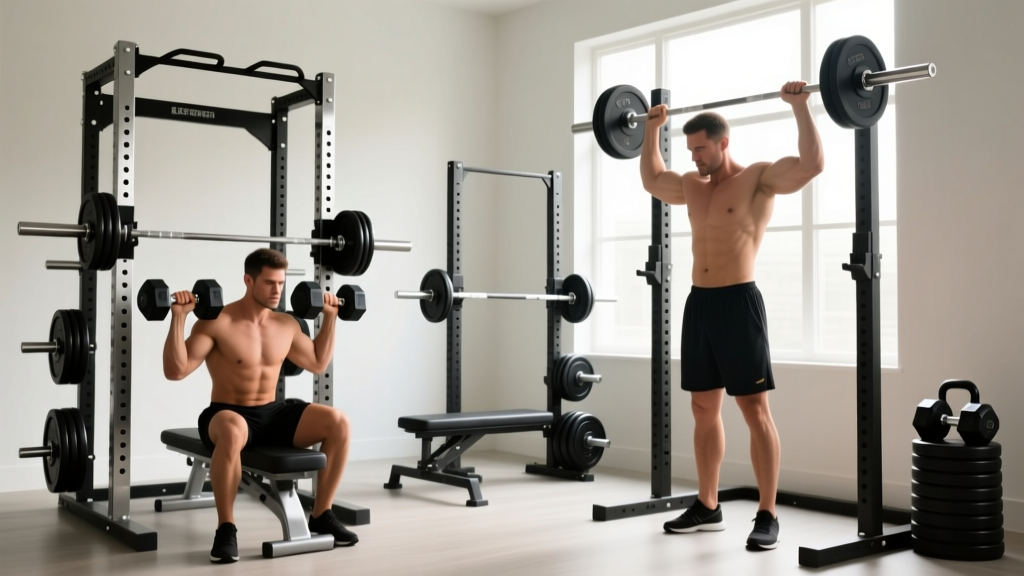
What Muscles Do Incline Dumbbell Press Work? & Barbell Collar Types Compared
Discover what muscles do incline dumbbell press work, then master gym safety with our beginner's step-by-step comparison of barbell collar and clamp types.

Welcome to the Free Weight Section: Anatomy Meets Equipment Safety
Starting your free-weight journey in 2026 can feel overwhelming. You are likely juggling two distinct learning curves simultaneously: understanding human biomechanics and mastering the physical gear required to train safely. Beginners often ask highly specific exercise questions while overlooking the critical safety equipment that keeps them alive in the squat rack. This guide bridges that gap. First, we will answer a fundamental hypertrophy question, then we will transition into a comprehensive, step-by-step comparison of barbell collars and clamps to ensure your home or garage gym is up to modern safety standards.
First Things First: What Muscles Do Incline Dumbbell Press Work?
Before you load up a barbell or grab a pair of hex dumbbells, you need to understand the anatomical targets of your chosen movements. The incline dumbbell press is a staple for upper-body development, but it requires precise bench angling to hit the right tissues.
- Clavicular Head of the Pectoralis Major (Upper Chest): This is the primary mover. According to ExRx.net's biomechanical database, setting the bench between a 30 and 45-degree angle maximizes clavicular fiber recruitment without excessively shifting the load to the shoulders.
- Anterior Deltoids (Front Shoulders): These act as powerful synergists. If your bench is set too high (above 45 degrees), the anterior deltoids will take over, turning a chest exercise into a shoulder press.
- Triceps Brachii: The triceps act as secondary synergists, responsible for the terminal lockout phase of the elbow extension.
- Stabilizers (Rotator Cuff & Serratus Anterior): Unlike a barbell, dumbbells require each arm to work independently, forcing the stabilizing muscles of the shoulder girdle to work overtime to prevent the weights from drifting outward.
Beginner Pro-Tip: When performing the incline dumbbell press, tuck your elbows slightly at a 45-degree angle to your torso. Flaring them out to 90 degrees places immense, unnecessary shear stress on the AC joint and rotator cuff.
Transitioning to the Barbell: Why Securing Your Plates is Non-Negotiable
Once you master dumbbell movements, you will inevitably move to the barbell for progressive overload. This is where equipment safety becomes paramount. The Mayo Clinic's guidelines on weight training safety heavily emphasize the importance of securing equipment to prevent catastrophic shifting of mass. A 45-pound iron plate sliding off one side of a barbell during a bench press or deadlift creates an immediate, violent asymmetrical load that can result in severe spinal, shoulder, or facial injuries.
To prevent this, you must use barbell collars. But not all collars are created equal. Let's break down the types available on the market today.
The Ultimate Barbell Collar and Clamp Types Comparison
Choosing the right collar depends on your budget, your barbell's sleeve tolerance, and the type of lifting you do. Here is the step-by-step breakdown of the four main categories.
1. Traditional Spring Collars
The classic wire spring collar is what you will find in most commercial gyms. They consist of a coiled steel spring with two handles that you squeeze to expand the inner diameter.
- Material: Zinc-plated steel wire.
- Price Range: $8 - $15 per pair.
- The Verdict: While cheap, they are not recommended for heavy or dynamic lifting. Over time, the metal fatigues, losing its outward tension. Furthermore, they fail to grip the sleeve tightly enough to prevent plates from sliding during high-impact drops.
2. Clamp / Lock-Jaw Collars
Clamp collars use a lever-action or squeeze-handle mechanism to tighten a rigid band around the barbell sleeve. Models like the Rogue HG 2.0 or Harbinger BioFit are industry standards.
- Material: Glass-reinforced nylon resin or extruded aerospace aluminum.
- Price Range: $25 - $45 per pair.
- The Verdict: The absolute best choice for 90% of lifters. The glass-reinforced nylon provides immense grip force (often exceeding 150 lbs of lateral resistance) without scratching the barbell's zinc or cerakote finish. They are quick to apply and remove.
3. Spinlock / Threaded Collars
These are heavy metal rings with internal threading that screw onto the grooved ends of a barbell. They are mostly found on cheap, standard 1-inch diameter bars, though some specialized Olympic deadlift bars use heavy-duty spinlocks.
- Material: Cast iron or chrome-plated steel.
- Price Range: $15 - $30 per pair.
- The Verdict: Extremely secure, but incredibly slow to use. If you are doing supersets or drop sets, the 30 seconds it takes to thread these on and off will ruin your workout density. Avoid these unless you are using a dedicated, threaded deadlift bar.
4. Lever / Quick-Release Competition Collars
Used in IPF powerlifting and IWF weightlifting competitions, these collars (like the Eleiko Olympic Competition Collars) use a heavy-duty steel lever and precision-machined pins to lock onto the sleeve.
- Material: Anodized aluminum with hardened steel locking pins.
- Price Range: $65 - $95 per pair.
- The Verdict: Overkill for most beginners, but unparalleled for competitive lifters who drop 500+ lb deadlifts or perform explosive Olympic cleans. They weigh exactly 2.5 kg each, which is factored into competition totals.
Comparison Matrix: Finding Your Perfect Fit
| Collar Type | Material | Grip Force / Security | Application Speed | 2026 Avg. Price | Best For |
|---|---|---|---|---|---|
| Spring | Steel Wire | Low (Degrades over time) | Fast | $12 | Light accessory work |
| Clamp (Resin) | Glass-Filled Nylon | High (~150+ lbs lateral) | Very Fast | $35 | General strength & hypertrophy |
| Spinlock | Cast Iron | Maximum (Threaded) | Very Slow | $25 | Standard 1" home bars |
| Lever / Comp | Aluminum / Steel | Maximum (Pin-locked) | Fast | $85 | Heavy drops & competition |
Step-by-Step: How to Properly Secure an Olympic Barbell
Even the best clamp collar will fail if applied incorrectly. Follow this beginner-friendly checklist every time you load the bar:
- Load the Plates Symmetrically: Always load the same weight on both sides simultaneously to prevent the bar from tipping off the J-cups.
- Wipe the Sleeve: Use a microfiber cloth to wipe away chalk, sweat, or oil from the barbell sleeve. A slippery sleeve drastically reduces the friction coefficient of your collar.
- Push Plates Flush: Ensure all bumper or iron plates are pushed completely flush against the barbell's inner shoulder. No gaps.
- Apply the Collar Flush: Slide your clamp collar directly against the outermost plate. Do not leave a half-inch gap between the plate and the collar.
- Engage the Lock: Squeeze the handles or pull the lever until you hear/feel the secondary locking mechanism click into place.
- The 'Tilt Test': Before lifting, slightly tilt the barbell upward on one side. If the plates shift even a millimeter, re-tighten the collar.
Real-World Edge Cases & Failure Modes
As you advance in your training, you will encounter edge cases that cheap gear simply cannot handle. Here is what you need to watch out for:
The 'Bar Whip' Effect
When lifting heavy deadlifts (315+ lbs), the steel shaft of an Olympic barbell bends and violently snaps back—a phenomenon known as 'bar whip'. This harmonic vibration travels down the sleeves. Traditional spring collars will literally vibrate and walk themselves off the sleeve during a heavy pull. Clamp collars with high-friction resin pads absorb this vibration and stay locked.
Sleeve Tolerance Discrepancies
An official Olympic barbell sleeve is exactly 50mm in diameter. However, budget bars manufactured overseas often have sleeves that measure 49.2mm or 49.5mm. If you buy rigid aluminum lever collars machined exactly to 50mm, they will slide right off a budget bar. Solution: Beginners using budget bars should always buy glass-reinforced nylon clamp collars, as the flexible resin conforms to slightly undersized sleeves.
Urethane vs. Cast Iron Friction
Urethane bumper plates have a high-friction rubberized hub that grips the steel sleeve naturally. Cast iron plates, however, are metal-on-metal. If you are doing incline bench presses with cast iron plates, the lateral tilt of the bar at the bottom of the movement can cause iron plates to slide if your collar grip force is inadequate. Always use high-tension clamp collars when lifting with bare iron.
Final Thoughts
Understanding what muscles do incline dumbbell press work is only half the battle; executing the movement safely with properly secured equipment is what ensures longevity in the iron game. Ditch the rusty spring collars, invest $35 in a high-quality pair of resin clamp collars, and focus your mental energy on progressive overload rather than worrying about a 45-pound plate sliding off your bar mid-rep.
More gear to consider
All reviews
Barbell or Dumbbell Bicep Curls: Neoprene Mistakes & Fixes

Cast Iron vs Competition Bells & CrossFit Workouts with Dumbbells

Space-Saving Rack Layouts for Light Dumbbells & Storage

Bowflex 1090 Dumbbells vs PowerBlock: 2026 Heavy-Duty Comparison

Barbell Collar and Clamp Types Comparison & Arm Blaster Dumbbell Curls