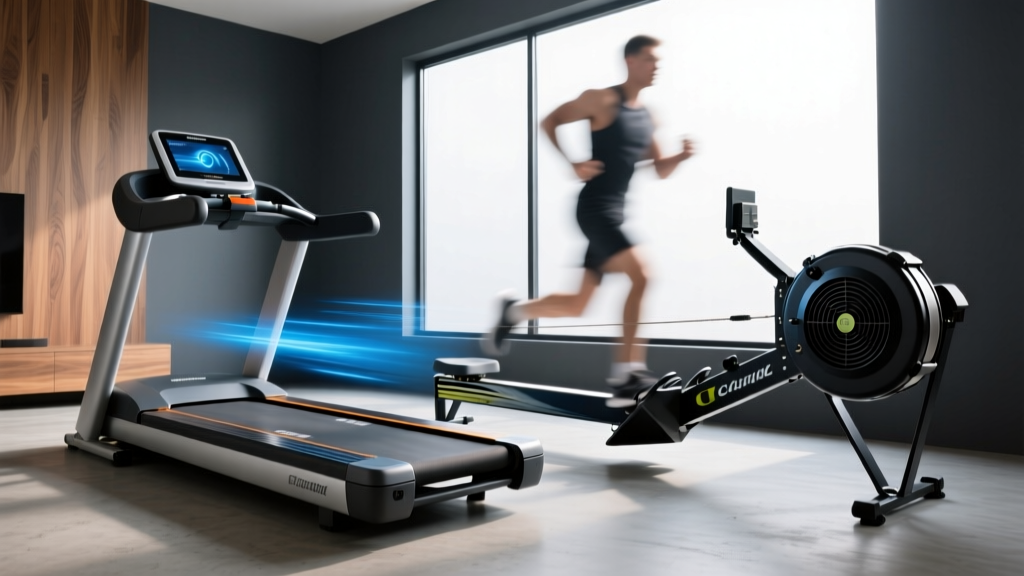
Walking Pads vs. Standard Treadmill Types: 2026 Comparison
Compare walking pads and standard treadmill types in our 2026 head-to-head review. Find the best fit for your home gym, budget, and fitness goals.

The Great Home Gym Debate: Compact vs. Traditional
As remote work and hybrid schedules continue to dominate in 2026, the demand for under-desk fitness solutions has skyrocketed. However, when consumers begin researching treadmill types, they are immediately confronted by a massive divide in the market: ultra-compact walking pads versus traditional, full-sized treadmills. While both machines serve the fundamental purpose of indoor cardiovascular exercise, their engineering, biomechanical impact, and long-term durability are worlds apart.
In this head-to-head comparison, we strip away the marketing jargon to evaluate the mechanical realities of walking pads (like the KingSmith X21 and UREVO Strol 2E) against standard treadmill types (such as the Sole F80 and Horizon 7.0S). Whether you are trying to sneak in 10,000 steps during a Zoom call or training for a sub-4-hour marathon, understanding the structural limitations and advantages of these treadmill types is critical before dropping hundreds—or thousands—of dollars.
Expert Insight: The most common mistake buyers make is confusing 'Peak Horsepower' with 'Continuous Duty Horsepower' (CHP). Walking pads often advertise 3.0 HP, but this is a peak measurement. The actual continuous motor output is usually between 1.0 and 1.5 CHP, which is insufficient for sustained running. Standard treadmill types accurately advertise 3.0 to 4.0 CHP.Head-to-Head Comparison Matrix
Before diving into the nuanced failure modes and biomechanics, let us look at the raw specifications that separate these two distinct treadmill types.
| Feature | Walking Pads (e.g., KingSmith X21) | Standard Treadmill Types (e.g., Sole F80) |
|---|---|---|
| Price Range (2026) | $249 - $699 | $799 - $2,500+ |
| Motor (Continuous Duty) | 1.0 - 1.75 CHP | 3.0 - 4.0 CHP |
| Max Speed | 6.0 - 7.6 MPH | 12.0 - 15.0 MPH |
| Belt Dimensions (W x L) | 15.7' x 43' to 17.5' x 47' | 20' x 55' to 22' x 60' |
| Weight Capacity | 220 - 265 lbs | 325 - 400 lbs |
| Incline Capability | None or Manual 3-5% | Power Incline 10-15% |
| Footprint & Storage | Slides under bed/couch (5' tall) | Folds vertically (requires 8' ceiling) |
Deep Dive: Walking Pads
Walking pads revolutionized the fitness industry by eliminating the console, handrails, and heavy steel uprights. Models like the UREVO Strol 2E (priced around $279) and the premium KingSmith WalkingPad X21 ($599) utilize a minimalist aluminum or high-density plastic frame wrapped around a continuous loop belt.
The Pros
- Unmatched Spatial Efficiency: A standard walking pad weighs between 60 and 85 pounds and measures roughly 55 inches long by 25 inches wide when folded. They easily slide under a standard 6-inch clearance sofa.
- Frictionless Workflow Integration: Because they lack towering consoles, they integrate seamlessly under standing desks. According to the Mayo Clinic, breaking up sedentary time with light walking significantly improves cardiovascular markers and glycemic control.
- Plug-and-Play Assembly: They arrive 95% pre-assembled, requiring only the unfolding of the handrail (if applicable) and plugging into a standard 120V outlet.
The Cons & Edge-Case Failures
- Belt Tracking Nightmares: Because walking pads use smaller diameter front and rear rollers (often under 2 inches), the belt is highly susceptible to drifting. Unlike standard treadmill types, many walking pads lack accessible tensioning bolts, meaning a slipped belt often requires manufacturer intervention or voids the warranty if manually adjusted.
- Thermal Throttling: If a 210 lb user attempts to jog at 6.0 MPH on a 1.25 CHP walking pad motor, the internal thermal sensor will frequently trip, shutting the machine down after 30-45 minutes to prevent a fire hazard.
- Stride Length Restriction: A 43-inch belt length forces users with a height over 5'9' to artificially shorten their stride, which can lead to hip flexor tightness and altered gait mechanics over time.
Deep Dive: Standard Treadmill Types
When fitness enthusiasts refer to traditional treadmill types, they are generally talking about motorized, full-deck treadmills with upright consoles, handrails, and shock-absorption systems. The Sole F80 ($999) and the Horizon 7.0S ($899) remain the gold standards in the 2026 mid-tier market.
The Pros
- Biomechanical Freedom: A 20-inch by 60-inch running surface accommodates the natural stride length of runners up to 6'4'. This allows for proper heel-to-toe transition without the subconscious fear of stepping off the rear roller.
- Heavy-Duty Durability: Standard treadmill types feature 3.0+ CHP motors with massive flywheels and large 3-inch rollers. These components dissipate heat efficiently, allowing for 2-hour marathon training blocks without thermal throttling.
- Dynamic Resistance: Power inclines up to 15% allow for targeted glute and hamstring activation, simulating hill climbs that walking pads simply cannot replicate.
The Cons & Edge-Case Failures
- Console Electronics Failure: The most common point of failure in modern standard treadmill types is not the motor, but the HD touchscreen console. Power surges or capacitor degradation on the main control board can render a $2,000 machine useless, often requiring a $400+ replacement part.
- Acoustic and Vibration Transfer: A 3.5 CHP motor combined with the impact of a 180 lb runner generates significant low-frequency vibrations. Without an specialized anti-vibration mat, this noise easily transfers through floor joists to rooms below.
- Permanent Spatial Commitment: Even when folded, a standard treadmill commands a 30-inch by 40-inch footprint and requires an 8-foot ceiling clearance to stand upright.
The Biomechanics Factor: Joint Impact and Gait
Choosing between these treadmill types is not just about space; it is about joint health. Walking pads typically utilize a thin, high-density MDF deck with minimal elastomer cushioning. While this provides a firm surface for walking, it offers zero shock absorption for running. The American Council on Exercise (ACE) emphasizes that proper footwear and surface shock absorption are critical to preventing repetitive stress injuries in the lower extremities.
Standard treadmill types feature multi-zone cushioning systems (like Sole's Cushion Flex or Horizon's Variable Response Cushioning). These decks are engineered to be softer at the strike zone to absorb impact, and firmer at the toe-off zone to provide energy return. If you have a history of plantar fasciitis, shin splints, or knee osteoarthritis, standard treadmill types are a non-negotiable requirement for anything beyond a casual 3.0 MPH stroll.
'Attempting to run on a non-cushioned walking pad alters your natural ground reaction forces. Users tend to adopt a heavier heel-strike to maintain balance on the narrow belt, which increases the shock wave traveling up the tibia by up to 18% compared to a properly cushioned full-sized deck.' — Sports Biomechanics Analysis, 2025.
Maintenance Showdown: What Breaks First?
Understanding the maintenance requirements of these treadmill types will save you hundreds of dollars in repair fees over a 5-year ownership cycle.
Walking Pad Maintenance
- Silicone Lubrication: Because the deck is so thin and heat dissipation is poor, walking pads require 100% silicone lubrication every 30-45 miles. Failure to do so will cause the belt to fuse to the MDF deck, instantly burning out the motor control board.
- Debris Ingestion: Lacking a raised motor hood, walking pads easily suck in pet hair and dust bunnies from the floor directly into the rear roller bearings, leading to a high-pitched whining noise and eventual bearing seizure.
Standard Treadmill Maintenance
- Belt Tensioning: Standard belts stretch over the first 50 miles. You will need to use a 6mm Allen wrench to adjust the rear roller bolts a quarter-turn clockwise to prevent the belt from slipping under heavy footfalls.
- Incline Motor Calibration: If your treadmill is moved across an uneven floor, the incline zero-point sensor can become miscalibrated, causing the deck to tilt slightly to one side. This requires a manual recalibration via the console's engineering menu.
The Final Verdict: Which Treadmill Type Should You Buy?
There is no universal 'best' option among these treadmill types; there is only the right tool for your specific lifestyle parameters.
Buy a Walking Pad If:
- You live in an apartment under 800 sq ft.
- Your primary goal is achieving 8,000-10,000 daily steps while working from home.
- You weigh under 220 lbs and have no intention of running faster than 6.0 MPH.
- Your budget is strictly capped at $500.
Buy Standard Treadmill Types If:
- You are training for 5K, 10K, or marathon events requiring sustained running.
- You require incline training for hiking prep or glute hypertrophy.
- You are over 6 feet tall and require a 55'+ belt length for a natural stride.
- You have joint sensitivities requiring advanced deck shock absorption.
Ultimately, walking pads are phenomenal tools for combating sedentary behavior and increasing Non-Exercise Activity Thermogenesis (NEAT). However, if your goal is progressive cardiovascular overload, high-intensity interval training (HIIT), or serious running, you must invest in the structural integrity and biomechanical safety provided by standard treadmill types. Assess your spatial constraints, define your fitness ceiling, and choose the machine that will actually get used in 2026 and beyond.
More gear to consider
All reviews
Merit Fitness 715T Plus Treadmill Setup & Noise Comparison

Under Desk Treadmill Office Review: Why My NordicTrack Treadmill Won't Turn On

Treadmill Setup: The 'Father Forced Son to Run on Treadmill' Risks

How to Lower a ProForm Treadmill: Fixes & Walking Pad Comparisons

Elliptical vs Treadmill: WalkingPad R3 Hybrid Foldable Treadmill