Walking Pad Reviews & How to Tighten Belt on NordicTrack Treadmill
Compare top 2026 walking pads vs standard treadmills. Includes a beginner-friendly step-by-step guide on how to tighten the belt on a NordicTrack treadmill.

The home fitness landscape in 2026 has firmly bifurcated into two distinct camps: the ultra-compact, under-desk walking pads designed for continuous low-intensity movement, and the robust, traditional treadmills built for dedicated, high-intensity cardio sessions. According to the Centers for Disease Control and Prevention (CDC), integrating consistent daily movement is critical for long-term cardiovascular health, which explains the massive surge in walking pad popularity for home offices. However, many fitness enthusiasts eventually find themselves managing a hybrid setup—using a walking pad for work hours and a full-sized machine like the NordicTrack T-Series for evening runs.
This comprehensive walking pad treadmill comparison and review will help you decide which machine fits your primary lifestyle needs. Furthermore, because traditional treadmills require periodic maintenance that walking pads generally avoid, we have included a detailed, beginner-friendly tutorial on how to tighten belt on NordicTrack treadmill models to keep your primary cardio machine running flawlessly.
Walking Pad vs. Traditional Treadmill: 2026 Comparison Matrix
Before diving into specific model reviews, it is essential to understand the mechanical and spatial differences between these two categories. The Physical Activity Guidelines for Americans emphasize that any amount of movement counts toward your daily goals, but the intensity and ergonomics vary wildly between machine types.
| Feature | Under-Desk Walking Pads | Traditional Treadmills (e.g., NordicTrack) |
|---|---|---|
| Top Speed | 4.0 to 7.5 MPH | 10.0 to 12.0 MPH |
| Incline Capability | Rarely (Fixed 0-3%) | Standard (0-15% Auto-Incline) |
| Belt Dimensions | 40" x 16" (Shorter stride) | 55" x 20"+ (Full running stride) |
| Maintenance Needs | Low (Sealed belts, small motors) | Moderate (Belt tensioning, lubrication) |
| Average 2026 Price | $199 - $499 | $399 - $899+ |
Top Walking Pad Treadmill Reviews for Home Offices
1. KingSmith WalkingPad R2 (2026 Edition)
Price: $499 | Motor: 2.5 HP | Top Speed: 7.5 MPH (with handle up)
The WalkingPad R2 remains the gold standard for premium under-desk treadmills. Its patented 180-degree folding mechanism allows it to slide under a bed or stand vertically in a closet. When the safety handlebar is raised, the motor unlocks its full 7.5 MPH potential, transitioning it from a casual walking pad to a legitimate light-jogging machine. The aluminum alloy frame supports up to 240 lbs, and the integrated LED display on the front panel is a massive improvement over older, hard-to-read remote-only displays.
2. Urevo Strol 2E Dual-Mode Walker
Price: $279 | Motor: 2.0 HP | Top Speed: 5.0 MPH
For budget-conscious buyers, the Urevo Strol 2E offers incredible value. It features a built-in, telescoping handlebar and a slightly wider running surface (17 inches) than its competitors, making it much more forgiving for users with a wider natural gait. While it lacks the incline and speed of a traditional treadmill, the Urevo app integration provides excellent daily step tracking and virtual walking routes, keeping NEAT (Non-Exercise Activity Thermogenesis) engaging throughout the workday.
3. NordicTrack T Series 5 (The Traditional Alternative)
Price: $399 | Motor: 2.6 HP | Top Speed: 10.0 MPH
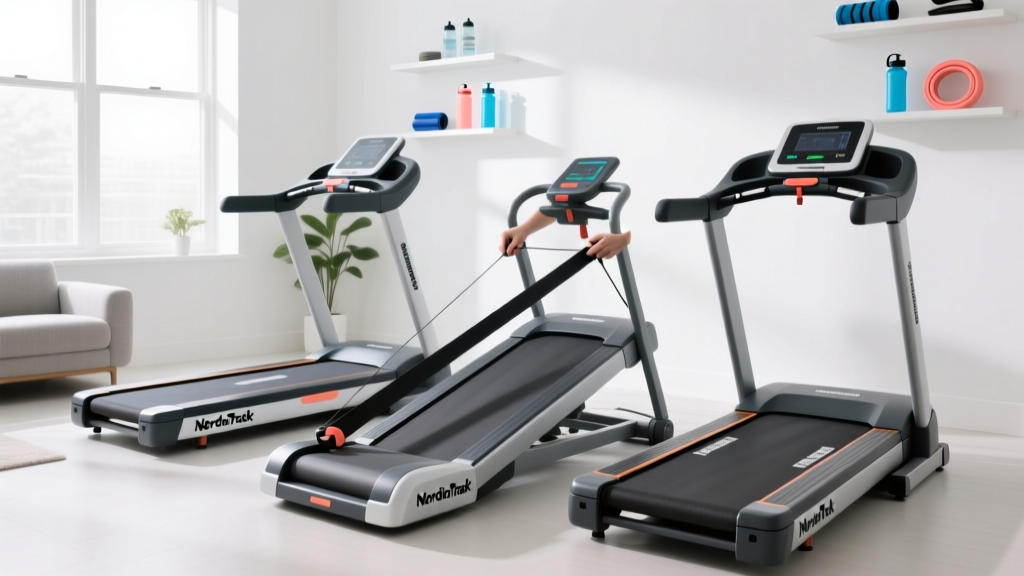
If your primary goal is dedicated cardiovascular conditioning rather than passive desk walking, the NordicTrack T Series 5 is the entry-level champion. It offers a 55-inch belt length, which is mandatory for safe running, and integrates seamlessly with iFIT for guided global workouts. However, because it utilizes a traditional, high-tension roller system, it requires periodic maintenance that walking pads do not.
💡 The Maintenance Bridge: Walking pads use low-friction, pre-tensioned, and often lubricant-free belts. Traditional treadmills like the NordicTrack T-Series use heavy-duty cotton/polyester blend belts that naturally stretch during the first 30 to 60 days of use. If your belt slips when you plant your foot, it is time for adjustment.Beginner Guide: How to Tighten Belt on NordicTrack Treadmill
Experiencing a slipping belt is one of the most common issues for new treadmill owners. It happens when the tension between the walking belt and the rear roller is insufficient. Here is your step-by-step, beginner-friendly guide on how to tighten belt on NordicTrack treadmill models safely and accurately.
Tools Required
- 3/16-inch Allen wrench (usually included in the original NordicTrack hardware kit)
- A clean, dry microfiber cloth
- Safety key (to be removed during the process)
Step 1: Power Down and Secure the Machine
Safety is paramount when working near the motor and roller mechanisms. Turn off the power switch located near the base of the treadmill, and unplug the power cord from the wall outlet. Remove the magnetic safety key from the console. This ensures the motor cannot accidentally engage while your hands are near the belt.
Step 2: Locate the Rear Adjustment Bolts
Move to the very back of the treadmill deck. You will see two hex-head bolts protruding from the left and right end caps. These bolts control the position of the rear roller. Moving the roller further back increases the tension on the walking belt.
Step 3: The 'Quarter-Turn' Rule
Insert your 3/16-inch Allen wrench into the left adjustment bolt. Turn the wrench exactly one-quarter (1/4) turn clockwise. Move to the right side and repeat the exact same 1/4 clockwise turn.
Expert Insight: Never turn the bolts more than a quarter turn at a time. Over-tightening is a leading cause of premature motor burnout and excessive friction, which can permanently damage the walking deck.
Step 4: Test the Tension at 3.0 MPH
Plug the machine back in and insert the safety key. Start the treadmill at a slow walking pace (3.0 MPH). Walk on the belt and plant your feet firmly with each step. If the belt still hesitates or slips under your weight, stop the machine, unplug it, and repeat Step 3 (another 1/4 turn on both sides).
⚠️ Critical Warning: You should be able to lift the walking belt about 2 to 3 inches off the deck in the center. If you cannot lift it at least 2 inches, you have over-tightened the belt. Loosen both bolts by 1/4 turn to prevent motor strain.Troubleshooting: Slipping vs. Drifting
Beginners often confuse a slipping belt with a drifting belt. The tightening method above only fixes slipping (when the front motor roller spins, but the belt doesn't move with it).
| Issue | Symptom | Solution |
|---|---|---|
| Belt Slipping | Belt hesitates or stops when you step on it, though the motor hums. | Tighten BOTH rear bolts equally (1/4 turn). |
| Belt Drifting Left | The belt slowly creeps toward the left side cap during use. | Turn the LEFT rear bolt 1/4 turn clockwise. |
| Belt Drifting Right | The belt slowly creeps toward the right side cap during use. | Turn the RIGHT rear bolt 1/4 turn clockwise. |
Frequently Asked Questions
Do I need to lubricate my NordicTrack belt after tightening it?
Most modern NordicTrack T-Series models (2020 and newer) feature maintenance-free, pre-lubricated walking belts. You should never apply silicone or liquid lubricants to these specific belts, as it can cause severe slipping and void the warranty. Always check your specific model's user manual to confirm if it requires a dry silicone spray.
Why does my walking pad not require this type of maintenance?
Walking pads like the Urevo or KingSmith utilize smaller, lower-torque motors and thinner, specialized polymer belts that do not stretch in the same manner as the heavy-duty, multi-ply cotton belts found on traditional running treadmills. Additionally, walking pads operate at lower speeds, generating less friction and heat, which drastically reduces the mechanical wear on the tensioning system.
How often should I check the belt tension on my traditional treadmill?
For a traditional treadmill used 3 to 4 times a week, check the belt tension every 3 months. You will almost always need to perform this tightening procedure once after the first 30 days of ownership as the factory belt fibers settle and stretch into their permanent operational state.
More gear to consider
All reviews
NordicTrack T 7.5 Series Treadmill Layout & Compact Cardio Options

Gold's Gym Trainer 410 Treadmill vs Ellipticals: 2026 Market Trends
Stationary Bike Types vs Conveyor Belt Treadmill Budget Guide

ProForm 390PI Treadmill vs Stationary Bikes: Budget Value Analysis

Upright, Recumbent & Spin Bikes vs HIIT Interval Training Treadmill