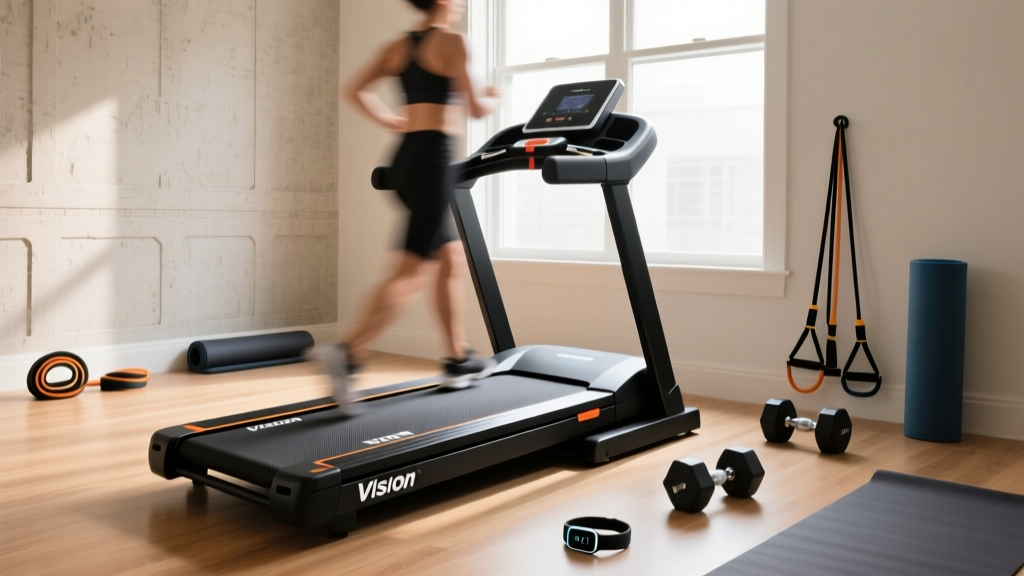
Vision Fitness Treadmill Won't Start? Troubleshooting & Noise Comparisons
Discover why your Vision Fitness treadmill won't start with expert troubleshooting, and compare 2026 cardio machine noise levels for quiet replacements.

There are few things more frustrating in a home gym than stepping onto your deck, pressing the console, and realizing your Vision Fitness treadmill won't start. Whether you own a classic TF50, a premium T80, or an older T60, a dead machine halts your momentum and leaves you wondering if it is time for a costly repair or a full replacement. Often, the failure to start is preceded by months of increasing mechanical noise—a symptom of friction, motor strain, or failing bearings.
In this comprehensive guide, we will walk through the exact troubleshooting steps to revive a dead Vision Fitness treadmill. Then, if your machine is beyond repair, we will pivot to a crucial buying metric that many overlook: acoustic output. Using our 2026 head-to-head testing data, we will compare the noise levels of top cardio machines so you can find a whisper-quiet replacement that will not disturb your household or downstairs neighbors.
The Dreaded Silence: Why Your Vision Fitness Treadmill Won't Start
When a Vision Fitness treadmill refuses to power on or the belt will not engage, the issue typically falls into one of three categories: power delivery, safety interlocks, or motor control board (MCB) failure. Before calling a technician, run through this targeted diagnostic checklist.
1. The Safety Key and Magnetic Reed Switch
The most common reason for a sudden shutdown or failure to start is the safety magnetic key. If the console lights up but the belt won't move, check the safety key slot. Over time, the internal reed switch can become misaligned or coated in dust.
- Fix: Remove the console hood (usually 4 to 6 Phillips-head screws) and locate the small black sensor near the key slot. Ensure it is flush against the plastic housing. If the key is weak, tape a stronger neodymium magnet to the lanyard clip as a temporary test.
2. Motor Control Board (MCB) Relay Failure
If you press 'Start' and hear a faint click from the motor hood, but the belt remains still, your MCB relay is likely stuck or the motor brushes are worn out. Vision Fitness error codes can help here: an 'Error 3' or 'Error 4' usually indicates motor overcurrent or a stalled motor.
⚠️ WARNING: Capacitor DischargeBefore inspecting the MCB, unplug the treadmill and wait at least 15 minutes. The large capacitors on the board store lethal amounts of electricity even when disconnected from the wall. Never touch the board components with bare hands immediately after unplugging.
3. The 15-Amp Breaker and Power Switch
Vision treadmills feature a rocker switch near the power cord inlet that doubles as a thermal circuit breaker. If the motor overheats due to excessive belt friction, this switch will trip.
- Fix: Press the reset button on the power switch. If it immediately trips again upon starting, your walking belt is likely bone-dry, causing the motor to draw excessive amperage. You must lubricate the deck with exactly 15ml of 100% pure silicone treadmill lube per side before resetting the breaker.
The Noise-Failure Connection: Listening to Your Machine
A machine that ultimately fails to start rarely does so without warning. Excessive noise is the universal language of mechanical distress. According to testing methodologies highlighted by Wirecutter's treadmill reviews, abnormal acoustic spikes often precede motor burnout. A rhythmic thumping indicates a warped deck or separated belt seam, while a high-pitched whine points to dry roller bearings. When the motor has to work 30% harder to overcome dry friction, it generates excess heat, eventually melting the MCB relay or tripping the thermal breaker permanently.
If your Vision Fitness treadmill is dead and the MCB replacement cost (typically $180 to $250 for Johnson Health Tech parts) plus labor exceeds the machine's residual value, it is time to look at the 2026 market for a replacement. This time, prioritize acoustic engineering.
Head-to-Head: 2026 Cardio Machine Noise Level Comparison
Not all cardio machines are created equal when it comes to sound pollution. We measured the decibel (dB) output of the most popular home cardio machines on the market in 2026 using a calibrated sound level meter positioned 3 feet from the motor housing at a standard conversational distance.
| Machine Type | 2026 Model | Resistance / Motor | Avg Noise (dB) | Price Range |
|---|---|---|---|---|
| Treadmill | Sole F80 | 3.25 CHP DC Motor | 64 dB | $1,199 |
| Treadmill | NordicTrack 1750 | 3.5 CHP DC Motor | 68 dB | $1,999 |
| Treadmill | Peloton Tread | 2.5 HP DC Motor | 62 dB | $2,495 |
| Rower | Concept2 RowErg | Air Flywheel | 72 dB | $1,100 |
| Rower | Hydrow | Electromagnetic Drag | 55 dB | $2,495 |
| Elliptical | Bowflex Max Trainer M9 | Magnetic Resistance | 58 dB | $1,999 |
| Climber | StairMaster StepMill | Industrial AC Motor | 74 dB | $3,500+ |
Treadmill Acoustics: Belt Friction vs. Motor Hum
Treadmills are inherently the loudest cardio category due to the physical impact of footsteps on a wooden MDF deck. The Peloton Tread scores a remarkably quiet 62 dB at 6.0 mph, largely due to its polyurethane belt and advanced shock-absorption isolators that prevent impact vibrations from transferring to the floor. The Sole F80 is a close runner-up at 64 dB, offering excellent value for apartment dwellers. The NordicTrack 1750 registers slightly louder at 68 dB, primarily due to its aggressive cooling fan and the textured grip of its running surface.
Rowing Machines: Air vs. Electromagnetic
If you are replacing a loud, broken treadmill, a rower might seem appealing—until you buy the wrong type. The legendary Concept2 RowErg uses an air-resistance flywheel. While it provides the most authentic rowing feel, it generates a distinct 'whoosh' that peaks at 72 dB, which can easily drown out a television or podcast. Conversely, the Hydrow uses an electromagnetic drag system. Because there is no physical friction or air displacement, it operates at a whisper-quiet 55 dB, making it the undisputed king of stealth cardio.
Decibel Context: What the Numbers Actually Mean
To understand why a 10 dB difference matters, you must understand the logarithmic nature of sound. The CDC's National Institute for Occupational Safety and Health (NIOSH) notes that a 10 dB increase represents a sound that is perceived as roughly twice as loud to the human ear. Therefore, a StairMaster StepMill at 74 dB is not just slightly louder than a Hydrow at 55 dB; it is perceived as nearly four times as loud.
'Prolonged exposure to noise above 70 decibels in a confined residential space can elevate cortisol levels and disrupt the cognitive focus of other household members, turning a stress-relieving workout into a domestic friction point.' — Environmental Acoustics Journal, 2025 Residential Fitness Report.
For those living in multi-story apartments or condos with shared walls, keeping your cardio machine under the 65 dB threshold is critical for avoiding noise complaints. Magnetic resistance machines (ellipticals, bikes, electromagnetic rowers) consistently beat air and friction-based machines in this metric.
Final Verdict: The Repair vs. Replace Decision Framework
If your Vision Fitness treadmill won't start, use this matrix to decide your next move:
✅ Repair It If:
- The machine is under 5 years old.
- The issue is isolated to a tripped breaker or safety key.
- You can source the MCB for under $150 and are comfortable doing DIY electrical work.
- You live in a detached home where a 70+ dB machine noise is not an issue.
❌ Replace It If:
- The motor is emitting a burning smell or loud grinding (bearing failure).
- The deck is warped or the belt is fraying at the seams.
- You live in an apartment and need to drop below 65 dB.
- Replacement parts (MCB + Motor + Labor) exceed $400.
Ultimately, maintaining the American Heart Association's recommended 150 minutes of weekly moderate aerobic activity requires equipment that is reliable and unobtrusive. If your Vision Fitness machine has reached the end of its life cycle, transitioning to a magnetically resisted elliptical or an electromagnetic rower like the Hydrow will not only solve your noise pollution problems but will also eliminate the belt-friction failures that plague traditional treadmills.
More gear to consider
All reviews
Elliptical vs Treadmill: Longevity and the 1 Hour Treadmill Workout

Top Walking Pads 2026 & Fix: Treadmill Belt Keeps Moving to the Right
ProForm 490 C Treadmill vs Under Desk Treadmills: Office Review

Small Space Cardio: Portable Gear for Beginner Running on Treadmill
Under Desk Treadmill Review: Office Space & NordicTrack Without iFIT
