Best Kettlebells to Upgrade a Beginner Dumbbell Workout Female Routine
Transitioning from a beginner dumbbell workout? Compare cast iron vs competition kettlebells to optimize your home gym layout, storage, and footprint.

The Evolution: Moving Beyond the Beginner Dumbbell Workout
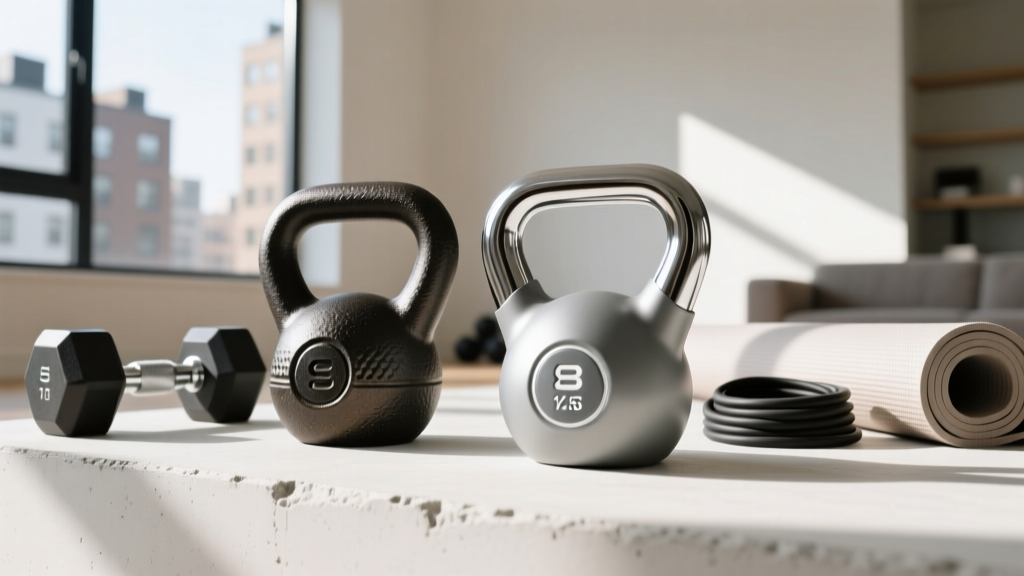
For many women, the foundation of home fitness begins with a standard beginner dumbbell workout female routine—typically utilizing 5 lb to 15 lb hex dumbbells for goblet squats, floor presses, and lateral raises. While hex dumbbells are excellent for isolated hypertrophy and static holds, progressing to ballistic movements like swings, cleans, and snatches requires a shift in equipment. As of 2026, the transition from dumbbells to kettlebells remains one of the most effective ways to build posterior chain power and cardiovascular endurance. However, this transition introduces a significant spatial challenge: how do you integrate kettlebells into a compact home gym without sacrificing your existing layout?
When upgrading your equipment, the primary debate centers on cast iron vs. competition kettlebells. This decision is not just about aesthetics or sport-specific training; it is fundamentally a space optimization and layout design issue. Understanding the dimensional differences between these two styles is critical for maximizing your home gym's footprint, selecting the right storage racks, and ensuring safe clearance zones for dynamic movements.
The Dimensional Dilemma: Cast Iron vs. Competition
Unlike dumbbells, which scale proportionally in both length and width as weight increases, kettlebells follow two distinct manufacturing philosophies. According to Rogue Fitness Kettlebell Specifications, traditional cast iron bells are cast from single-piece molds, meaning a 12 kg bell is physically smaller in height, width, and handle diameter than a 24 kg bell. Conversely, competition kettlebells adhere to strict International Union of Kettlebell Lifting (IUKL) standards, maintaining identical outer dimensions regardless of the weight inside.
| Specification | Cast Iron (e.g., Rogue Standard) | Competition (e.g., Kettlebell Kings) | Space & Layout Impact |
|---|---|---|---|
| Height (16kg) | ~230 mm | 210 mm (Uniform) | Competition bells allow for uniform horizontal shelf spacing. |
| Width / Base (16kg) | ~180 mm (Varies by weight) | 280 mm (Uniform) | Cast iron requires staggered rack pegs; competition fits flush grids. |
| Handle Diameter | 33 mm - 35 mm (Scales up) | 35 mm (Strict) | Uniform handles prevent grip fatigue when switching weights mid-set. |
| Base Shape | Rounded or slightly flattened | Perfectly flat, machined | Flat bases allow for safe floor storage and stacking in tight corners. |
Space Optimization: Footprint and Racking Logistics
When designing a home gym layout, vertical and horizontal storage efficiency is paramount. If you are purchasing a progressive set of kettlebells (e.g., 8kg, 12kg, 16kg, 20kg) to replace your dumbbell-centric routine, the physical footprint of your storage rack will vary wildly based on the bell type.
💡 Layout Pro-Tip: The Uniform Grid Advantage
Because competition kettlebells share the exact same 210mm height and 280mm width, you can install a uniform wall-mounted peg rack with exact 300mm horizontal spacing. Cast iron bells, due to their scaling widths, require either a staggered peg layout or a deep, bulky horizontal tree rack that protrudes 24+ inches into your workout space. For apartment gyms or spare bedrooms, competition bells save up to 18% of horizontal wall space when racked.
Furthermore, the flat, machined base of a competition kettlebell allows for secure floor stacking or tight corner clustering. Cast iron bells, with their rounded or uneven bases, are prone to rolling and require dedicated matting or cradles to prevent floor damage and spatial drift.
Layout Design: Clearance Zones for Ballistic Movements
Transitioning from a beginner dumbbell workout to kettlebell training fundamentally changes the spatial clearance required in your gym. Dumbbell exercises like chest presses or lunges primarily occupy the vertical plane directly above or beside the body. Kettlebell ballistics, however, demand a dynamic clearance radius.
- The Swing Radius: A standard two-handed kettlebell swing requires a minimum 36-inch clearance behind the athlete and 48 inches in front. Unlike dumbbells, the bell travels between the legs and projects forward to chest height.
- The Snatch Drop Zone: When dropping a heavy kettlebell from overhead, the bell falls vertically but can bounce or roll if it hits an uneven surface. You must designate a 4x4 foot "drop zone" lined with 3/4-inch horse stall mats, separate from your dumbbell rack.
- Ceiling Height Constraints: Competition kettlebells are slightly shorter (210mm) than heavy cast iron bells. If you are training in a basement with low HVAC ducting, the uniform, compact profile of competition bells reduces the risk of ceiling strikes during overhead snatches and presses.
"When transitioning female clients from dumbbells to kettlebells, I always map out the 'swing arc' first. Most home gyms are designed for static lifting. If your coffee table or TV stand is within 4 feet of your lifting platform, you are working in a high-risk spatial zone." — Certified Strength and Conditioning Specialist (CSCS) spatial guidelines, 2025.
Cost vs. Spatial ROI
Budget inevitably influences equipment selection, but it must be weighed against spatial ROI (Return on Investment). As of early 2026, pricing structures reflect the manufacturing complexities of each style:
- Cast Iron Kettlebells: Typically priced between $1.60 and $2.20 per pound. They are cost-effective for building a heavy set, but the varying dimensions mean you will likely need to upgrade your storage rack as you buy larger sizes, incurring secondary spatial costs.
- Competition Kettlebells: Priced higher, usually $2.80 to $3.50 per pound. The premium pays for the steel-shell construction and uniform dimensions. The spatial ROI is realized in the ability to use a single, compact, wall-mounted rack for your entire collection, from 8kg to 32kg.
Step-by-Step: Designing Your Kettlebell Corner
To seamlessly integrate kettlebells into your existing home gym layout without overcrowding the space, follow this spatial optimization protocol:
- Audit Your Current Dumbbell Footprint: Measure the exact dimensions of your current hex dumbbell rack. If it is a bulky A-frame, consider replacing it with a wall-mounted tiered shelf to free up floor space for kettlebell swings.
- Establish the 4x4 Ballistic Zone: Clear a 4-foot by 4-foot area directly in front of your mirror or wall. Lay down interlocking rubber mats. This zone must remain entirely free of dumbbells, benches, or storage racks during use.
- Install a Flush-Mount Peg Rack: If you opt for competition bells, install a heavy-duty steel peg rack directly into your wall studs. Space the pegs exactly 12 inches apart. This keeps the bells off the floor, eliminating tripping hazards and making vacuuming/sweeping the gym space effortless.
- Color-Code for Cognitive Flow: Competition bells feature standardized IUKL color bands (e.g., Yellow for 16kg, Green for 24kg). This visual cueing reduces the time spent searching for the right weight in a dimly lit garage gym, streamlining your workout flow and keeping the space organized.
Final Verdict: Which Should You Choose?
If your primary goal is to execute high-repetition ballistics, maintain strict form consistency, and optimize a compact home gym layout, competition kettlebells are the superior choice. Their uniform dimensions allow for streamlined, space-saving storage solutions that cast iron simply cannot match. However, if you are strictly performing grinds (squats, presses) and have ample floor space to accommodate a sprawling horizontal tree rack, cast iron kettlebells offer a more budget-friendly entry point. By treating your equipment upgrade as a spatial design project rather than just a purchase, you ensure your home gym remains functional, safe, and primed for your continued progression.
More gear to consider
All reviews
EZ Curl Bar vs Straight Bar Budget & Dumbbell Goblet Squat Workout
Single Arm Dumbbell Row Setup: Olympic vs Standard Weight Plates

Bumper vs Iron Plates: Budgeting From a 5lb Dumbbell Up

Space Optimization: Storing the Titan Circus Dumbbell & Standard Sets

Hex vs Urethane Dumbbells & Vertical Leg Press Smith Machine Layouts
