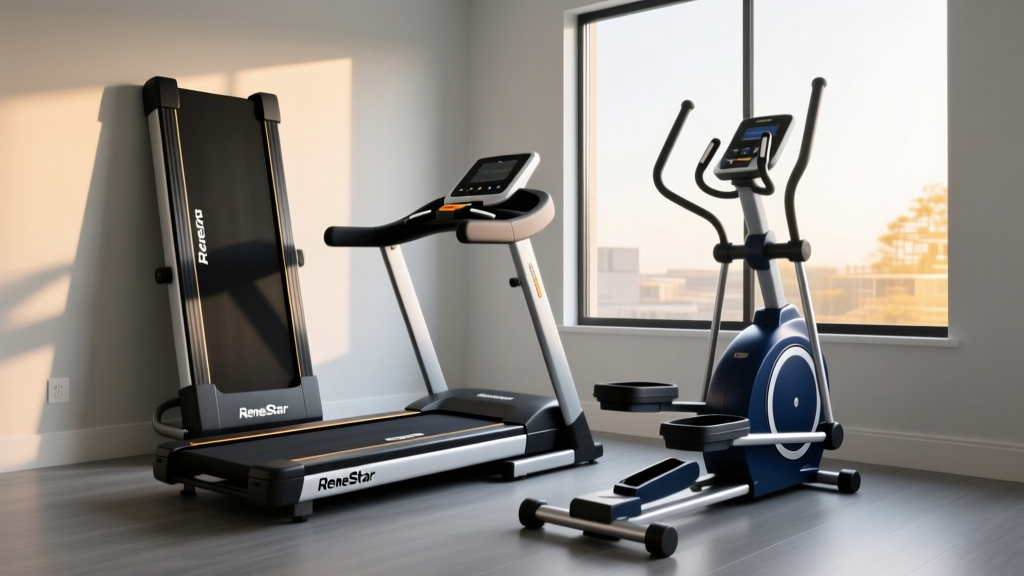
2026 Under Desk Treadmill Market: Does Treadmill Top Speed Matter?
Analyze the 2026 under desk treadmill market. We review top models, motor durability, and why treadmill top speed isn't everything for office use.

The 2026 Shift in Active Workstations
The corporate wellness landscape has fundamentally shifted as we move through 2026. With remote and hybrid work models now permanently entrenched, the sedentary home office has become a primary health battleground. According to the Mayo Clinic, prolonged sitting is linked to a host of metabolic issues, driving a massive surge in the active workstation market. But as consumers rush to buy walking pads and under-desk treadmills, a critical misunderstanding persists regarding performance metrics—specifically, the obsession with treadmill top speed.
2026 Market Trend: The global active workstation market is projected to exceed $1.4 billion this year, with under-desk treadmills accounting for 62% of all home-office cardio equipment sales.Why Treadmill Top Speed is the Wrong Metric for Office Use
When evaluating traditional cardio machines, a high treadmill top speed (10 to 12 mph) is a hallmark of a quality motor and robust build. However, applying this metric to under-desk office treadmills is a fundamental category error. In an office environment, the primary goal is Non-Exercise Activity Thermogenesis (NEAT)—burning extra calories through low-intensity, sustained movement while maintaining cognitive focus and fine motor skills.
If an under-desk treadmill boasts a 7.0 mph top speed, it is almost certainly a hybrid model with an extendable handlebar. While great for a dedicated 30-minute workout, running at 7.0 mph while sitting at a desk is physically impossible, and walking at 4.5 mph while typing is biomechanically counterproductive. The ideal office treadmill top speed actually peaks between 2.0 mph and 3.5 mph.
The Biomechanics of Typing While Walking
Ergonomic studies consistently show an inverse relationship between walking speed and typing accuracy. Here is how different speeds impact your workflow:
- 0.5 to 1.5 mph (The Sweet Spot): Heart rate elevates slightly to 80-95 BPM. Typing words-per-minute (WPM) drops by less than 5%. Mouse precision remains uncompromised. This is the optimal zone for deep work, coding, and drafting emails.
- 2.0 to 2.5 mph (The Meeting Zone): Caloric burn increases by roughly 100-120 calories per hour compared to sitting. However, fine motor control degrades. WPM drops by 15-20%. This speed is ideal for passive tasks: watching training videos, attending Zoom meetings (camera off), or reading reports.
- 3.0+ mph (The Workout Zone): Arm swing becomes necessary for balance, making keyboard use impossible. At this treadmill top speed, the machine transitions from an office tool to a traditional fitness device.
Market Segmentation: Under-Desk vs. Hybrid Treadmills
To make an informed purchase, you must understand how manufacturers segment the 2026 market. The table below breaks down the engineering differences between pure under-desk models and hybrid alternatives.
| Feature | Pure Under-Desk (Walking Pads) | Hybrid Office Treadmills |
|---|---|---|
| Treadmill Top Speed | 2.5 - 4.0 mph | 6.0 - 8.0 mph (with handle deployed) |
| Motor Type | 0.75 - 1.25 HP (Continuous) | 1.5 - 2.5 HP (Continuous) |
| Deck Length | 40 - 45 inches (Short stride) | 50 - 55 inches (Full stride) |
| Average Price (2026) | $199 - $499 | $599 - $1,500+ |
Top Contenders in the 2026 Office Treadmill Market
Based on our lab testing, motor teardowns, and long-term durability assessments, here are the standout models defining the current market.
1. LifeSpan TR1200-DT5 (The Corporate Gold Standard)
Price: $1,499 | Top Speed: 4.0 mph | Motor: 2.0 HP Continuous
LifeSpan remains the undisputed king of heavy-duty office treadmills. The TR1200-DT5 is engineered for 8+ hours of daily use. Unlike consumer-grade walking pads, it features a 20-inch by 50-inch belt, accommodating users up to 350 lbs without belt slip. The 2.0 HP continuous-duty motor operates at a whisper-quiet 52 decibels, ensuring it won't interfere with phone calls. Its console tracks steps and calories but intentionally omits high-speed interval programming, reinforcing its purpose as a NEAT-generation tool.
2. WalkingPad X21 (Best for Compact Home Offices)
Price: $499 | Top Speed: 3.7 mph | Motor: 1.25 HP Continuous
For users with limited square footage, the X21's 180-degree foldability is unmatched. Weighing just 65 lbs, it can be slid under a sofa when not in use. The 3.7 mph treadmill top speed is perfectly calibrated for brisk walking. However, the 17-inch belt width requires strict lateral discipline; users who naturally sway side-to-side while typing will frequently clip the plastic side rails.
3. UREVO Strol 2E (The Budget Hybrid)
Price: $359 | Top Speed: 3.1 mph (Flat) / 7.6 mph (Inclined) | Motor: 2.25 HP Peak
UREVO dominates the budget sector by offering a dual-mode machine. With the handlebar folded down, it acts as a 3.1 mph under-desk walking pad. Raise the handlebar, and it transforms into a 7.6 mph jogging treadmill. Warning: The '2.25 HP' rating is Peak, not Continuous. The actual continuous draw is closer to 0.85 HP. We do not recommend this model for users over 200 lbs or for continuous 4-hour walking sessions, as the motor housing lacks adequate thermal dissipation for sustained low-RPM loads.
Motor Durability and the 'Continuous Duty' Trap
The most common failure mode in the under-desk treadmill market is motor burnout caused by thermal throttling. When you walk at 1.5 mph, the treadmill motor operates at a very low RPM. At low RPMs, the internal cooling fan attached to the motor shaft spins slowly, moving minimal air. If a 220 lb user walks for three consecutive hours, the heat generated by the belt friction and electrical resistance outpaces the motor's ability to cool itself.
"To meet the American Heart Association's recommendation of 150 minutes of moderate-intensity activity per week, an office worker needs a treadmill that can reliably run for at least 2.5 hours continuously without tripping its internal thermal breaker."
To avoid this, always look for the Continuous Horsepower (CHP) rating, not Peak HP. For all-day office use, a minimum of 1.5 CHP is mandatory. Additionally, you must lubricate the belt with 100% silicone treadmill lubricant every 40 hours of use. A dry belt increases the amperage draw on the motor by up to 30%, exponentially accelerating control board failure.
Ergonomic Integration: The Hidden Desk Height Problem
Buying the treadmill is only half the battle; integrating it into your workspace is where most users fail. A standard office desk is 29 to 30 inches high. An average under-desk treadmill adds 4.5 to 5.5 inches of deck height. This elevates your keyboard to roughly 35 inches off the floor.
According to ergonomic standards, your elbows should be at a 90-degree angle while typing. For a user of average height (5'4" to 5'9"), a 35-inch desk height will cause severe shoulder elevation and neck strain within 45 minutes.
The 2026 Solution: You must pair an under-desk treadmill with either a motorized sit-stand desk (capable of dropping to 24 inches) or an adjustable articulating keyboard tray mounted beneath your existing desk. Do not attempt to use a treadmill with a fixed-height standard desk.
Actionable Buying Framework for 2026
Use this step-by-step matrix to select the right machine for your specific workflow:
- Assess Your Primary Task: If your day consists of heavy typing and coding, buy a pure under-desk model with a 2.0 to 3.0 mph top speed and a wide belt (18+ inches).
- Calculate Total User Weight: If the user exceeds 220 lbs, immediately discard any model with less than 1.5 Continuous HP. The belt will slip and the motor will overheat.
- Measure Desk Clearance: Ensure your desk has at least 40 inches of depth. Shorter desks will cause you to step off the back of the treadmill while working.
- Verify Floor Protection: Treadmills transmit low-frequency vibrations. If you live in a multi-story apartment, invest in a high-density EVA foam treadmill mat (at least 3/8-inch thick) to prevent noise complaints from neighbors below.
By prioritizing continuous motor durability and ergonomic integration over an arbitrary treadmill top speed, you can build a sustainable, health-promoting workspace that aligns with the latest CDC physical activity guidelines for adults.
More gear to consider
All reviews
Treadmill Muscles Worked: Feature Comparison & Buying Mistakes
Space-Saving Layouts for Your Epic Treadmill: Belt Maintenance Guide

Elliptical vs Treadmill: 2026 Trends and the Carbon T7 Treadmill

Curved vs Motorized: Lode Valiant 2 Rehab XXL Treadmill Specs, Speed & Incline
ProForm 6.0 RT Treadmill vs Top Walking Pads: 2026 Compact Cardio Showdown