Elliptical Machine vs Treadmill: Setup & Feature Guide
Deciding between an elliptical machine vs treadmill? Compare key features, spatial footprints, and complete home installation walkthroughs.

The Spatial Reality: Footprint and Clearance Requirements
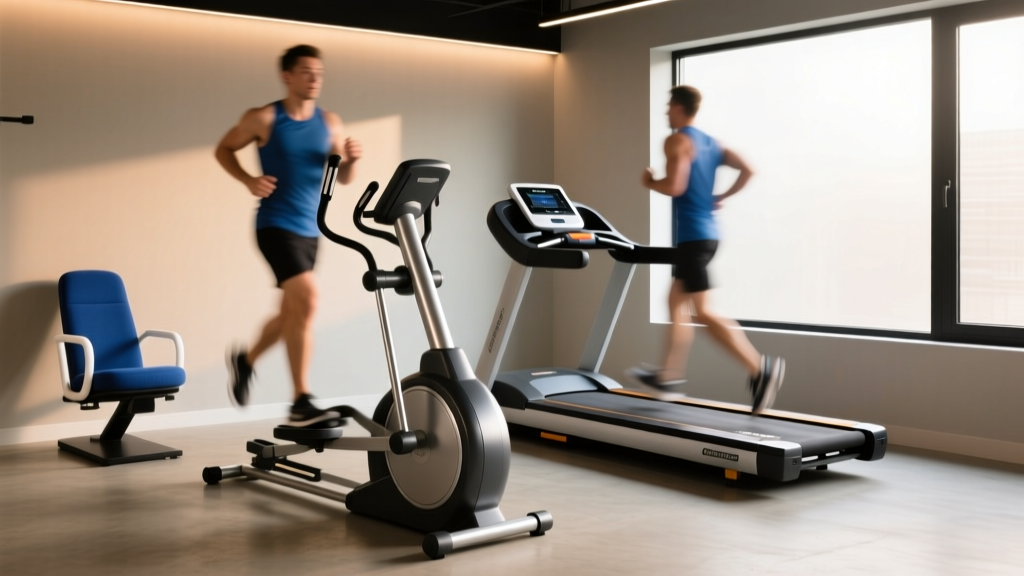
The debate of an elliptical machine vs treadmill usually centers on joint impact and calorie burn. However, as home gym designers and installation experts, we look at this from a completely different angle: what your floor, walls, and electrical panel can actually support. In 2026, cardio equipment is more technologically advanced than ever, but the physical footprint and structural demands remain a harsh reality for home gym owners.
When comparing a premium treadmill like the Sole F80 against a high-end elliptical like the Sole E35, the spatial requirements dictate your installation options. The Sole F80 measures 82 inches long by 37 inches wide. However, you must account for the 'safety buffer zone.' The American College of Sports Medicine recommends at least 24 inches of clearance on each side and 48 inches behind the treadmill to prevent injury in the event of a fall. This pushes the actual required floor space to roughly 130 inches by 85 inches.
Ellipticals are generally more compact. The Sole E35 footprint is roughly 83 inches by 29 inches. Because there is no rear ejection risk, the side and rear clearance requirements are significantly reduced. However, ellipticals introduce a different spatial hurdle: vertical clearance.
Calculating Ceiling Height for Ellipticals vs. Treadmills
A common installation failure occurs when users forget to account for the 'step-up height' of an elliptical. The Sole E35 has a step-up height of about 15 inches at its highest pedal apex. If a 6-foot-tall user (72 inches) is on the machine, their total height becomes 87 inches. Standard 8-foot ceilings (96 inches) leave only 9 inches of clearance, which feels claustrophobic and risks head strikes if posture shifts. Treadmills, conversely, only add deck height (usually 8 to 10 inches) plus incline elevation, which rarely exceeds 15 inches of total added height at the front, keeping the user's head well below the ceiling.
Electrical and Power Setup: What Your Outlets Can Handle
One of the most critical differences in the elliptical machine vs treadmill comparison is electrical demand. Modern treadmills with interactive HD touchscreens and powerful continuous horsepower (CHP) motors are essentially heavy appliances.
⚠️ CRITICAL INSTALLATION WARNING: Never plug a motorized treadmill into a shared bedroom circuit or use a standard indoor extension cord. According to the National Fire Protection Association (NFPA), overloading circuits with high-draw motorized equipment is a leading cause of residential electrical fires. Always use a dedicated 15-amp or 20-amp wall receptacle.A treadmill with a 3.5 to 4.0 CHP motor (like the NordicTrack Commercial 1750) can draw up to 15 amps under peak load—such as when a 250-lb user is running at 10 mph on a 15% incline. If your treadmill shares a 15-amp circuit with a space heater, window AC unit, or even a high-draw vacuum, the breaker will trip mid-workout. Furthermore, manufacturers explicitly void warranties if the machine is plugged into a GFCI (Ground Fault Circuit Interrupter) outlet, which are common in garages and basements, due to the nuisance tripping caused by motor surges.
Ellipticals, on the other hand, are incredibly power-efficient. Because they rely on magnetic resistance and the user's momentum rather than a massive drive motor to move a belt, models like the Bowflex Max Trainer M9 draw minimal current (often under 3 amps). They can safely be plugged into standard shared household circuits without risking a breaker trip.
Floor Load and Vibration: Structural Installation Needs
When installing cardio equipment on second-floor rooms or over finished basements, dynamic load is a major factor. The American Heart Association promotes both machines for cardiovascular health, but the biomechanical force they transfer to your floor joists is vastly different.
| Machine Type | Average Machine Weight | Dynamic Impact Multiplier | Required Matting |
|---|---|---|---|
| Motorized Treadmill | 250 - 350 lbs | Up to 3x User Body Weight | 3/4-inch Vulcanized Rubber |
| Front-Drive Elliptical | 180 - 250 lbs | 1.2x User Body Weight | 3/8-inch High-Density EVA |
When a 200-lb user runs on a treadmill, the momentary downward impact force can exceed 600 lbs per stride. This creates severe acoustic vibration transfer to rooms below. To mitigate this, we recommend installing 3/4-inch thick vulcanized rubber horse stall mats (readily available at agricultural supply stores for about $50-$70 each) cut to size. Cheap PVC or thin yoga mats will compress to zero thickness under a treadmill's leveling feet, offering no vibration dampening.
Ellipticals provide a smooth, continuous circular motion. The force is distributed evenly across four wide stabilizer feet, and there is zero 'strike' impact. A standard 3/8-inch high-density EVA foam mat is sufficient to protect hardwood floors from scratching and minor sweat drips.
Assembly Walkthrough: Unboxing to First Stride
The physical installation process varies wildly between these two machines. According to Consumer Reports' treadmill buying guide, assembly is often the most frustrating part of ownership. Here is a step-by-step reality check for both.
Treadmill Assembly: The Heavy Lift
- Unboxing and Positioning: Treadmill boxes often weigh over 300 lbs. You must unbox the machine in the exact room where it will live. Attempting to move a fully assembled Sole F80 through a standard 30-inch interior doorway is nearly impossible due to the welded deck frame.
- Upright Weldment: This is a two-person job. One person must support the 80-lb upright mast while the other threads the delicate console data cables through the steel tube. Pinching this ribbon cable is the #1 cause of 'dead on arrival' console errors.
- Belt Tensioning and Calibration: Once bolted down, the belt must be tensioned using a 3/4-inch socket wrench on the rear roller bolts. You must run the machine at 3 mph and adjust the left and right bolts in exact quarter-turn increments to prevent the belt from drifting and fraying against the side rails.
Elliptical Assembly: Precision Alignment
- Flywheel and Base: Ellipticals ship with the heavy flywheel pre-installed to the base, but the packaging is awkward. You will need a furniture dolly to move it into position.
- Pedal Arm Alignment: This is the critical failure point. When attaching the pedal arms to the central crank bearings, you must ensure the threads are perfectly straight. Cross-threading the crank arm will strip the bearing housing, rendering the machine useless and requiring a full warranty replacement of the chassis.
- Shroud Installation: Ellipticals feature multiple plastic shrouds that snap and screw into place. Taking your time to align the plastic tabs prevents the annoying 'rattling' sound that plagues poorly assembled ellipticals.
Feature Comparison Matrix: Justifying the Setup Effort
Once installed, how do the features justify the setup hassle? Below is a direct comparison of what you get from premium models in both categories.
| Feature Category | Premium Treadmill (e.g., NordicTrack 1750) | Premium Elliptical (e.g., Bowflex M9) |
|---|---|---|
| Incline / Resistance | -3% Decline to 15% Incline | 20 Levels of Magnetic Resistance |
| Interactive Coaching | Auto-adjusts speed/incline via GPS routes | Auto-adjusts resistance via JRNY app |
| Maintenance Needs | Annual silicone belt lubrication, belt alignment | Virtually zero; occasional pivot joint oiling |
| Biomechanical Focus | Running gait, bone density loading, sprinting | Low-impact cardio, glute/hamstring isolation |
Expert Verdict: Which Installation Fits Your Home?
Choosing between an elliptical machine vs treadmill is ultimately a compromise between your fitness goals and your home's physical limitations. If you have a dedicated ground-floor room with 20-amp electrical circuits, reinforced flooring, and ample square footage, a premium treadmill offers the most dynamic, full-body athletic training available indoors. The setup is grueling, and the electrical demands are high, but the biomechanical benefits of loaded running are unmatched.
Conversely, if you are outfitting a second-floor bedroom, an apartment, or a space with standard shared electrical circuits, the elliptical is the undisputed champion of home installation. It demands less space, draws minimal power, eliminates impact noise, and requires virtually zero ongoing maintenance. By understanding the installation realities outlined above, you can purchase your next cardio machine with absolute confidence, knowing it will seamlessly integrate into your home environment.
More gear to consider
All reviews
Is a Bowflex Climber Treadmill Hybrid the Best Compact Cardio?

Curved Manual vs Motorized: ProForm Treadmills Beginner Guide

Sunny Health & Fitness WalkStation Slim Flat Treadmill Review (2026)
Folding Treadmill Walmart Buying Mistakes & Feature Fixes

Rowing Machine Buying Guide & Technique vs T10 9B Reflex Treadmill