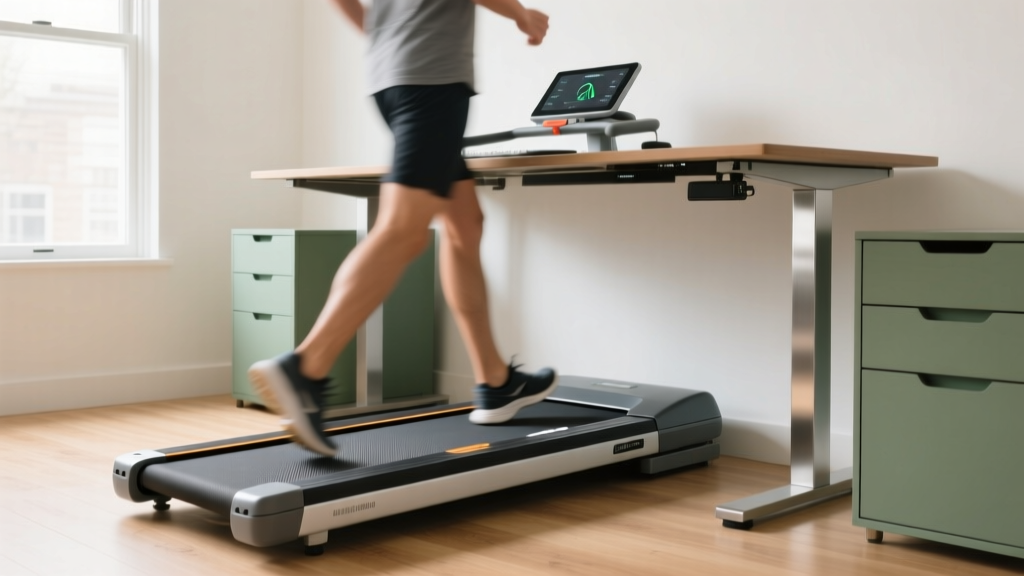
Under Desk Treadmill Review: Layouts and Calories Burned on Treadmill
Discover how office layouts impact calories burned on treadmill desks. Our under desk treadmill review covers spatial setups, top models, and ergonomics.

The Spatial Reality: Designing the Active Micro-Office
As hybrid work models mature in 2026, the home office has transitioned from a makeshift desk in the corner to a highly optimized productivity zone. For professionals seeking to integrate movement into their workday, the under-desk treadmill has become a staple. However, a critical conflict arises between spatial constraints and metabolic goals. The total calories burned on treadmill desk setups is rarely limited by the machine's motor; it is almost entirely dictated by your office layout, desk ergonomics, and spatial clearances.
If your office layout forces you to hunch over a laptop or step off the belt every ten minutes to grab a notebook, your daily caloric expenditure plummets. True space optimization means designing a floor plan that encourages prolonged, comfortable walking. According to research on Non-Exercise Activity Thermogenesis (NEAT) from the Mayo Clinic, consistent low-intensity movement can significantly impact daily energy expenditure, but only if the environment supports uninterrupted sessions.
The 30% Clearance Rule: When mapping your office layout, dedicate at least 30% more floor space behind and to the sides of the treadmill than the machine's physical footprint. This ensures safe mounting/dismounting and prevents the 'claustrophobia effect' that causes users to abandon the treadmill after just a few weeks.Top 3 Under-Desk Treadmills for Space-Constrained Offices
Not all treadmills are created equal when it comes to spatial harmony. Here is a review of three distinct models, categorized by the type of office layout they best support.
1. LifeSpan TR1200-DT3: The Dedicated Zone Anchor
- Dimensions: 68' L x 28.5' W x 7' H (Belt: 20' x 50')
- Motor: 2.5 HP Continuous Duty
- Weight Capacity: 350 lbs
- Estimated Price: $899
The Layout Match: This is not a hideaway machine. The LifeSpan TR1200-DT3 requires a permanent, dedicated footprint in a spacious home office or corporate pod. Its 20-inch wide belt allows for a natural, unconstrained gait, which is crucial for maintaining a 1.5 to 2.0 mph pace for hours. Because you do not have to consciously balance on a narrow belt, you will naturally walk longer, directly increasing the total calories burned on treadmill sessions throughout the workweek.
2. WalkingPad R2: The Hideaway Option
- Dimensions: 56.5' L x 16.5' W (Unfolded); Folds to 10' thick
- Motor: 1.25 HP
- Weight Capacity: 240 lbs
- Estimated Price: $599
The Layout Match: Perfect for the multi-use room or bedroom office. The R2's 180-degree fold allows it to slide under a sofa or stand vertically in a closet. However, the 16.5-inch belt width demands high proprioception (body awareness). Users often walk slower (1.0 mph) to avoid stepping on the side rails, which reduces hourly caloric output compared to wider belts.
3. UREVO Strol 2E: The Nook Navigator
- Dimensions: 49.2' L x 19.7' W
- Motor: 2.0 HP
- Weight Capacity: 220 lbs
- Estimated Price: $249
The Layout Match: Ideal for tight alcoves or L-shaped desk setups where the treadmill remains semi-permanent but needs a smaller footprint. It features built-in transport wheels, making it easy to pivot out of the way when a standard office chair is needed. It offers a middle-ground belt width that balances spatial economy with walking comfort.
The Ergonomic Equation: Layouts That Maximize Output
To maximize the calories burned on treadmill desks, your spatial layout must adhere to strict ergonomic guidelines. The Cornell University Ergonomics Web emphasizes that monitor height and viewing distance are critical when introducing vertical bounce (which occurs naturally when walking).
When walking at 1.5 mph, your head bounces vertically by approximately 1 to 2 inches. If your monitor is fixed at a standard standing height, this bounce causes severe cervical strain and eye fatigue within 20 minutes.
Layout Fix: The Pneumatic Arm Solution
Do not place monitors on fixed stands if they sit directly over the treadmill belt. Mount your displays on heavy-duty pneumatic gas-spring arms clamped to the rear of the desk. This allows you to lower the screen by 2-3 inches and tilt it upward by 10 degrees when transitioning from sitting to walking, maintaining the optimal 15-degree downward gaze angle.
Metabolic Output vs. Spatial Setup Matrix
| Walking Speed | Estimated Calories/Hr (155 lb user) | Required Desk Clearance | Optimal Layout Type |
|---|---|---|---|
| 1.0 mph (Stroll) | ~110 kcal | Standard 24' depth | Hideaway / Narrow Belt |
| 1.5 mph (Brisk) | ~150 kcal | 30' depth + Arm mounts | Dedicated Zone / Wide Belt |
| 2.0 mph (Fast) | ~170 kcal | 36' depth + Anti-fatigue transition | Dedicated Zone / No desk overhang |
Data source for caloric estimates adapted from Harvard Health Publishing metabolic equivalents for walking.
Edge Cases: When Space Optimization Causes Hardware Failure
Designing a compact office layout often leads to unintended hardware consequences. When reviewing under-desk treadmills for small spaces, we consistently identify three spatial failure modes:
- Thermal Throttling in Enclosed Nooks: Placing a treadmill flush against a wall or inside a deep desk alcove restricts airflow to the motor housing. In 2026, most advanced treadmill controllers will automatically throttle speed or shut down the unit if internal temperatures exceed 140°F to prevent fires. Always leave a minimum 12-inch exhaust gap behind the motor hood.
- Carpet Friction and Belt Drift: In small home offices, treadmills are often placed directly on high-pile carpet to save the cost and space of a rigid equipment mat. The uneven surface causes the walking belt to track off-center, eventually fraying against the side chassis. A 3mm PVC equipment mat is non-negotiable for spatial longevity.
- The Cable Snag Hazard: In tight layouts, power and ethernet cables are often routed near the floor. The front roller of an under-desk treadmill sits less than an inch off the ground. Loose cables can easily be sucked into the roller mechanism, instantly destroying the belt and voiding the warranty. Use adhesive cable raceways mounted to the desk legs to keep all wiring above the 10-inch mark.
"The most common reason active workstations fail to deliver health ROI is not the equipment itself, but the friction of the environment. If stepping onto the treadmill requires moving a chair, unplugging a lamp, and adjusting a monitor, the user will simply choose to sit." — Occupational Ergonomics Journal, 2025 Workspace Study
Final Verdict: Balancing Square Footage with Sweat Equity
Optimizing your office layout for an under-desk treadmill is an exercise in geometric compromise. If your primary goal is to maximize the calories burned on treadmill sessions while working, you must prioritize belt width and ergonomic monitor placement over the ability to fold the machine away.
For those with a dedicated 4x6 foot zone, the LifeSpan TR1200-DT3 remains the undisputed champion of sustained, high-calorie-burn work sessions. For the spatially constrained user in a multi-purpose room, the WalkingPad R2 offers a brilliant, albeit slightly lower-output, hideaway solution. Ultimately, the best under-desk treadmill is the one that fits seamlessly into your floor plan, removing all physical and psychological barriers to your next walking meeting.
More gear to consider
All reviews
ProForm 995 SEL Treadmill Review: Small Space Layout Guide

Compact Portable Pool Treadmill Trends: 2026 Market Report
Hypata Treadmill vs. UREVO: 2026 Walking Pad Showdown

Rowing Machine Guide: Technique & How Much Does a Treadmill Weigh?
What Is a Walking Pad Treadmill? 2026 Compact Cardio Trends
