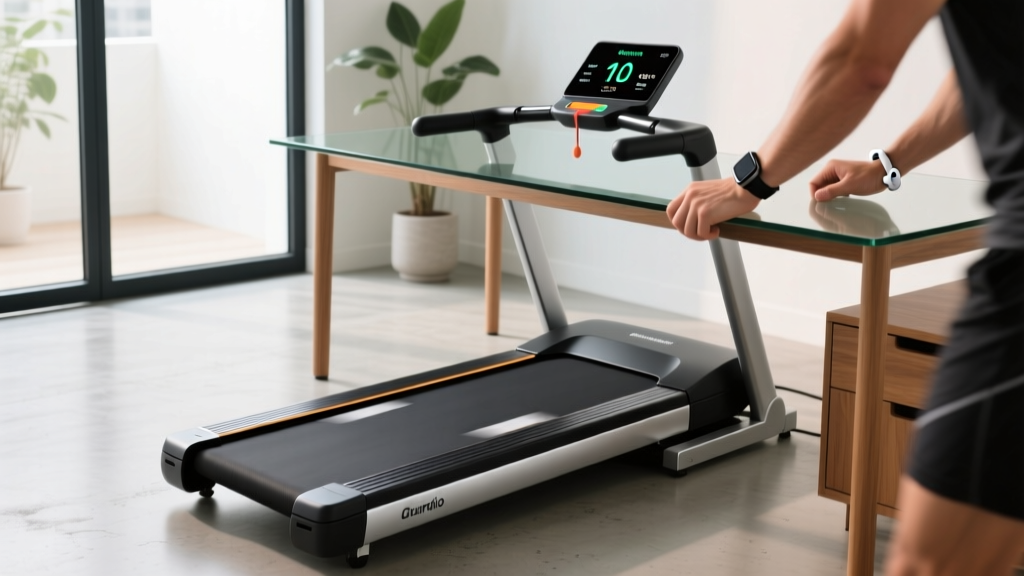
Under Desk Treadmill Review: Treadmill Exercises to Lose Belly Fat
Discover the best under desk treadmills for 2026. We break down budgets, ROI, and effective treadmill exercises to lose belly fat while working.

The Biomechanical Reality: Desk Treadmills vs. Belly Fat
When professionals search for treadmill exercises to lose belly fat, they typically envision high-intensity interval training (HIIT) on a commercial gym machine, complete with steep inclines and sprinting speeds. However, the reality of the modern home office requires a different approach. Under-desk treadmills (or walking pads) cap out at 4.0 to 5.0 mph and lack incline motors. So, can they actually help you lose visceral and subcutaneous belly fat?
The answer lies in Non-Exercise Activity Thermogenesis (NEAT). According to research published by the National Institutes of Health (NIH), NEAT accounts for the energy expended for everything we do that is not sleeping, eating, or sports-like exercise. By substituting 3 to 4 hours of sedentary sitting with low-intensity walking on an under-desk treadmill, you can burn an additional 300 to 500 calories per day. Over a month, this creates a caloric deficit substantial enough to target stubborn belly fat, provided your diet remains controlled.
In this 2026 budget breakdown and value analysis, we evaluate the top under-desk treadmills on the market, calculate their true cost-per-use, and outline specific desk-bound treadmill exercises to maximize your fat-loss ROI.
2026 Under-Desk Treadmill Budget Breakdown & Value Analysis
Not all walking pads are created equal. The market is flooded with cheap, friction-heavy belts that burn out their motors within months of daily office use. Here is a deep dive into three distinct budget tiers, analyzing their real-world value for the dedicated remote worker.
The Budget Tier: UREVO Strol 2E (Approx. $299)
The UREVO Strol 2E is the gateway drug to active workspaces. Priced around $299, it features a 2.5 HP peak motor (roughly 1.25 continuous HP) and a max speed of 4.0 mph. The deck is relatively thin at 4.5 inches, making it easy to slide under a standard sofa.
The Value Catch: The motor is rated for roughly 1.5 to 2 hours of continuous use before requiring a cooldown. If you plan to walk for 4 hours a day, this motor will likely overheat and fail within 8 to 10 months. It is best suited for casual users who want 60 minutes of daily movement.
The Mid-Range Workhorse: LifeSpan TR1200-DT5 (Approx. $899)
LifeSpan has dominated the active office space for years, and the TR1200-DT5 remains the gold standard for mid-budget buyers. At $899, you get a 2.0 HP continuous-duty motor, a heavier steel frame, and a 5.5-inch deck height. It supports up to 350 lbs and is explicitly engineered for 6 hours of daily use.
The Value Catch: The console is basic, and it lacks the smart-app integration of newer 2026 models. However, the cost-per-use over a 4-year lifespan makes it the most financially sound choice for serious remote workers.
The Premium Office Investment: iMovR ThermoTread GT (Approx. $1,595)
If you are outfitting a corporate home office and demand silence, the iMovR ThermoTread GT is the apex predator. Priced at $1,595, it boasts a 3.0 HP continuous motor, a 5.0 mph top speed, and an ultra-quiet belt system that won't interfere with Zoom calls. It features a built-in 'click-track' audio cue that subtly alerts you if you drift off-center on the belt.
The Value Catch: The high upfront cost is steep, but it comes with a 3-year commercial warranty and a 10-year frame warranty, making it a literal 'buy it for life' office asset.
💡 The 'Cost-Per-Use' Reality Check
If you use your treadmill for 3 hours a day, 250 working days a year (750 hours annually):
• UREVO ($299): $0.40/hour (but expect to replace it every 1.5 years).
• LifeSpan ($899): $1.20/hour (lasts 4-5 years).
• iMovR ($1,595): $2.13/hour (lasts 10+ years).
Verdict: The LifeSpan offers the best intersection of durability and hourly cost for the average full-time remote worker.
Feature & Value Matrix
| Feature | UREVO Strol 2E | LifeSpan TR1200-DT5 | iMovR ThermoTread GT |
|---|---|---|---|
| Price (2026) | $299 | $899 | $1,595 |
| Continuous HP | ~1.25 HP | 2.0 HP | 3.0 HP |
| Max Speed | 4.0 mph | 4.0 mph | 5.0 mph |
| Daily Limit | 1.5 - 2 Hours | 6 Hours | Unlimited |
| Deck Height | 4.5 inches | 5.5 inches | 5.25 inches |
Optimizing Your Routine: Treadmill Exercises to Lose Belly Fat at Your Desk
Because you cannot perform high-knee sprints or steep incline climbs on an under-desk treadmill, you must manipulate intensity through posture and micro-intervals to stimulate fat oxidation. The Centers for Disease Control and Prevention (CDC) recommends breaking up prolonged sitting with frequent movement, but to specifically target belly fat, we need to elevate your heart rate into Zone 2 (60-70% of your max HR) while working. Here are three desk-safe treadmill exercises to achieve this:
- The Core-Braced Power Walk (2.5 - 3.5 mph): Set the treadmill to 3.0 mph. Instead of walking passively, actively engage your transverse abdominis (imagine pulling your belly button toward your spine). Swing your arms slightly if your keyboard setup allows, or keep your hands lightly hovering over the desk while maintaining a rigid, upright posture. This isometric core engagement combined with low-intensity steady-state (LISS) cardio forces the body to utilize stored visceral fat for energy.
- Keyboard Micro-Intervals: Alternate between 1.5 mph (for complex typing or reading tasks) and 3.5 mph (for passive video watching or brainstorming). Shifting speeds every 10 minutes prevents metabolic adaptation and keeps your heart rate fluctuating, mimicking the caloric afterburn of traditional HIIT but scaled for the office.
- Calf-Raise Pacing (1.0 mph): Drop the speed to a slow crawl (1.0 mph). With every step, exaggerate the push-off phase by rising onto your toes. This engages the posterior chain and calf muscles, increasing overall lower-body muscle activation and slightly elevating the caloric burn of a slow walk without causing upper-body bounce that would ruin your typing accuracy.
Hidden Costs, Edge Cases, and Workspace Integration
Buying the treadmill is only the first financial hurdle. To avoid buyer's remorse, consider these often-overlooked edge cases:
- The Desk Height Tax: Standard office desks are 29 to 30 inches high. Adding a 5-inch treadmill deck means your keyboard is now 34 to 35 inches from the floor, which will cause severe shoulder and wrist strain. You must factor in the cost of an adjustable sit-stand desk (like the FlexiSpot E7, approx. $479) or a desktop converter to maintain proper ergonomic alignment.
- Footwear Wear and Tear: Walking 10 miles a day in socks will destroy the belt's traction and lead to plantar fasciitis. However, wearing outdoor running shoes indoors will track in debris that grinds down the motor. Budget $40 every six months for a dedicated pair of indoor-only, zero-drop walking shoes (like the Xero Shoes Prio) to protect both your feet and the machine.
- Acoustic Limitations: While the iMovR is whisper-quiet, budget models like the UREVO can emit a high-pitched whine at speeds over 3.0 mph. If you are on frequent microphone calls, stick to speeds under 2.0 mph on budget models to avoid audio compression artifacts on Zoom or Teams.
Final Verdict: Maximizing Your ROI
Integrating an under-desk treadmill into your workday is one of the most effective, passive ways to create the caloric deficit required to lose belly fat. While it won't replace the explosive power of gym-based treadmill exercises to lose belly fat, the sheer volume of daily calorie expenditure via NEAT makes it a superior long-term weight management tool for sedentary professionals.
For the budget-conscious remote worker testing the waters, the UREVO Strol 2E is an acceptable entry point. However, for full-time professionals seeking a reliable, daily driver that won't void its warranty after a month of heavy use, the LifeSpan TR1200-DT5 remains the undisputed value champion of 2026. Pair it with an ergonomic standing desk, commit to 3 hours of daily core-braced walking, and watch your daily energy expenditure transform.
For more insights on integrating daily movement into a sedentary lifestyle, review the guidelines on walking and metabolic health provided by Harvard Health Publishing.
More gear to consider
All reviews
NordicTrack C1500 Treadmill vs Stationary Bikes: Value Breakdown

Elliptical vs Treadmill: Home Cardio & Water Treadmill Dog Rehab

Walking Pad Setup: Beating the Indoor Bike vs Treadmill Dilemma
Does Incline Treadmill Burn More Calories? Folding Space-Saver Review

True Z500 Treadmill Reviews & Motor HP Buying Guide