Rowing Guide: Beating Treadmills That Don't Require a Subscription
Master rowing machine technique and explore our 2026 buying guide. See why rowers outshine treadmills that don't require a subscription for home gyms.

The Subscription-Free Cardio Dilemma: Rowers vs. Treadmills
When outfitting a home gym in 2026, many buyers exhaustively search for treadmills that don't require a subscription to avoid the $39 to $44 monthly SaaS traps common with smart fitness brands. While finding a standalone treadmill is a smart financial move, it limits you to a lower-body, high-impact workout. Enter the rowing machine: the ultimate inherently subscription-free cardio powerhouse that delivers an 86% full-body muscle engagement rate without forcing you into a digital paywall.
Unlike smart treadmills that throttle your screen or limit scenic routes without a monthly fee, high-quality rowers provide complete, un-gated access to their performance monitors, workout data, and resistance mechanisms right out of the box. This guide breaks down exactly why a rower might be the superior investment for your home gym, which models to buy this year, and how to master the biomechanics of the stroke.
Head-to-Head: Rowing Machine vs. No-Subscription Treadmill
Before diving into specific models, it is crucial to understand how the rowing machine stacks up against a premium, subscription-free treadmill (like the Sole F80 or Horizon 7.0 AT) across key performance and lifestyle metrics.
| Feature | Rowing Machine (e.g., Concept2 RowErg) | No-Subscription Treadmill (e.g., Sole F80) |
|---|---|---|
| Muscle Engagement | 86% (Legs, Core, Back, Arms) | 40-50% (Primarily Lower Body) |
| Joint Impact | Zero-impact (Seated, fluid motion) | High-impact (2.5x body weight on knees/ankles) |
| Caloric Burn (Vigorous) | 600-900 kcal/hour | 600-800 kcal/hour |
| Space Footprint | ~96' x 24' (Separates or stands upright) | ~80' x 35' (Heavy, difficult to move) |
| Noise Level | Moderate (Air whoosh or Water splash) | High (Motor hum + footstrike thuds) |
| Paywall Risk | None (All metrics unlocked natively) | None (If specifically chosen) |
2026 Rowing Machine Buying Guide: Top Models Evaluated
The rowing machine market is segmented by resistance type: Air, Magnetic, and Water. Here are the top contenders that guarantee zero hidden subscription fees.
1. Concept2 RowErg (The Gold Standard)
Price: $1,000 | Resistance: Air | Weight: 57 lbs
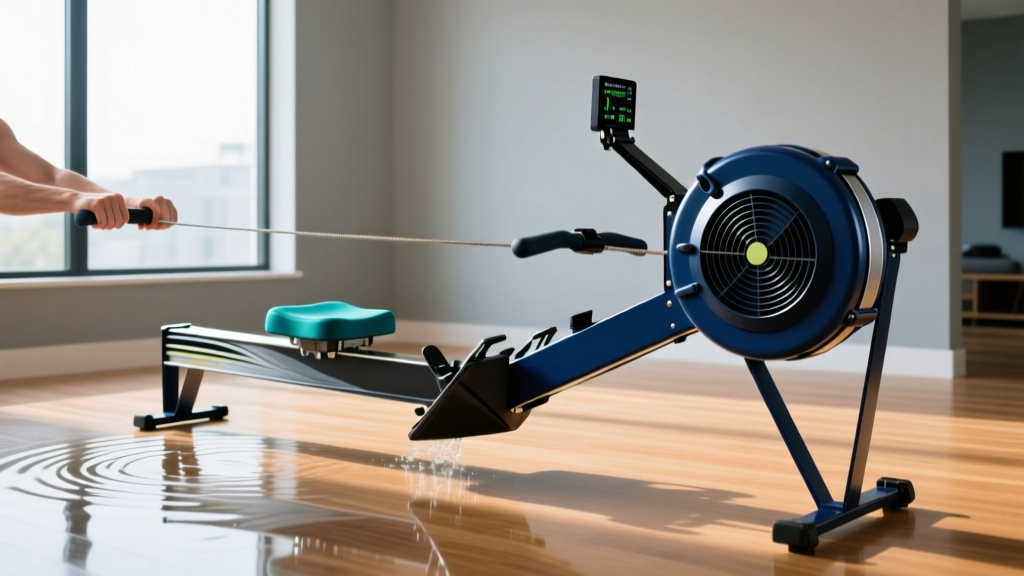
The Concept2 RowErg remains the undisputed champion of home and commercial gyms. Its PM5 performance monitor is completely open, allowing you to connect via Bluetooth to third-party apps like ErgData or Kinomap without a proprietary paywall. The air resistance scales infinitely with your effort, making it ideal for both elite athletes and beginners. The only maintenance required is occasional chain oiling and wiping down the monorail.
2. Hydrow Apollo (Premium Water Resistance)
Price: $1,595 | Resistance: Water | Weight: 108 lbs
While Hydrow is famous for its subscription-based smart rowers, the Apollo model is a standalone, water-resistance machine that operates beautifully without a membership. The polycarbonate water tank provides a highly authentic 'catch' and soothing acoustic feedback. It folds vertically, taking up just 2 square feet of floor space, making it perfect for design-conscious homes.
3. Sunny Health SF-RW5515 (Budget Pick)
Price: $250 | Resistance: Water | Weight: 62 lbs
For those transitioning away from expensive cardio ecosystems, this budget water rower offers incredible value. The LCD monitor is basic but tracks time, stroke count, and calories without any Wi-Fi requirements or app lockouts. The wooden frame aesthetic mimics premium brands at a fraction of the cost, though the foot straps and bungee return cord may require replacement after 2-3 years of heavy use.
Mastering the Technique: The 4-Phase Stroke
According to the American Council on Exercise (ACE), improper rowing technique is the leading cause of lower back pain and suboptimal caloric burn. Rowing is not an arm exercise; it is a powerful leg drive disguised as a full-body movement.
Pro Tip: The 60-20-20 RuleA proper rowing stroke derives 60% of its power from the legs, 20% from the core hinge, and only 20% from the arms. If your biceps are burning before your quads, your sequencing is flawed.
- The Catch: Sit tall with shins vertical (knees directly over ankles). Hinge forward from the hips at roughly a 1-o'clock position. Arms are fully extended, shoulders relaxed.
- The Drive: Initiate the movement by pushing explosively with your legs. Do not pull with your arms yet. Once the legs are nearly straight, hinge the torso back to an 11-o'clock position, then finally draw the handle to your lower ribs.
- The Finish: Legs are fully extended, torso slightly leaned back, handle resting at the sternum. Elbows should be drawn past the ribcage.
- The Recovery: Reverse the sequence exactly. Extend arms, hinge torso forward past the knees, then bend the knees to slide back to the catch. The recovery should take twice as long as the drive (a 1:2 ratio).
The Damper Setting Myth: Understanding Drag Factor
A common mistake among former treadmill users transitioning to rowing is cranking the damper setting to 10, assuming higher resistance equals a better workout. This is a fast track to lumbar fatigue.
'Setting the damper to 10 does not mean you are getting the best workout. It simply changes the feel of the row, much like shifting gears on a bicycle.' - Concept2 Official Training Guide
Instead of focusing on the 1-10 dial, look at the Drag Factor on your monitor's diagnostic menu. For standard aerobic conditioning (equivalent to a steady-state 5K run), aim for a drag factor between 100 and 130. For strength-focused intervals, push it to 130-150. Elite heavyweight rowers typically race at a drag factor of 115-125.
Space, Storage, and Maintenance Realities
When comparing space utility, rowers easily beat out even the best folding treadmills. A treadmill's folding mechanism often requires a heavy hydraulic lift and still dominates a room's vertical and horizontal space.
- Air Rowers: Most separate into two pieces in under 10 seconds. The Concept2 RowErg can be stored in a closet or stood upright (requires an optional $15 vertical stand).
- Water Rowers: Generally do not separate but can be tilted vertically into a corner. Warning: Water rowers require maintenance. You must drop a chlorine tablet into the tank every 6 months to prevent algae growth, which can degrade the polyurethane seals.
- Magnetic Rowers: Often feature a fold-in-half design, but the magnetic brake housing can be bulky. They are the quietest option, ideal for apartment dwellers.
Expert Verdict: Why the Rower Wins the Home Gym Spot
If your primary goal is to escape the recurring revenue models of modern fitness tech, searching for treadmills that don't require a subscription is a valid starting point. However, pivoting your focus to a high-quality rowing machine offers a vastly superior return on investment. You gain a zero-impact, full-body cardiovascular and muscular endurance tool that requires minimal maintenance, occupies a fraction of the space, and natively provides all the performance data you need without a single monthly fee. Whether you choose the indestructible Concept2 RowErg or the aesthetic Hydrow Apollo, you are investing in a lifetime of unrestricted fitness.
More gear to consider
All reviews
NordicTrack Treadmill T6.5s: Feature Comparison & Buying Mistakes

Matrix Treadmill Planet Fitness Effect on Upright, Recumbent & Spin Bikes

High Heels Treadmill Review: Best Walking Pads for Work Shoes
Under Desk Treadmill Review: LifeFitness Club Series Treadmill Care
Virtual Reality Treadmill Buying Guide & Top Setups 2026