Troubleshooting Electrical Safety and Mirrors for a Home Gym Setup
Avoid breaker trips and shattered glass. Our troubleshooting guide covers home gym electrical safety requirements and installing mirrors for a home gym.

The Hidden Dangers of DIY Home Gym Infrastructure
When planning a dedicated workout space, most lifters obsess over the knurling on a power bar or the screen resolution on a smart trainer. Rarely do they consider the structural and electrical bones of the room. Yet, according to the National Fire Protection Association (NFPA), electrical failures and malfunctions are among the leading causes of home structure fires. A home gym is a high-draw environment that pushes standard residential circuits to their limits.
Beyond the risk of tripped breakers and melted wiring, the physical layout of your gym introduces structural hazards. Heavy equipment, dropped weights, and the installation of large wall fixtures all require careful planning. This troubleshooting guide addresses the most critical home gym electrical and safety requirements, with a special focus on the often-overlooked intersection of wall wiring and the placement of large glass fixtures.
Calculating Your Home Gym's Electrical Load
The most common mistake in garage or basement gym setups is overloading a single 15-amp circuit. In North America, a standard 120V/15A circuit provides a maximum of 1,800 watts. However, the National Electrical Code (NEC) dictates that continuous loads (those running for three hours or more, like a space heater or a long cardio session on a motorized treadmill) should not exceed 80% of the circuit's capacity—capping it at a safe 1,440 watts.
If you plug a 1,500-watt space heater into the same outlet as your entertainment center and a motorized treadmill, you will trip the breaker. Worse, if the breaker is outdated or faulty, the wires inside your walls can overheat.
Equipment Power Draw & Circuit Requirements
| Equipment Type | Peak Wattage | Recommended Circuit | Wire Gauge Required |
|---|---|---|---|
| Motorized Treadmill (e.g., Precor TRM 731) | 1,500W - 1,800W | Dedicated 20A (120V) | 12 AWG Copper |
| Smart Rowing Machine (e.g., Concept2 RowErg) | 50W - 100W | Shared 15A or 20A | 14 AWG Copper |
| Portable Space Heater (1500W) | 1,500W | Dedicated 15A or 20A | 14 AWG (15A) / 12 AWG (20A) |
| Mini-Fridge / Air Conditioning Unit | 500W - 1,200W (Surge) | Dedicated 15A or 20A | 14 AWG Copper |
Pro Tip: Hiring a licensed electrician to run a new dedicated 20-amp circuit with 12 AWG wire typically costs between $250 and $450, depending on the distance from your main panel. This is a non-negotiable investment if you are running commercial-grade cardio equipment.
Common Wiring Mistakes and How to Troubleshoot Them
Even with adequate circuits, poor power distribution practices create severe fire and shock hazards. The Consumer Product Safety Commission (CPSC) explicitly warns against the misuse of extension cords and power strips in high-draw environments.
- The Daisy-Chain Mistake: Plugging a surge protector into another surge protector or extension cord violates OSHA and fire safety standards. It increases resistance, causing the cord to overheat. Always plug surge protectors directly into the wall receptacle.
- Undersized Extension Cords: Using a cheap, 16-gauge extension cord to power a 15-amp treadmill is a massive fire hazard. If you absolutely must use an extension cord temporarily, it must be a heavy-duty, 12-gauge (or lower number) cord rated for the amperage of the device. However, a permanent home gym setup should rely on properly installed wall outlets.
- Missing GFCI Protection: If your home gym is in a garage, basement, or shed, NEC code requires Ground Fault Circuit Interrupter (GFCI) outlets. These protect you from lethal shocks if sweat, spilled water bottles, or humidity bridge the gap between live components and grounded surfaces.
Safely Installing Mirrors for a Home Gym (Without Hitting Wiring)
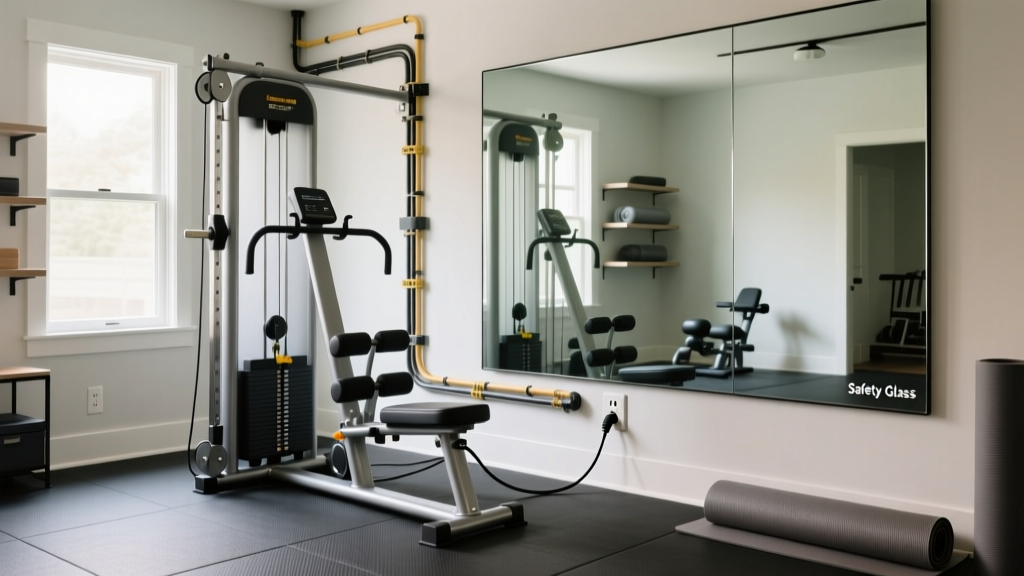
When sourcing and installing mirrors for a home gym, lifters rarely consider the electrical infrastructure hiding behind the drywall. A proper gym mirror setup is crucial for checking form on heavy squats and deadlifts, but mounting large sheets of glass introduces unique electrical and structural hazards.
The 1.25-Inch Rule and Stud Drilling
To safely mount heavy 1/4-inch tempered glass gym mirrors (which can weigh over 100 lbs for a standard 6x8 foot section), you must secure a Z-bar (French cleat) mounting system directly into the wall studs. Here is where the electrical danger lies:
WARNING: The National Electrical Code requires that Romex (NMB) electrical cables running through studs be set back at least 1.25 inches from the face of the stud. If you use standard 2-inch or 2.5-inch drywall screws to secure your mirror's Z-bar cleat, you risk piercing a live electrical wire, causing a short circuit, a hidden wall fire, or electrocution.
The Fix: Always use a high-quality stud finder with built-in AC voltage detection (such as the Klein Tools ET450) to map out exactly where wiring enters and exits the stud bays before drilling. When securing the Z-bar, use 1-inch or 1.25-inch lag screws. Because standard drywall is 1/2-inch thick, a 1-inch screw will penetrate the stud by 1/2-inch, providing ample holding strength for the cleat while staying well clear of the 1.25-inch electrical setback zone.
Mirror Placement and Impact Safety
Electrical safety isn't the only concern when hanging mirrors for a home gym. Placement relative to your equipment is critical. Never mount standard glass mirrors directly behind a dumbbell rack or a kettlebell swing zone. A dropped 50-lb dumbbell will shatter standard glass into dangerous, heavy shards.
Best Practice: If your layout requires mirrors near free-weight drop zones, opt for 1/4-inch acrylic mirrors or apply a shatter-resistant safety film (like 3M Safety & Security Window Film) to the back of tempered glass. This ensures that if an impact occurs, the glass cracks in a spiderweb pattern but remains adhered to the backing, preventing lacerations and protecting the baseboard outlets below from falling debris.
Quick Troubleshooting Checklist for Gym Power Issues
If you are currently experiencing electrical gremlins in your home gym, use this diagnostic matrix to identify and resolve the issue safely.
- Symptom: Treadmill abruptly shuts off and resets after 10-15 minutes of use.
Cause: Overheating motor due to voltage drop from an undersized extension cord, or friction on the running belt causing the motor to draw excess amperage.
Fix: Remove the extension cord, plug directly into a 20A wall outlet, and lubricate the treadmill belt with 100% silicone lubricant. - Symptom: LED overhead gym lights flicker when the mini-fridge compressor kicks on.
Cause: Inrush current from the fridge compressor is causing a momentary voltage sag on a shared circuit, or the LEDs are incompatible with the dimmer switch.
Fix: Move the fridge to a different circuit, or replace the dimmer switch with an ELV (Electronic Low Voltage) dimmer rated specifically for LED loads. - Symptom: GFCI outlet in the garage gym trips randomly, even when equipment is off.
Cause: Moisture intrusion in the outlet box, or a worn-out GFCI sensor (they typically degrade after 7-10 years).
Fix: Install an "in-use" weatherproof outlet cover to block ambient garage humidity, or replace the GFCI receptacle with a new 20A weather-resistant (WR) model.
Frequently Asked Questions
Can I run my home gym equipment on a 240V circuit?
Most residential fitness equipment is designed for standard 120V outlets. However, if you are installing commercial-grade equipment (like a Woodway treadmill or a motorized robotic spotter arm for a squat rack), it may require a 240V circuit. Never use a step-up transformer for high-draw fitness equipment; hire an electrician to install a proper 240V NEMA receptacle.
What is the safest type of mirror for a home gym?
For safety and clarity, 1/4-inch tempered glass with a polished edge and a shatter-resistant backing is the gold standard. Avoid cheap, thin acrylic mirrors for your main lifting zone, as they suffer from severe optical distortion (the "funhouse" effect) which can throw off your spatial awareness during heavy Olympic lifts.
Do I need a dedicated circuit for my smart home gym lighting?
Not necessarily. LED lighting draws very little power (often less than 100 watts for a whole room). You can safely share a 15A lighting circuit with your gym's overhead LEDs, provided the circuit isn't also burdened by high-draw appliances or space heaters.
More gear to consider
All reviews
Weider 8530 Home Gym vs Bowflex PR1000: Remodel Guide

Bowflex PR1000 Home Gym: The Ultimate Beginner Starter Kit Guide

Marcy Home Gym 989 Setup: Mirror & Lighting Budget Guide

Weatherproofing Your BodyBoss Home Gym 2.0 Outdoor Setup
Weatherproofing Your Outdoor All Black Home Gym Setup
