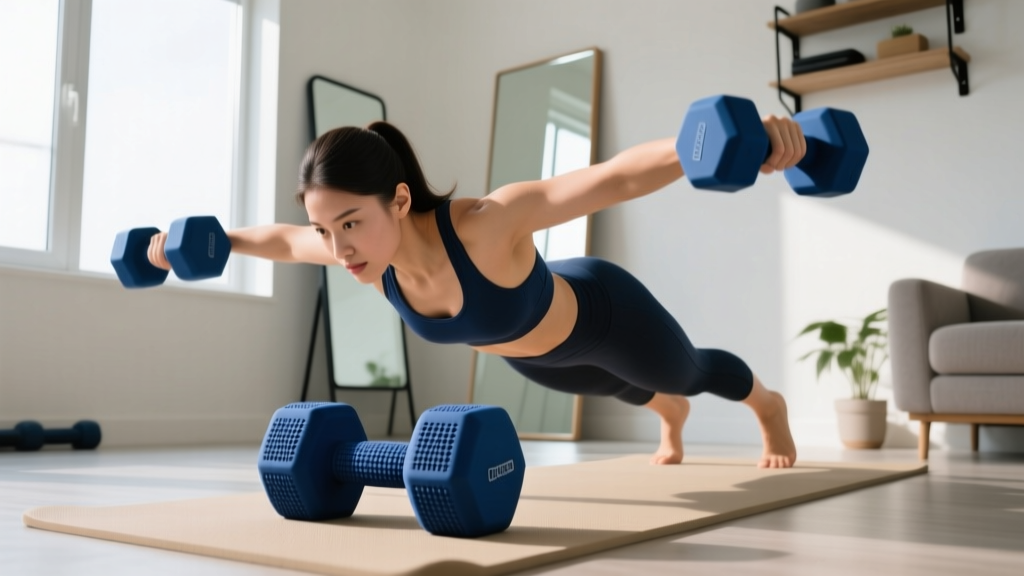
Troubleshooting Dumbbell Laterals with Neoprene Home Weights
Fix common form and grip mistakes when performing dumbbell laterals with neoprene home weights. Expert troubleshooting for better shoulder gains.

The dumbbell lateral raise is the undisputed king of medial deltoid isolation. For home gym owners, neoprene-coated dumbbells are often the default equipment choice for this movement. Why? Because strict laterals require relatively light loads (typically 5 to 25 pounds), and neoprene sets dominate this specific weight tier while protecting hardwood floors and reducing noise. However, the unique material properties of neoprene—combined with the extreme biomechanical leverage of the lateral raise—create a specific set of troubleshooting variables that most lifters ignore.
If your shoulders aren't growing, or if you're experiencing joint pain during your home workouts, the issue likely lies at the intersection of your form and your equipment. This guide breaks down the most common mistakes lifters make when performing dumbbell laterals with neoprene weights and provides actionable, biomechanically sound solutions.
The Neoprene Grip Factor: Why Your Form Might Be Slipping
Neoprene (polychloroprene) is a synthetic rubber prized for its soft, matte finish. Unlike knurled steel or textured urethane, neoprene is slightly porous. During high-repetition sets or intense drop sets, sweat accumulates on the surface, drastically reducing the coefficient of friction between your palm and the dumbbell handle.
⚠️ Equipment Warning: Chalk and NeopreneNever use liquid or block chalk on neoprene dumbbells. The chalk embeds into the porous rubber, creating a slick, hardened paste that permanently ruins the grip texture and transfers a messy residue to your floors and clothing. If sweat is an issue, use a microfiber towel between sets or wear lightweight cotton lifting gloves.
When the neoprene handle becomes slippery, your body subconsciously compensates by overgripping. You squeeze the handle with excessive force, recruiting the flexor carpi ulnaris and radialis (forearm muscles). This premature forearm fatigue limits the neural drive to your medial deltoids, causing you to terminate the set before your shoulders reach true mechanical failure.
4 Biomechanical Mistakes in Dumbbell Laterals (and How to Fix Them)
Mistake 1: The 'Pouring the Pitcher' Internal Rotation Myth
For decades, fitness magazines advised lifters to internally rotate the shoulder (thumb pointing down) at the top of the lateral raise, mimicking 'pouring a pitcher of water.' Modern sports science has thoroughly debunked this. Internal rotation during shoulder abduction forces the greater tuberosity of the humerus to grind against the acromion process, severely increasing the risk of subacromial impingement and supraspinatus tendonitis. According to Johns Hopkins Medicine, repetitive impingement is a leading cause of rotator cuff degradation.
The Fix: Maintain a neutral grip (thumbs slightly higher than pinkies) or a slight external rotation throughout the entire range of motion. This clears the subacromial space and isolates the medial delt safely.
Mistake 2: Ego Lifting and Lumbar Extension
Because neoprene dumbbells are visually associated with 'lightweight' aerobics, lifters often suffer from bruised egos and attempt to swing 20 lb or 25 lb neoprene dumbbells using momentum. This involves leaning back, extending the lumbar spine, and using the upper trapezius to heave the weight up. The medial deltoid is a small, pennate muscle; it cannot handle heavy loads without assistance from larger muscle groups.
The Fix: Perform the movement seated on a flat bench, or stand with your glutes squeezed and core braced. If you cannot pause the dumbbell for one full second at the top of the movement (arm parallel to the floor), the weight is too heavy. Drop down to the next neoprene increment (usually a 2.5 lb or 5 lb jump).
Mistake 3: Scapular Elevation (Shrugging the Weight)
As the arms approach 90 degrees of abduction, the upper traps naturally want to take over to lift the scapula. If you initiate the lift by shrugging, you shift the tension away from the lateral delt and onto the levator scapulae and upper traps.
The Fix: Actively depress your scapula (pull your shoulder blades down into your back pockets) before initiating the raise. Keep your neck relaxed and eyes fixed straight ahead.
Mistake 4: Incorrect Elbow Flexion Angle
The lateral raise is a third-class lever. The further the weight is from the axis of rotation (the shoulder joint), the higher the torque. Bending the elbows to 90 degrees drastically shortens the lever arm, making the exercise too easy and shifting tension to the anterior delt. Conversely, locking the elbows completely straight places undue shear stress on the elbow joint capsule.
The Fix: Maintain a slight, fixed bend in the elbow (about 10 to 15 degrees). Think about leading the lift with your elbows, not your hands.
Weight Selection: Matching Neoprene Dumbbells to Your Lever Arm
Neoprene dumbbells are typically sold in fixed increments from 3 lbs to 20 lbs. Because the lateral raise is highly sensitive to leverage, selecting the correct weight is critical. Below is a data-driven framework for selecting your working weight for strict, seated dumbbell laterals in 2026.
| Experience Level | Target Rep Range | Men (Per Dumbbell) | Women (Per Dumbbell) |
|---|---|---|---|
| Beginner (0-6 months) | 12 - 15 reps | 5 - 8 lbs | 3 - 5 lbs |
| Intermediate (6-24 months) | 10 - 15 reps | 10 - 15 lbs | 5 - 10 lbs |
| Advanced (2+ years) | 8 - 12 reps | 15 - 22.5 lbs | 10 - 15 lbs |
Handle Diameter Note: When buying neoprene sets from brands like CAP Barbell or Yes4All, be aware that handle thickness scales with weight. A 5 lb neoprene dumbbell typically features a narrow 32mm-35mm handle, which is highly ergonomic for isolation work. However, 15 lb and 20 lb neoprene dumbbells often utilize thicker 38mm-40mm handles to support the denser iron core. This increased girth accelerates grip fatigue, reinforcing the need to control the eccentric phase rather than over-squeezing.
Troubleshooting Joint Pain: The Scapular Plane Adjustment
If you are executing the movement with perfect form but still experience a pinching sensation in the front or side of your shoulder, you are likely lifting strictly in the frontal plane. The shoulder joint is not designed to abduct perfectly sideways. To align with the natural orientation of the glenoid fossa, you must lift in the scapular plane (scaption). As detailed in the biomechanical breakdowns by ExRx, moving the arms slightly forward optimizes the length-tension relationship of the deltoid fibers.
- Step 1: Stand with your feet shoulder-width apart, holding your neoprene dumbbells at your sides.
- Step 2: Instead of keeping the dumbbells directly in line with your ears, bring them forward by about 20 to 30 degrees. Your hands should be hovering just in front of your outer thighs at the starting position.
- Step 3: Raise the dumbbells along this forward-angled path until your arms are parallel to the floor.
- Step 4: Control the negative (eccentric) phase for a full 2 seconds, resisting gravity as the neoprene coating glides back down your outer thighs.
Frequently Asked Questions
My forearms give out before my shoulders. Should I use lifting straps?
Using traditional lifting straps for lateral raises is generally not recommended, as it alters the wrist mechanics and can create an unnatural lever pull. Instead, try using lifting hooks or loosely wrapping standard cotton figure-8 straps just to secure the grip without pulling on the wrist joint. Alternatively, switch to a hex-rubber dumbbell with a knurled steel handle for your heavy lateral sets, saving the neoprene for higher-rep, lighter burnout sets.
Why does my neoprene dumbbell smell and feel sticky?
Neoprene is susceptible to UV degradation and bacterial buildup from sweat. If your dumbbells feel sticky or emit a sour odor, the synthetic rubber is breaking down. Wipe them down weekly with a 50/50 mixture of white vinegar and water. Never leave neoprene dumbbells in direct sunlight or a hot garage, as heat accelerates the off-gassing and melting of the polychloroprene coating.
Are adjustable dumbbells better than fixed neoprene for laterals?
While adjustable dumbbells (like Bowflex or Nuobell) are excellent for heavy presses and rows, their bulky physical footprint makes them awkward for strict lateral raises. The wide ends of adjustable dumbbells can bump against your hips at the bottom of the movement, and their large cages alter the center of gravity. Fixed 5 lb to 15 lb neoprene dumbbells remain the superior, cost-effective choice (averaging $1.50 to $2.00 per pound in 2026) for pure, unobstructed shoulder isolation.
Mastering the dumbbell lateral raise requires respecting both human biomechanics and the physical limitations of your equipment. By correcting your grip, lifting in the scapular plane, and selecting the appropriate neoprene weight tier, you will eliminate joint pain and force the medial deltoids to grow.
More gear to consider
All reviews
Best Loadable Dumbbell Weight Systems: 2026 Hands-On Review

Olympic vs Standard Plates & Shadow Boxing with Dumbbells
EZ vs Straight Bar Care & Upper Back Exercises with Dumbbells
Deadlift Exercise with Dumbbells: Adjustable Set Setup & 2026 Review

EZ Curl Bar vs Straight Bar: Space Layouts & Dumbbell Tricep Exercises
