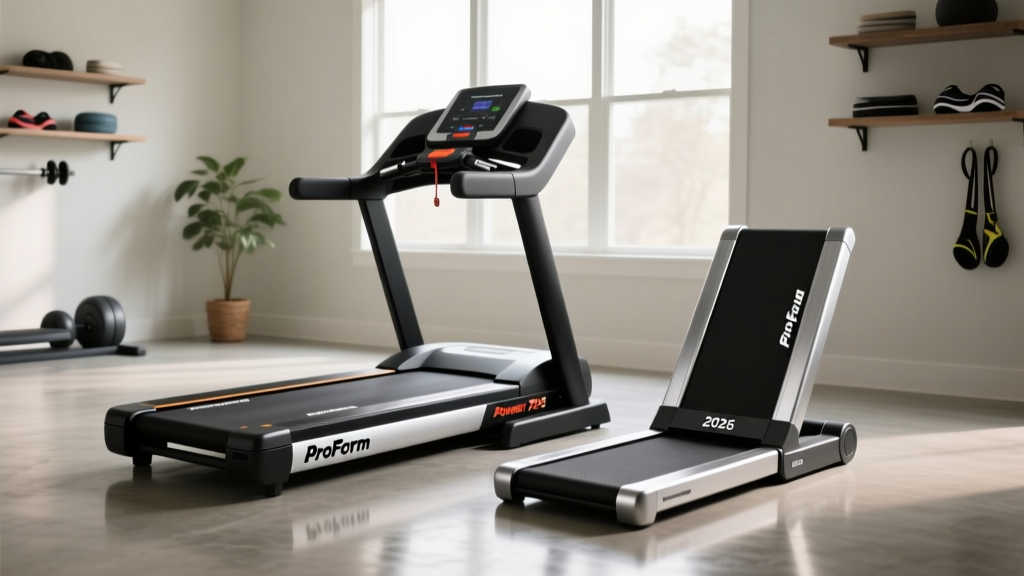
Treadmill for Walking Exercise vs Bikes: 2026 Budget
Compare the budget and value of a treadmill for walking exercise against stationary bike types (upright, recumbent, spin). Find your best 2026 cardio fit.

The 2026 Cardio Dilemma: Walking Treadmills vs. Stationary Bikes
When outfitting a home gym on a strict budget, buyers frequently debate the merits of a treadmill for walking exercise against the diverse world of stationary bikes. According to the American Heart Association, adults need at least 150 minutes of moderate-intensity aerobic activity per week. Both walking pads and indoor cycles fulfill this requirement, but their long-term financial footprints, spatial demands, and biomechanical wear profiles differ drastically.
This comprehensive budget breakdown dissects the true cost of ownership in 2026, pitting entry-level walking treadmills against the three primary stationary bike types: upright, recumbent, and spin (indoor cycling).
Baseline Budget: The Treadmill for Walking Exercise
Not everyone needs a $3,000 commercial-grade running machine. For low-impact, steady-state cardio, a dedicated treadmill for walking exercise is a highly efficient investment. However, "budget" in the treadmill space is a relative term riddled with hidden failure modes.
Upfront Costs and Model Tiers
- Under-Desk Walking Pads (e.g., WalkingPad R2, UREVO): Ranging from $299 to $599. These feature 1.0 to 1.25 CHP (Continuous Horsepower) motors and 15-inch to 17-inch belt widths.
- Standard Walking Treadmills (e.g., Sunny Health SF-T723016, Horizon T101): Priced between $450 and $899. You get a 2.0 to 2.5 CHP motor, a 20-inch belt, and basic shock absorption.
Maintenance and Failure Modes
Walking treadmills require strict adherence to maintenance schedules. The primary failure point is belt friction. If you neglect to apply 100% silicone lubricant every 40 hours of use, the deck will warp, and the motor will draw excess amperage, eventually tripping your home circuit breaker. Budget $25 annually for lubricant and eventual deck replacement.
Stationary Bike Types: Upright, Recumbent, and Spin
If spatial constraints or joint limitations make a treadmill for walking exercise impractical, stationary bikes offer compelling alternatives. Let us break down the three distinct categories by budget and biomechanical value.
1. Upright Bikes: The Traditional Budget Option
Upright bikes simulate a traditional bicycle posture but with a wider, more padded seat and a heavier flywheel for momentum.
- Price Range: $250 (Basic magnetic resistance) to $899 (Electromagnetic with interactive displays).
- Top Value Pick: Schwinn 170 Upright ($699). Features a 25-pound flywheel and dual-track LCD displays.
- Value Proposition: Excellent for seniors or those recovering from lower-body injuries. The vertical footprint is minimal (often under 4 square feet).
- Failure Modes: Cheap uprights use tension-cable magnetic resistance that stretches and snaps over time. Opt for models with digital electromagnetic resistance (ECB) systems, which have zero physical contact and virtually no wear parts.
2. Recumbent Bikes: Ergonomic Value and Joint Support
Recumbent bikes feature a step-through design with a bucket seat positioned behind the pedal crank. This shifts the user's center of gravity, eliminating load from the lumbar spine and wrists.
- Price Range: $399 to $1,800.
- Top Value Pick: Sole SR500 ($1,099) or JLL RE100 ($399 for extreme budgets).
- Value Proposition: Unmatched for users with sciatica, herniated discs, or severe obesity. Mayo Clinic experts frequently recommend recumbent cycling for sustainable, joint-friendly aerobic conditioning.
- Failure Modes: The seat rail adjustment mechanism on budget models (under $500) often relies on plastic pop-pins that shear off under heavy lateral stress. Always invest in a steel spring-pin adjustment system.
3. Spin (Indoor Cycling) Bikes: High-Intensity ROI
Spin bikes are built for high-cadence, out-of-the-saddle intervals and aggressive riding postures. They are the closest indoor equivalent to outdoor road cycling.
- Price Range: $450 to $2,500+.
- Top Value Pick: Schwinn IC4 ($799) or Echelon EX-5s ($1,299).
- Value Proposition: Highest caloric expenditure per minute. A vigorous spin session can burn 600-800 calories per hour, significantly outpacing a moderate walking pace.
- Failure Modes: Chain-driven budget spin bikes require monthly tensioning and lubrication. Furthermore, sweat corrosion is a massive killer of spin bike bottom brackets. In 2026, always buy a bike with a sealed cartridge bottom bracket and a belt-drive system (like Gates Carbon Drive) to eliminate drivetrain maintenance entirely.
2026 Value Comparison Matrix
| Equipment Type | Avg. Entry Cost | 5-Year Maintenance | Footprint (Sq Ft) | Best For |
|---|---|---|---|---|
| Walking Pad / Treadmill | $350 - $600 | $125 (Lube/Belt) | 12 - 18 | NEAT, Under-desk use |
| Standard Walking Treadmill | $500 - $900 | $200 (Lube/Deck) | 25 - 30 | Brisk walking, Light jog |
| Upright Bike | $300 - $700 | $0 - $50 | 4 - 6 | Compact spaces, Rehab |
| Recumbent Bike | $400 - $1,100 | $50 (Seat mesh) | 10 - 14 | Back pain, Seniors |
| Spin Bike (Belt Drive) | $600 - $1,000 | $0 | 8 - 10 | HIIT, Weight loss |
Hidden Costs: Space, Power, and Noise
When evaluating the true budget of a treadmill for walking exercise versus a stationary bike, buyers often ignore environmental costs.
"Acoustic pollution and floor loading are the silent budget killers in home fitness. A 150-pound user walking on a budget treadmill generates repetitive impact forces that can crack laminate flooring and disturb downstairs neighbors, necessitating a $100-$150 high-density EVA foam mat."
Electrical Draw: Walking treadmills pull between 6 to 12 amps under load. If you are plugging your treadmill into a shared 15-amp bedroom circuit alongside a space heater or AC unit, you will trip the breaker. Upright and recumbent bikes with electromagnetic resistance draw less than 2 amps, while self-generating spin bikes require zero wall power.
Resale Value: According to fitness industry depreciation trends, high-end spin bikes retain roughly 40-50% of their value after three years. Budget walking treadmills, due to high wear on the deck and motor, retain less than 15% of their original purchase price on the secondary market.
Practical Decision Framework for 2026 Buyers
To eliminate buyer's remorse, apply this three-step diagnostic before checking out:
- The Joint-Audit: Stand up and perform a deep bodyweight squat. If you experience patellar tendon pain or lumbar compression, immediately cross the treadmill for walking exercise off your list. The repetitive heel-strike impact, even at 3.0 mph, transmits up to 1.5 times your body weight through your kinetic chain. Pivot to a recumbent bike.
- The Spatial-Mapping: Measure your ceiling height. Standard walking treadmills elevate the user by 6 to 8 inches. If your ceiling is 8 feet and you are 6 feet tall, you will experience claustrophobia and potential head-strikes. Spin bikes and recumbent bikes keep your head at baseline elevation.
- The Sweat-Corrosion Test: If you are a heavy sweater, avoid friction-resistance spin bikes and budget treadmills with exposed motor housings. Sweat is highly acidic and will corrode the aluminum flywheels and steel decks within 24 months. Demand sealed magnetic resistance and powder-coated steel frames.
The Final Verdict: Maximizing Your Cardio Budget
Choosing between a treadmill for walking exercise and a stationary bike ultimately hinges on your biomechanical needs and spatial reality. As Harvard Health notes, the "best" exercise is simply the one you will perform consistently without pain.
If your goal is to increase daily NEAT (Non-Exercise Activity Thermogenesis) while working from home, a $499 under-desk walking pad is an unbeatable investment. However, if you suffer from lumbar radiculopathy or live in a small apartment with strict noise ordinances, allocating that same $500 budget toward a mid-tier magnetic recumbent bike or a belt-driven spin bike will yield a vastly superior 5-year return on investment, with zero lubrication required and a fraction of the acoustic footprint.
More gear to consider
All reviews
Stair Climber vs ProForm 750 Treadmill: Home Guide

Walking Pad vs Assault Treadmill: A Beginner's Step-by-Step Guide

ProForm 9000 Treadmill Reviews: 2026 Belt Maintenance Trends
Under Desk Treadmill Office Review: Matrix Treadmill Review Care

2026 Trends: Livestrong LS8 0 Treadmill vs Stationary Bike Types