Is Running on the Treadmill the Same as Running Outside? 2026 Guide
Is running on the treadmill the same as running outside? Discover the biomechanical differences and use our 2026 feature comparison to buy the right machine.

Is running on the treadmill the same as running outside? Biomechanically, the two modalities are nearly identical, but environmental resistance and psychological engagement differ significantly. When comparing running on treadmill vs outside, the primary distinction is that a motorized belt assists with leg turnover, while outdoor running requires active propulsion against wind and varied terrain. This guide is designed for beginner runners, marathon trainees, and recreational athletes deciding how to allocate their weekly mileage. Modern 2026 smart treadmills feature adaptive cushioning, yet they cannot fully replicate the stabilizing demands of natural environments. Understanding these differences ensures you train effectively for your specific goals, whether that involves completing a local 5K race or maintaining general cardiovascular health during winter months.
- Treadmill belts assist leg turnover, reducing hamstring activation compared to outdoor running.
- Setting a 1% to 2% incline on a treadmill accurately simulates outdoor air resistance.
- Outdoor running burns 5% to 10% more calories due to wind drag and terrain variability.
- Modern treadmills offer up to 40% greater shock absorption than standard asphalt surfaces.
Biomechanics: Is Running on the Treadmill the Same as Running Outside?
Muscle Activation and Joint Impact
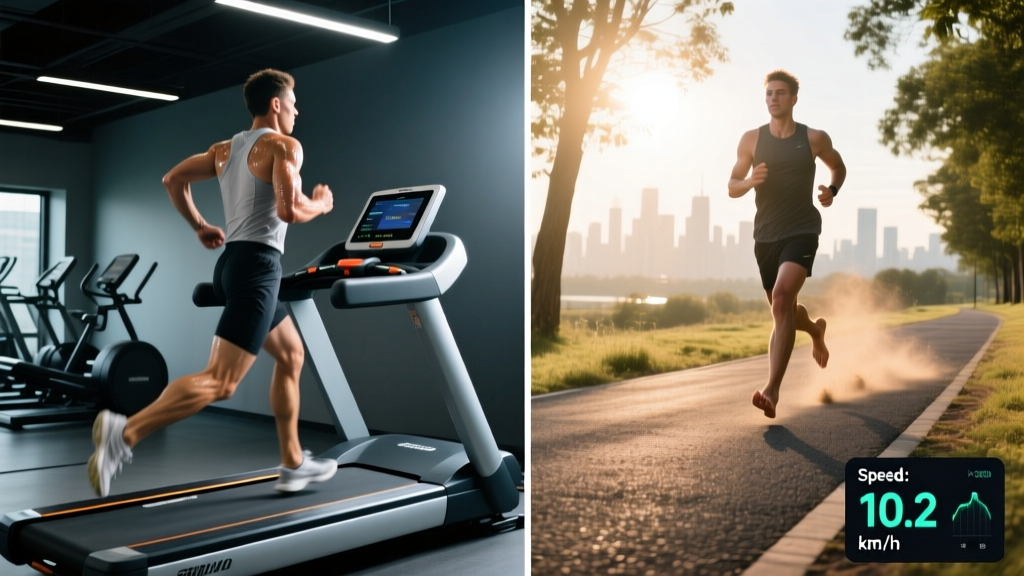
When analyzing is running on the treadmill the same as running outside, muscle recruitment patterns reveal subtle but critical differences. Overground running requires the hamstrings and glutes to actively pull the body forward over a stationary surface. In contrast, the moving belt of a treadmill pulls the leg backward, reducing the mechanical load on the posterior chain.
Research indexed by the National Library of Medicine confirms that outdoor running demands greater stabilizing muscle activation. Navigating uneven pavement, grass, or trails forces the ankle and hip stabilizers to work continuously. Treadmill running provides a perfectly flat, predictable surface, which is beneficial for injury rehabilitation but limits functional strength development.
The 1% Incline Rule
To accurately replicate the energy cost of outdoor running, you must account for the lack of wind resistance indoors. Setting your machine to a 1% to 2% incline effectively mimics the aerodynamic drag experienced when running outdoors at a moderate pace. Without this adjustment, treadmill running artificially inflates your perceived fitness level.
Furthermore, joint impact varies significantly between the two modalities. High-end 2026 treadmill models feature multi-zone shock absorption systems that reduce impact forces by up to 40% compared to standard asphalt. This makes indoor running a superior choice for athletes managing shin splints or recovering from stress fractures.
Environmental and Psychological Factors
Weather and Terrain Variability
The most obvious advantage of treadmill versus running outside is environmental control. Outdoor runners must contend with temperature fluctuations, humidity, and precipitation, all of which elevate cardiovascular strain. Running outdoors in 85-degree heat forces the body to divert blood flow to the skin for cooling, raising your heart rate by 10 to 15 beats per minute compared to a climate-controlled gym.
Conversely, outdoor terrain variability builds robust physical resilience. Hill running, cambered roads, and technical trails force constant micro-adjustments in stride length and cadence. This variability prevents the repetitive strain injuries often associated with maintaining an identical 180 steps per minute cadence on a flat treadmill belt for extended durations.
Pacing and Mental Engagement
Pacing outdoors requires internal awareness and discipline, as the runner must actively manage their effort against changing topography. Treadmills enforce an external pace, which can lead to a false sense of fitness when transitioning to race day. The mental engagement required to navigate traffic, avoid obstacles, and process scenic stimuli makes outdoor running psychologically stimulating, whereas treadmill running often requires external distraction like video screens or podcasts to combat monotony.
Treadmill Versus Running Outside: Decision Framework
Use the following comparison matrix to determine which modality best fits your current training phase and physical condition.
| Training Scenario | Recommended Modality | Primary Rationale |
|---|---|---|
| Recovering from joint injury | Treadmill | 40% greater shock absorption reduces skeletal loading. |
| Building race-day resilience | Outside | Terrain variability and air resistance mimic actual event conditions. |
| Executing precise interval splits | Treadmill | Motorized belt enforces exact speeds up to 15 mph maximum speed. |
| Improving mental toughness | Outside | Exposure to weather and lack of forced pacing builds psychological grit. |
| High-intensity calorie burn | Outside | Outdoor running burns 5% to 10% more calories due to wind drag. |
Frequently Asked Questions
Key Terminology Definitions
Proprioception: Proprioception is the body's ability to sense its location, movements, and actions in space. In outdoor running, uneven surfaces constantly challenge proprioceptive feedback loops, requiring micro-adjustments in foot placement and ankle stabilization that are largely absent when running on a flat, predictable motorized treadmill belt.
Air Resistance Penalty: The air resistance penalty refers to the extra metabolic energy a runner expends to push through atmospheric drag while moving forward outdoors. This aerodynamic friction increases exponentially with speed, meaning sprinters face a significantly higher physiological tax outside compared to stationary indoor treadmill environments where ambient air remains still.
Does running on a treadmill burn the same calories as outside?
No. Outdoor running typically burns 5% to 10% more calories than treadmill running at the exact same speed. This caloric discrepancy is driven by the air resistance penalty, the mechanical work required to propel your body mass forward without belt assistance, and the activation of stabilizing muscles on uneven ground.
Are treadmills bad for your knees?
Treadmills are not inherently bad for your knees. In fact, the engineered deck flex on modern machines reduces ground reaction forces compared to concrete sidewalks. However, running exclusively on a treadmill can lead to overuse injuries if you fail to vary your incline and speed, as the perfectly repetitive motion stresses the exact same tissue fibers repeatedly.
Conclusion and Next Steps
Is running on the treadmill the same as running outside? While the fundamental cardiovascular and muscular benefits remain consistent, the biomechanical assistance of the belt and the absence of environmental variables make them distinct training tools. Neither modality is universally superior; rather, they serve complementary roles in a comprehensive running program. Treadmills excel at controlled pacing and joint preservation, while outdoor running builds functional resilience and race-specific endurance.
Your Next Step: Audit your current weekly mileage. If 100% of your runs occur on a treadmill, schedule two outdoor runs this week on varying terrain to rebuild your proprioceptive feedback loops. If you run exclusively outside, add one treadmill session featuring precise 1% incline intervals to refine your pacing accuracy.
More gear to consider
All reviews
Air Bike vs Assault: Treadmill Running Versus Outdoor Running Value

Rowing Guide and Technique: Reebok FR20Z Floatride Treadmill Comparison

Escape the Sheep Treadmill Trap: Small Space Budget Guide

Compact Gym Layouts: Bike Types vs Sprint Interval Training Treadmill

Bike Types vs Treadmill Fat Burning Walking Workouts: Value Breakdown