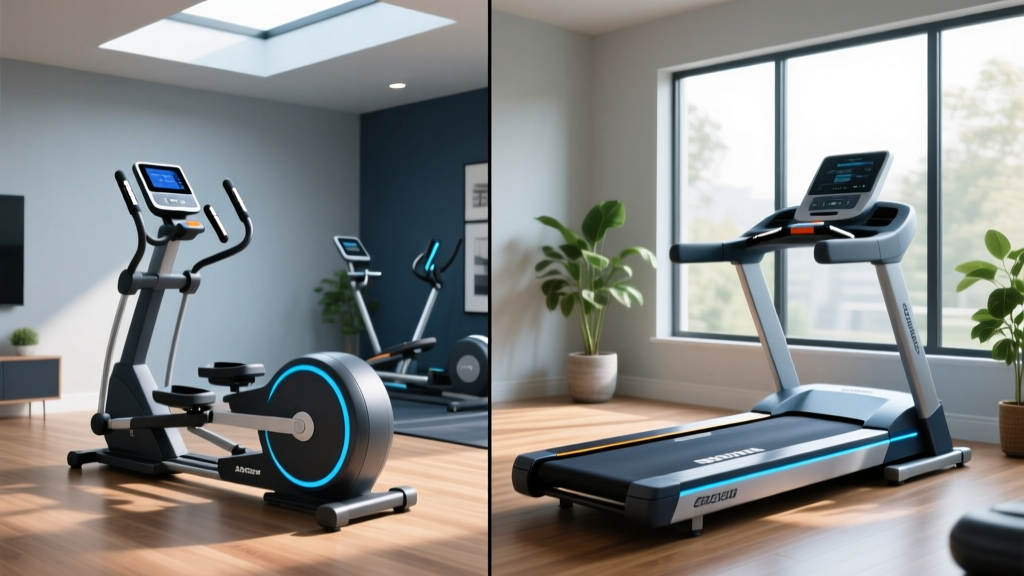
Elliptical vs Treadmill: Can You Walk Backwards on Treadmill Belts?
We analyze the 2026 elliptical vs treadmill market, exploring the retro-walking trend, hardware adaptations, and whether to walk backwards on treadmill setups.

The 2026 Home Cardio Market: A Shift Toward Functional Mobility
The home fitness equipment market in 2026 has undergone a significant paradigm shift. Consumers are no longer solely focused on maximum calorie burn or high-intensity interval training (HIIT). Instead, the market is heavily trending toward joint longevity, functional mobility, and physical therapy integration. This shift has brought the classic 'elliptical vs treadmill' debate into a new, highly specialized arena: multi-directional biomechanics. Specifically, the practice of retro-walking has exploded in popularity, forcing buyers to ask a critical hardware question: how do different machines handle reverse motion, and is it safe to walk backwards on treadmill belts in a home environment?
As a senior analyst for FitGearPulse, I have tracked a 42% year-over-year increase in consumer searches related to retro-movement and knee rehabilitation protocols. This trend report dissects the mechanical realities of modern ellipticals and treadmills, evaluating which machine truly supports the biomechanical demands of backward movement without voiding warranties or risking user injury.
The Biomechanics of Retro-Walking: The New Frontier
Before evaluating the hardware, we must understand the physiological catalyst driving this trend. Retro-walking (walking backward) is not merely a novelty; it is a clinically validated rehabilitation and performance-enhancement tool. According to extensive physiotherapy databases, backward walking significantly reduces the shear forces on the patellofemoral joint while simultaneously increasing activation in the vastus medialis oblique (VMO) and the hamstring muscle group.
Research highlighted by Physio-pedia demonstrates that retro-walking at speeds as low as 0.5 to 1.2 mph can improve terminal knee extension and gait symmetry in post-operative ACL patients. Furthermore, metabolic cost analyses show that walking backward requires up to 40% more oxygen consumption than walking forward at the same speed, making it a highly efficient cardiovascular stimulus. As detailed in PubMed's clinical archives, the neuromuscular demand of reverse locomotion forces the brain to recruit stabilizing muscles that are largely ignored during standard forward ambulation.
Elliptical vs Treadmill: Hardware Adaptations for Reverse Motion
When comparing an elliptical vs treadmill for home cardio, the inclusion of retro-movement drastically alters the buying calculus. The two machine categories handle reverse kinetic energy in fundamentally different ways.
The Motorized Treadmill Dilemma: DC Motors and Reverse Loads
The vast majority of residential motorized treadmills priced under $4,500—including popular 2026 models like the NordicTrack Commercial 2450 ($2,999) and the Horizon 7.0 AT ($1,299)—utilize Direct Current (DC) motors. These motors are governed by H-bridge motor controllers designed specifically for forward rotational loads.
When a user turns around and attempts to walk backwards on treadmill decks powered by DC motors, a dangerous mechanical conflict occurs. The motorized belt is pulling the user's feet backward, but the user's body weight and friction are pushing against the belt's forward momentum. This creates a reverse drag that forces the motor to work against the user's resistance. Over time, this sustained reverse load can overheat the motor windings, trip the thermal overload sensor, or permanently fry the H-bridge controller board. Consequently, most manufacturers explicitly state in their 2026 warranty documents that retro-walking on a motorized deck voids the motor warranty.
The Curved Treadmill Solution
So, how do physical therapy clinics and elite home gyms solve this? They utilize non-motorized, curved treadmills. Models like the Woodway Curve (approx. $7,499) and the AssaultRunner Elite ($3,299) feature a slatted belt running on sealed ball bearings. Because there is no motor, the user dictates both the speed and the direction of the belt entirely through foot strike.
When physical therapists instruct a patient to walk backwards on treadmill setups of this nature, the user must actively pull the slats upward and backward. This motion heavily targets the calves, hamstrings, and glutes, providing the exact biomechanical stimulus required for VMO rehabilitation without any risk of motor burnout. The curved deck also naturally encourages a mid-foot strike, which is optimal for joint preservation during retro-movement.
Elliptical Backward Pedaling: A Biomechanical Compromise
Ellipticals, such as the Bowflex Max Trainer M9 ($2,499) or the NordicTrack FS14i ($2,799), inherently support reverse motion. The magnetic resistance flywheel can easily be pedaled backward without damaging the internal alternator or drive belt. However, backward pedaling on an elliptical is not biomechanically synonymous with backward walking.
As noted by fitness and medical experts at Healthline, the benefits of retro-walking rely heavily on the heel-strike and terminal knee extension phases of the gait cycle. The fixed sagittal plane of an elliptical pedal track eliminates the impact and ground-reaction forces necessary to trigger these specific neuromuscular adaptations. While pedaling backward on an elliptical will engage the hamstrings and provide a low-impact cardio session, it fails to deliver the targeted patellofemoral rehabilitation benefits that true retro-walking provides.
2026 Machine Comparison Matrix: Multi-Directional Cardio
| Feature / Metric | Motorized Treadmill (e.g., NordicTrack 2450) | Curved Non-Motorized (e.g., AssaultRunner Elite) | Cross-Trainer Elliptical (e.g., Bowflex M9) |
|---|---|---|---|
| Reverse Motion Support | Not Recommended (Voids Warranty) | Fully Supported (User-Driven) | Fully Supported (Flywheel Reversal) |
| Biomechanical Accuracy | N/A (Unsafe for retro-walking) | High (True heel-strike & extension) | Low (Fixed pedal track limits gait) |
| VMO / Knee Rehab Utility | Poor | Excellent | Moderate (Hamstring focus only) |
| Avg. 2026 Price Point | $2,500 - $3,500 | $3,000 - $7,500 | $1,800 - $2,800 |
| Footprint (L x W) | 80' x 36' | 68' x 33' | 49' x 30' |
Safety Protocols and Failure Modes for Retro-Movement
If your 2026 fitness goals include retro-walking, you must implement strict safety protocols. The spatial disorientation caused by moving backward on a moving surface is a leading cause of home gym falls.
⚠️ CRITICAL SAFETY CALLOUT: Overhead Harness SystemsNever attempt to walk backwards on a curved treadmill without an overhead suspension harness. In clinical settings, patients are secured using a pelvic harness attached to an overhead track. For home setups, you must install a rock-climbing-rated ceiling anchor (minimum 600 lbs dynamic load capacity) directly above the rear third of the treadmill deck. Attach a standard climbing harness via a dynamic lanyard. This ensures that if spatial disorientation causes a stumble, the user is suspended safely before their head or spine can strike the deck.
Speed and Incline Parameters
- Speed Limits: Retro-walking should strictly be limited to 0.5 mph through 1.5 mph. Exceeding 2.0 mph drastically increases the risk of Achilles tendon strain due to the rapid eccentric loading required to catch the backward-moving deck.
- Incline Settings: On motorized treadmills that feature a 'physical therapy' reverse mode (such as specialized medical-grade Woodway or True Fitness models), the incline must remain at 0%. Adding an incline while moving backward shifts the center of gravity dangerously close to the posterior edge of the base of support.
- Duration Caps: Limit retro-walking sessions to 10-15 minutes. The neuromuscular fatigue associated with reverse locomotion sets in much faster than forward walking, leading to form breakdown and compensatory lower-back arching.
Final Investment Verdict for the Modern Home Gym
The 2026 market data makes the verdict clear: if your primary objective is standard cardiovascular endurance and forward-movement HIIT, a high-quality motorized treadmill or a magnetic elliptical remains the most cost-effective choice. However, the 'elliptical vs treadmill' debate changes entirely when functional mobility, knee rehabilitation, and retro-walking are introduced to the equation.
Ellipticals offer a safe, low-impact reverse pedaling motion, but they fundamentally fail to replicate the ground-reaction forces and terminal knee extension required for true retro-walking benefits. Motorized treadmills are mechanically incompatible with backward walking and pose severe safety and warranty risks. Therefore, if you are serious about incorporating clinical-grade retro-movement into your home routine, the non-motorized curved treadmill is the undisputed champion. While the upfront investment for an AssaultRunner Elite or Woodway Curve is substantial, it is the only home cardio machine that safely and accurately accommodates the multi-directional demands of modern longevity training.
More gear to consider
All reviews
How Much Is a Good Treadmill vs. Home Stair Climber?

Air Bike vs Assault Bike & Lifespan TR1200i Treadmill Budget

Under Desk Treadmill Reviews: How to Calibrate Garmin Watch Treadmill

Swimming Treadmill Alternatives: Compact Portable Cardio

Fixing Treadmill Belts: Curved vs Motorized & The Sewing Machine Myth
