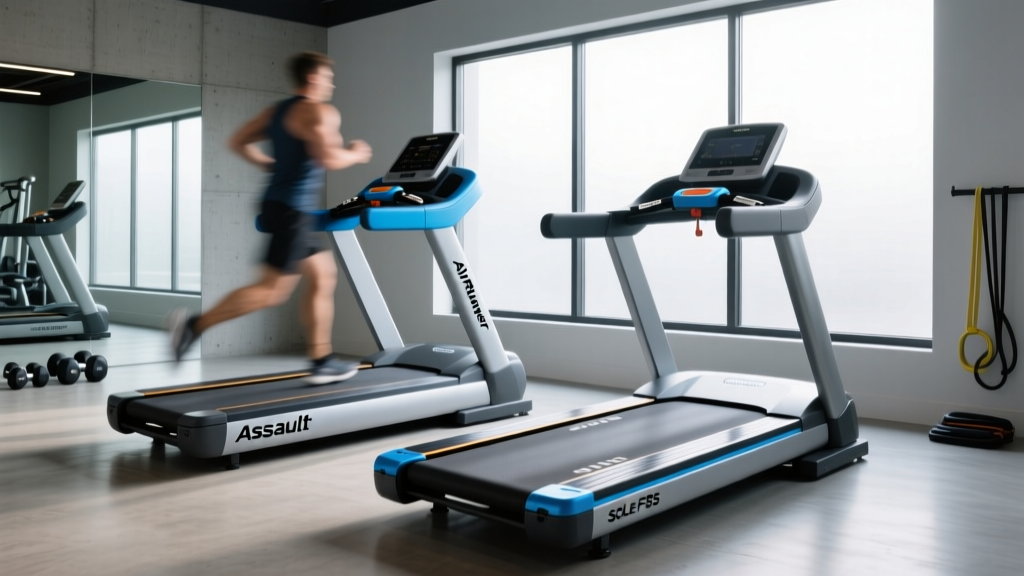
Treadmill Sprints Guide: Assault AirRunner vs Sole F85
Master treadmill sprints with our head-to-head comparison of the Assault AirRunner and Sole F85. Discover specs, biomechanics, and the best fit for HIIT.

The Biomechanics of Treadmill Sprints: Curved vs. Motorized
Executing high-intensity treadmill sprints requires equipment that can handle explosive force, rapid acceleration, and heavy biomechanical loads. In 2026, the market is dominated by two distinct philosophies for sprint interval training (SIT): the manual curved deck and the heavy-duty motorized flat deck. To help you build the ultimate home HIIT station, we are putting the gold-standard manual treadmill, the Assault AirRunner, head-to-head against the premier motorized powerhouse, the Sole F85.
When you perform treadmill sprints, the deck beneath your feet dictates your muscle recruitment. Motorized treadmills pull your foot backward, which slightly reduces hamstring and glute activation compared to overground running. Conversely, manual curved treadmills force you to drive the belt yourself, requiring a forefoot strike and significantly higher posterior chain engagement.
The Energy Expenditure Spike
Research published in the Journal of Strength and Conditioning Research indicates that running on a curved, non-motorized treadmill increases caloric expenditure by up to 30% compared to a motorized treadmill at the same perceived exertion. The manual resistance forces your muscles to do the work that a motor would otherwise handle, making curved decks highly efficient for short, brutal sprint intervals.
Head-to-Head Specification Matrix
Before diving into the nuances of sprint mechanics on each machine, let us look at the raw data. These specifications reflect the current 2026 manufacturing standards for both models.
| Feature | Assault AirRunner | Sole F85 |
|---|---|---|
| Drive System | 100% Manual (User-Powered) | 4.0 CHP Motorized |
| Max Speed | Unlimited (User-Dependent) | 12 MPH |
| Belt Type | Vulcanized Rubber Slat Belt | 2-ply Cushion Flex (22in x 60in) |
| Incline/Decline | Fixed Curved Geometry | 0% to 15% Incline |
| Weight Capacity | 350 lbs | 400 lbs |
| MSRP (2026) | $3,599 | $2,399 |
Assault AirRunner: The Manual Sprint Specialist
The Assault AirRunner is purpose-built for the functional fitness community. Because it lacks a motor, your top speed is limited only by your leg turnover. Elite sprinters can easily push this machine past 18 MPH, a velocity that would require a commercial-grade motorized treadmill costing upwards of $8,000.
Sprint Mechanics and Deck Geometry
The AirRunner features a specific parabolic curve. When you want to initiate a sprint, you simply move your foot strike further up the front curve. This shifts your center of gravity forward, increasing the downward force on the belt and causing immediate acceleration. To decelerate, you shift your strike to the center apex of the curve. This tactile feedback loop makes it incredibly safe for all-out sprints; if you stumble or lose form, the belt stops the moment you stop driving it.
Pros and Cons for HIIT
- Pro: Zero acceleration lag. Motorized treadmills take 3 to 5 seconds to ramp up to 12 MPH. The AirRunner accelerates instantly with your stride.
- Pro: Unrestricted top speed. Perfect for elite athletes who find 12 MPH too slow for true max-velocity sprints.
- Con: The belt width is only 17 inches. During fatigued sprint intervals, your form will degrade, and the narrow running surface demands intense focus to avoid stepping on the side rails.
- Con: Lack of programmable automated intervals. You must manually track your work/rest ratios using the basic LCD console or an external smartwatch.
Sole F85: The Motorized Heavyweight
The Sole F85 represents the pinnacle of traditional motorized home treadmills. It is built like a tank, featuring a massive 4.0 Continuous Horsepower (CHP) motor and a heavy-gauge steel frame. For users who want to mix steady-state zone 2 cardio with high-intensity treadmill sprints, the F85 offers unparalleled versatility.
Speed, Incline, and Interval Programming
While 12 MPH (a 2:00 per mile pace) is the hard ceiling, it is sufficiently fast for 95% of the population performing sprint intervals. Where the Sole F85 truly shines in a head-to-head comparison is its incline capability. You can program sprint intervals that include a 15% grade, simulating brutal hill sprints that the fixed-geometry AirRunner simply cannot replicate.
Certified Trainer Insight: According to the American Heart Association, incorporating both flat speed-work and inclined resistance into your HIIT routines maximizes cardiovascular adaptation. The Sole F85 allows you to program a 30-minute workout that alternates between flat 11 MPH sprints and 10% incline 8 MPH power-strides, keeping the neuromuscular system constantly challenged.
Pros and Cons for HIIT
- Pro: The 22-inch by 60-inch running surface is incredibly forgiving. When you are gasping for air on your final sprint interval, the wide deck prevents accidental missteps.
- Pro: Automated interval programming. You can set the console to automatically ramp the speed up and down, allowing you to focus purely on the effort rather than fumbling with buttons while sprinting.
- Con: Motor ramp-up time. The heavy flywheel takes roughly 4 seconds to reach top speed, which slightly alters the timing of strict 20-second Tabata protocols.
- Con: The 12 MPH speed cap will bottleneck advanced track athletes looking for true overspeed training.
Maintenance and Failure Modes: What Breaks First?
High-intensity treadmill sprints place immense mechanical stress on equipment. Here is what you need to know about the long-term durability and specific failure modes of both machines.
Assault AirRunner Edge Cases
Because the AirRunner relies on a vulcanized rubber slat belt riding on precision sealed bearings, there is no motor to burn out. However, the primary failure mode is belt stretch. After 3 to 5 years of aggressive daily sprinting, the rubber slats can elongate, causing the belt to slip on the drive sprockets. Fixing this requires purchasing a tensioning kit (approx. $150) and using a torque wrench to adjust the rear axle. Additionally, the exposed bearings can attract pet hair and dust, requiring annual vacuuming and re-greasing to prevent grinding noises.
Sole F85 Edge Cases
The Sole F85's 4.0 CHP motor is heavily insulated, but the true vulnerability during sprint training lies in the incline motor and deck friction. If you repeatedly perform max-speed sprints at a 15% incline with minimal rest, the incline motor's thermal overload switch may trip, forcing the deck to flatten out mid-workout to protect the hardware. Furthermore, the explosive force of sprinting drives the belt hard into the deck. If you fail to lubricate the deck with 100% silicone spray every 150 miles, the friction will cause the drive belt to slip and the main motor to overheat, eventually tripping the main circuit breaker.
The Final Verdict: Which Fits Your Sprint Protocol?
Choosing between the Assault AirRunner and the Sole F85 comes down to your specific athletic goals, space constraints, and training style.
Buy the Assault AirRunner If:
- You are a CrossFit athlete, functional fitness competitor, or track athlete who needs to exceed 12 MPH.
- You prefer forefoot striking and want to maximize hamstring and glute recruitment during your sprints.
- You want a zero-maintenance motor and instantaneous acceleration for strict, short-duration intervals (e.g., 10-second fly sprints).
Buy the Sole F85 If:
- You want a hybrid machine that handles both grueling sprint intervals and long, slow recovery jogs with automated programming.
- You want to incorporate steep hill sprints into your HIIT repertoire.
- You are a heavier runner (over 250 lbs) or have a wider gait, requiring the 22-inch wide belt and 400 lb weight capacity for safe, stable footing when fatigued.
Both machines are elite-tier investments for 2026, but understanding the biomechanical and mechanical differences ensures your home gym is perfectly calibrated to your sprint training demands.
More gear to consider
All reviews
Is Your Treadmill Not Good for Knees? 2026 Rowing Machine Guide

Beyond the Housemaid Treadmill Scene: A Beginner Rowing Guide

Rowing Machine Guide: Technique & How Much Does a Treadmill Weigh?
Define Pesticide Treadmill? Curved vs Motorized Cardio Escapes
Rowing Machine Guide: Better Than a Stationary Bike or Treadmill?
