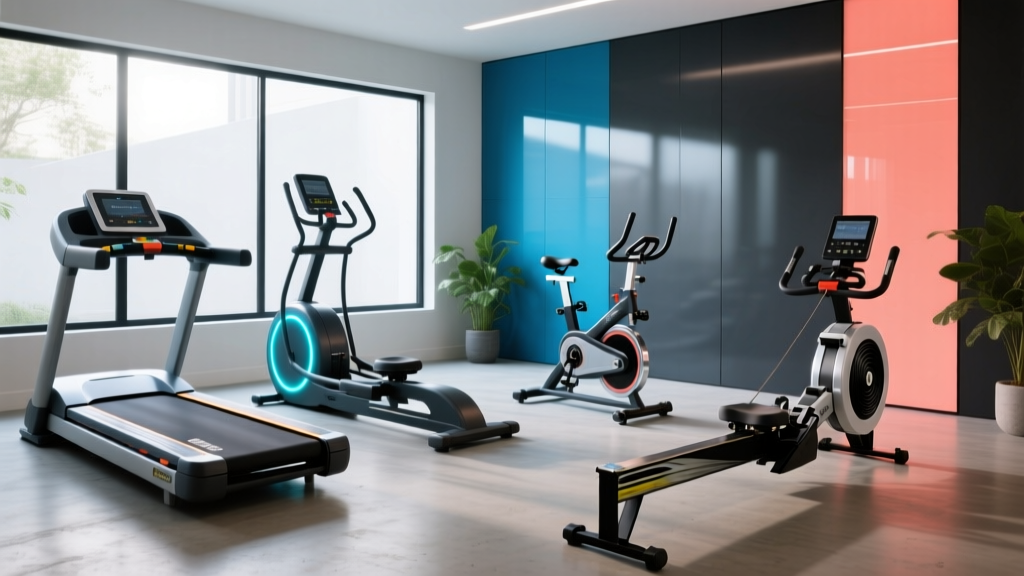
Cardio Machine Noise Level Comparison & The Two Stage Treadmill Test
Compare decibel levels of top cardio machines and learn how motor stability impacts the accuracy of the two stage treadmill test for home and lab use.

The Intersection of Acoustic Engineering and Clinical Precision
As high-end home gyms and boutique biomechanics labs continue to evolve in 2026, the demand for cardio equipment that bridges the gap between residential comfort and clinical utility has never been higher. Two critical factors dominate purchasing decisions for these specialized environments: acoustic output and physiological testing fidelity. While consumers often research cardio machine noise level comparison data to ensure their equipment won't disrupt shared living spaces or office environments, advanced users and physical therapists must also ensure the machine can sustain precise workloads for standardized assessments like the two stage treadmill test.
In this comprehensive guide, we analyze the decibel footprints of modern cardio machines, explore the acoustic interference that can disrupt heart rate telemetry, and detail how to properly administer submaximal treadmill protocols on low-noise equipment.
2026 Cardio Machine Noise Level Comparison Matrix
Understanding noise output requires looking beyond simple "quiet" marketing claims. Sound is measured in decibels (dB), a logarithmic scale where an increase of 10 dB represents a perceived doubling of loudness. According to the National Institute for Occupational Safety and Health (NIOSH), prolonged exposure to noise above 70 dB can begin to cause auditory fatigue, making sub-65 dB operation a critical benchmark for indoor fitness spaces.
| Machine Category | Reference Model (2026) | Drive / Resistance System | Idle / Low Load (dB) | Peak Output (dB) | Primary Noise Source |
|---|---|---|---|---|---|
| Slat-Belt Treadmill | Woodway 4Front | Brushless DC / Vulcanized Rubber | 52 dB | 64 dB (at 8 mph) | Footstrike impact (dampened) |
| Traditional Treadmill | Technogym Skillrun | AC Motor / Polyurethane Belt | 55 dB | 68 dB (at 10 mph) | Motor hum and belt friction |
| Indoor Cycle | Peloton Bike+ | Magnetic / Poly-V Belt | 42 dB | 54 dB (100 RPM) | Cooling fan and drivetrain whir |
| Air Rower | Concept2 RowErg | Air Flywheel / Chain | 58 dB | 78 dB (Max Drag) | Air displacement and chain rattle |
| Magnetic Rower | Hydrow Arc | Electromagnetic / Belt | 45 dB | 56 dB (Sprint Pace) | Rail roller friction |
| Elliptical | Life Fitness Club Series | Front-Drive Magnetic | 48 dB | 59 dB (High Resistance) | Joint articulation and pedal bearings |
Understanding the Two Stage Treadmill Test
While maximal testing (like the Bruce Protocol) pushes users to volitional exhaustion, submaximal testing is the gold standard for home labs, corporate wellness programs, and physical therapy clinics. The two stage treadmill test is a highly reliable submaximal protocol used to estimate VO2 max and cardiovascular efficiency without requiring expensive metabolic carts. The American College of Sports Medicine (ACSM) heavily endorses submaximal steady-state testing for general population fitness assessments due to its safety and repeatability.
Standard Protocol Parameters
To achieve valid data, the treadmill must hold exact speeds and inclines without micro-fluctuations. The standard two-stage protocol operates as follows:
- Warm-Up: 3 minutes at 2.0 mph, 0% grade to acclimate the user and verify heart rate telemetry.
- Stage 1: 3 minutes at 3.0 mph, 0% grade. Heart rate is recorded during the final 30 seconds. This establishes a baseline metabolic cost.
- Stage 2: 3 minutes at 3.0 mph, 5% grade (or higher depending on the specific Åstrand or YMCA variant). Heart rate is recorded in the final 30 seconds.
- Calculation: The difference in steady-state heart rate between the two stages is plotted against the known metabolic equivalent (MET) jump to extrapolate estimated VO2 max.
Why Motor Acoustics and Stability Matter
Administering this test on a cheap, noisy treadmill introduces two critical failure modes:
- Acoustic Telemetry Interference: Low-grade brushless motors often emit a high-frequency whine in the 2,000–4,000 Hz range. This specific frequency band can cause electromagnetic interference (EMI) with unshielded ANT+ and Bluetooth chest straps, resulting in dropped heart rate packets right when you need the Stage 2 steady-state reading.
- Thermal Throttling and Belt Lag: When the treadmill transitions from Stage 1 (0% grade) to Stage 2 (5% grade), the motor must instantly increase torque. Inferior motors experience "belt lag"—a momentary deceleration of 0.2 to 0.5 mph before catching up. This mechanical inconsistency alters the user's stride and artificially inflates the heart rate response, ruining the validity of the VO2 max prediction.
Top Treadmill Picks for Low Noise and High Testing Fidelity
If your goal is to conduct accurate two stage treadmill tests in a noise-sensitive environment, you must invest in commercial-grade acoustic dampening and precision torque control. Here are the top performers for 2026.
1. Woodway 4Front (The Biomechanics Lab Standard)
Price Range: $7,500 - $8,200
Acoustic Profile: 52 dB (Idle) / 64 dB (Load)
Testing Suitability: Exceptional. The 4Front uses a slat-belt design driven by vulcanized rubber and precision ball bearings. Because there is no traditional friction deck, the motor doesn't fight belt friction when the incline increases to 5% for Stage 2. The transition is instantaneous, and the lack of deck friction eliminates the low-frequency rumble that plagues traditional treadmills, making it ideal for environments where auscultation (blood pressure cuff readings) is performed between stages.
2. Technogym Skillrun (The Connected Athlete Choice)
Price Range: $11,000 - $13,500
Acoustic Profile: 55 dB (Idle) / 68 dB (Load)
Testing Suitability: Outstanding. The Skillrun features a 7.5 HP peak AC motor that operates with near-silent magnetic braking assistance. Its console natively supports submaximal testing algorithms and integrates flawlessly with Polar H10 chest straps, bypassing any localized EMI from the motor housing. The multilayer polyurethane belt absorbs footstrike shock, reducing impact noise transfer to floors below.
3. True Fitness PS10.0 (The Clinical Value Pick)
Price Range: $4,800 - $5,500
Acoustic Profile: 58 dB (Idle) / 71 dB (Load)
Testing Suitability: Very Good. While slightly louder than the Woodway, the PS10.0 is a staple in outpatient cardiac rehab centers. It features True's Soft System cushioning and a heavily insulated motor hood that traps mechanical noise. Its console includes pre-programmed submaximal fitness tests, automatically adjusting the incline and speed to strict clinical tolerances required for the two stage protocol.
"The validity of any submaximal cardiovascular test relies entirely on the mechanical consistency of the ergometer. A treadmill that fluctuates in speed or grade during stage transitions introduces an unquantifiable variable into the metabolic equation." — Journal of Sports Science & Medicine Biomechanics Review
Frequently Asked Questions
Can I perform the two stage treadmill test on a walking pad?
No. Walking pads lack the motor torque, belt length, and incline capabilities required for standardized testing. Furthermore, their small DC motors are highly prone to thermal throttling and speed fluctuations under continuous load, which would invalidate the steady-state heart rate data required for the test.
How does room acoustics affect heart rate monitoring during the test?
While room echo doesn't directly affect Bluetooth telemetry, high ambient noise (above 75 dB) from a loud treadmill motor can cause user stress and elevated sympathetic nervous system arousal. This can artificially inflate the user's heart rate by 3 to 6 BPM, skewing the VO2 max prediction. Utilizing a machine from our low-noise comparison matrix ensures the user remains in a relaxed, parasympathetic baseline during Stage 1.
Do magnetic resistance bikes offer a better alternative for submaximal testing?
Yes, if treadmill testing is contraindicated. Magnetic bikes (like the Keiser M3i or Wattbike) operate at roughly 45-50 dB and offer wattage accuracy within +/- 1%. However, the two stage treadmill test specifically evaluates weight-bearing cardiovascular efficiency and running/walking economy, which cannot be directly translated from a cycling protocol due to differences in muscle mass recruitment.
More gear to consider
All reviews
How to Turn On Life Fitness Treadmill vs Portable Cardio Trends

Getting Your Ass on the Treadmill: Curved Manual vs Motorized
2026 Trend Report: Portable Cardio vs Dedicated Outlet for Treadmill
Centr Runr Treadmill Review & Space-Saving Bike Layouts

2026 Rowing Machine Buying Guide & Cadence Treadmill Comparison
