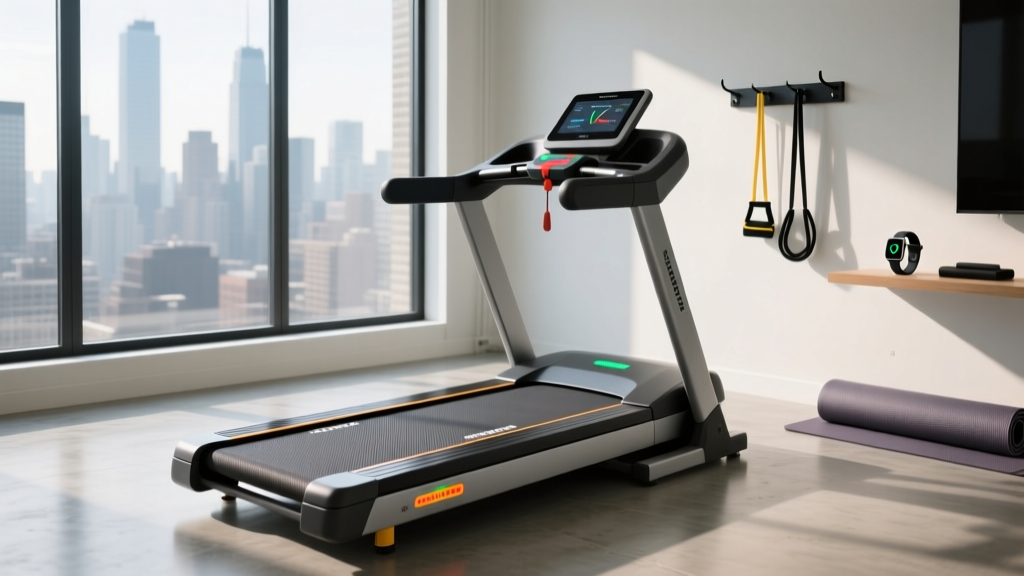
Treadmill Sprint Features: A Beginner's 2026 Buying Guide
Learn how to choose the right machine for high-intensity intervals. Our step-by-step treadmill sprint buying guide compares key 2026 features.

Why Standard Treadmills Fail at Sprinting
Stepping onto a treadmill for a casual 3.0 MPH walk is vastly different from launching into a 10.0 MPH all-out effort. When you transition into high-intensity interval training (HIIT), the biomechanical forces and mechanical demands on the machine multiply exponentially. Many beginners purchase entry-level walking pads or light-jogging treadmills, only to experience belt stuttering, motor overheating, and dangerous latency when attempting sprint intervals.
According to Mayo Clinic's research on interval training, sprint intervals are one of the most efficient ways to improve cardiovascular health and metabolic rate. However, to execute them safely at home, your equipment must be engineered for rapid acceleration, heavy impact, and lateral stability. This step-by-step buying guide will walk you through the exact features you need to look for in 2026 to build a safe, effective sprinting setup.
⚠️ Safety Warning for Beginners: Never attempt a treadmill sprint without using the safety magnetic key. If you lose your balance at 10+ MPH, the machine must stop immediately. Always straddle the side decks when starting the belt for a flying-start sprint.Step 1: Decoding Motor Specs (The CHP Rule)
The most common mistake beginners make is looking at 'Peak Horsepower' (PHP) rather than 'Continuous Horsepower' (CHP). Peak horsepower is the maximum output the motor can hit for a few seconds before overheating. Continuous horsepower is what the motor can sustain during your entire 30-second sprint interval.
The 180-Pound Acceleration Test
When a 180-pound user demands an instant jump from 3.0 MPH to 10.0 MPH, the motor must overcome massive inertia. A standard 2.5 CHP motor will stutter, causing the belt to slip under your foot—a primary cause of treadmill-related shin splints and falls. For dedicated sprinting, you must look for a minimum of 3.5 CHP, with 4.0 CHP being the gold standard for heavy users or those pushing past 12 MPH.
- Under 3.0 CHP: Walking and light jogging only. Avoid for sprinting.
- 3.5 CHP: Suitable for most users up to 200 lbs for HIIT and sprint intervals.
- 4.0+ CHP: Commercial-grade acceleration; zero belt lag for users up to 350 lbs.
Step 2: Belt Dimensions and Biomechanics
Sprinting alters your gait. Unlike walking, where your feet track in a relatively straight, narrow line, sprinting introduces lateral sway and a significantly longer stride extension. If your treadmill belt is too narrow or too short, you will subconsciously shorten your stride to avoid hitting the front motor cover or stepping off the side, leading to severe hamstring and hip flexor strain.
For any true treadmill sprint workout, the absolute minimum belt size is 22 inches wide by 60 inches long. The 22-inch width accommodates the natural lateral hip rotation of a full-speed sprint, while the 60-inch length ensures that users over 5'8" can fully extend their drive leg without kicking the front shroud.
Step 3: Speed Ceilings and Incline Responsiveness
Many budget treadmills cap out at 10.0 MPH (a 6:00 minute mile pace). While fast for a beginner, intermediate sprinters quickly outgrow this ceiling. Furthermore, sprinting isn't just about flat speed; hill sprints are incredible for building power with lower joint impact. You need a machine that not only hits 12.0 MPH but also adjusts incline rapidly.
2026 Sprint-Ready Treadmill Comparison Matrix
| Model (2026) | Motor (CHP) | Belt Size | Max Speed / Incline | Est. Price |
|---|---|---|---|---|
| Sole F85 | 4.0 CHP | 22" x 60" | 12 MPH / 15% | $1,999 |
| Horizon 7.8 | 3.5 CHP | 22" x 60" | 12 MPH / 15% | $1,499 |
| Matrix T75 | 3.5 CHP (AC) | 22" x 60" | 12 MPH / 15% | $2,899 |
Step 4: Deck Shock Absorption and Frame Stability
When you sprint, the ground reaction force (GRF) can reach up to three times your body weight with every foot strike. If your treadmill deck lacks proper elastomer cushioning, that kinetic energy travels directly up your tibia into your knees and lower back. Look for multi-zone cushioning systems—like Sole's Cushion Flex or Horizon's Variable Response Cushioning—which provide softer impact in the strike zone and a firmer push-off in the rear zone.
Equally important is the frame weight. A treadmill weighing under 150 lbs will physically rock and wobble during a 10 MPH sprint. Ensure the unit you purchase has a minimum shipping weight of 200 lbs and a heavy-gauge steel frame to anchor the machine to your floor.
Expert Insight: The American Heart Association's guidelines on interval workouts emphasize that proper form is critical during high-intensity bursts. A wobbling treadmill frame forces your core to overcompensate for machine instability, ruining your sprint mechanics and increasing injury risk.
Step 5: Console Latency and Quick-Dial Controls
In a 20-second sprint interval, you don't have time to tap a glass touchscreen, wait for the software to register the input, and watch the speed increment by 0.1 MPH. Touchscreen latency is a major hazard for HIIT. You need a machine with physical, tactile 'Quick-Dial' speed and incline knobs, or dedicated one-touch speed buttons (e.g., instant jump to 8, 10, and 12 MPH) located on the handrails.
Beginner Protocol: Your First Treadmill Sprint Session
Once you've secured a sprint-capable treadmill, ease into the mechanics. Do not start with 30-second max-effort sprints. Use this beginner-friendly 'Flying Start' protocol to train your central nervous system and get used to the belt speed:
- Warm-Up (5 Minutes): Walk at 3.0 MPH, gradually increasing to a light jog at 5.0 MPH.
- The Straddle: Increase the belt speed to 8.0 MPH while you stand on the stationary side rails.
- The Flying Start: Hold the handrails, step onto the moving belt, and immediately let go, matching your leg turnover to the belt.
- The Sprint (10 Seconds): Push the pace to 9.0 or 10.0 MPH for just 10 seconds. Focus on driving your knees, not leaning back.
- The Bail-Out: Grab the rails, lift your body weight, and step back onto the side rails. Let the belt continue running.
- Recovery (50 Seconds): Rest on the rails or walk slowly at 2.5 MPH.
- Repeat: Complete 5 to 8 rounds, followed by a 3-minute cool-down walk.
Frequently Asked Questions
Can I do treadmill sprints on a walking pad?
No. Walking pads typically max out at 4.0 to 6.0 MPH and feature 1.5 CHP motors. Attempting to sprint on a walking pad will instantly trip the motor's thermal overload switch and void your warranty, while the lack of handrails poses a severe fall hazard.
Do I need a treadmill with a decline feature for sprinting?
While decline (-3% to -5%) is excellent for eccentric muscle loading and downhill running preparation, it is not strictly necessary for beginner sprint intervals. A standard 0% to 15% incline range is more than sufficient for flat sprints and hill repeats.
How often should I lubricate the belt if I sprint frequently?
High-speed sprinting generates significantly more friction and heat than walking. While standard users lubricate their decks every 150 miles, dedicated sprinters should check belt lubrication every 75 to 100 miles using 100% silicone treadmill lubricant to prevent the deck from warping.
More gear to consider
All reviews
Walking Pad vs Treadmill: Getting 30 Minutes on Treadmill Setups
Rowing Machine Guide: Ergometer Console vs Treadmill Monitor Metrics
Upright, Recumbent, Spin Bike Care & FitThrill Treadmill Maintenance

Rowing Machine Buying Guide: Beating the Treadmill MET Score

Air Bike vs Assault Bike Care: Longevity & Treadmill MET Calculator
