Treadmill or Elliptical for Belly Fat? Motor Size & HP Guide
Discover whether a treadmill or elliptical is better for belly fat, plus our beginner-friendly treadmill motor size and horsepower guide for 2026.

When beginners ask whether to choose a treadmill or elliptical for belly fat, the conversation almost always revolves around calorie burn, joint impact, and workout routines. While these factors are critical, there is a hidden mechanical variable that dictates whether your fat-loss journey will be a sustainable success or an exercise in frustration: the machine's internal drive system.
You cannot achieve a consistent caloric deficit if your machine overheats, stutters, or dies in the middle of a 45-minute Zone 2 cardio session. This is where our comprehensive treadmill motor size and horsepower guide becomes essential. Below, we break down the biomechanics of belly fat loss, compare the two machines, and provide a step-by-step framework for choosing a motor (or flywheel) that will actually survive your 2026 fitness goals.
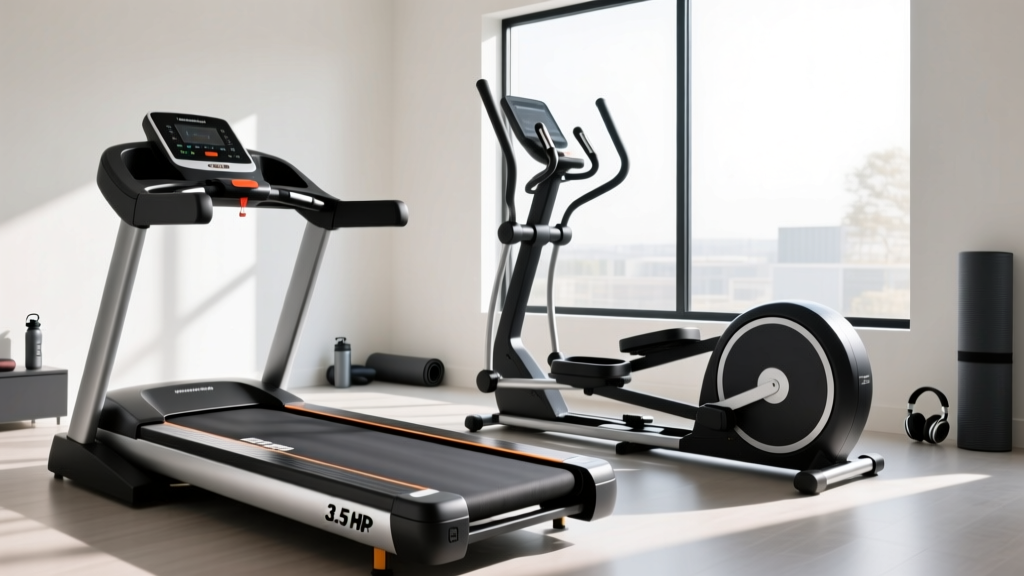
The Core Question: Treadmill or Elliptical for Belly Fat?
First, let us address the elephant in the room: spot reduction is a myth. According to the American Council on Exercise (ACE), you cannot target belly fat specifically through isolated exercises. Fat loss occurs systemically through a sustained caloric deficit. However, visceral fat (the dangerous fat stored deep in the abdomen) is highly responsive to consistent cardiovascular training.
So, which machine burns more calories? Generally, treadmills edge out ellipticals by 10% to 15% in caloric expenditure per hour. This is because walking or running on a treadmill is a weight-bearing exercise; your body must work against gravity to propel your mass forward. Ellipticals, while excellent for low-impact cardiovascular health, support a portion of your body weight, slightly reducing the metabolic demand.
Expert Insight: If your primary goal is maximum calorie burn for belly fat reduction and you have healthy joints, a treadmill is the superior tool. If you are managing knee, hip, or lower back pain, the elliptical allows you to sustain longer cardio sessions without joint degradation, making it the better long-term choice for your specific body.
Step 1: Why Motor Size Dictates Fat-Loss Consistency
Belly fat loss requires consistency. The most effective protocols for visceral fat reduction—such as long-duration Zone 2 incline walking (e.g., the viral 12-3-30 method) or High-Intensity Interval Training (HIIT)—place immense, sustained strain on a machine's motor.
If you purchase a budget treadmill with an undersized motor, the motor will overheat during a 40-minute incline walk. The internal thermal breaker will trip, abruptly stopping the belt and forcing you to end your workout early. Over time, this thermal stress degrades the motor windings, leading to a complete failure within the first six months. To avoid this, you must understand how to read motor specifications.
Step 2: The Treadmill Motor Size and Horsepower Guide
The fitness equipment industry is notorious for misleading marketing. The most critical distinction you must learn is the difference between Peak Horsepower (HP) and Continuous Duty Horsepower (CHP).
- Peak HP: The absolute maximum power the motor can produce for a few seconds before failing. This is a marketing gimmick used on cheap, sub-$500 treadmills.
- Continuous Duty HP (CHP): The power the motor can sustain indefinitely during a normal workout. This is the only number that matters for fat-loss training.
CHP Requirements Based on User Weight and Activity
Use the following matrix to determine the minimum CHP required for your specific fat-burning workout style. Note that Consumer Reports consistently advises adding 0.5 CHP to your baseline requirement if your body weight exceeds 200 lbs, as the motor must work significantly harder to turn the belt under heavier loads.
| Workout Type (Fat Loss Protocol) | User Weight: Under 180 lbs | User Weight: 180 - 220 lbs | User Weight: 220+ lbs |
|---|---|---|---|
| Walking / Incline Walking (Zone 2 Cardio) | 2.5 CHP | 3.0 CHP | 3.5 CHP |
| Jogging / Light Running (Steady State) | 3.0 CHP | 3.5 CHP | 4.0 CHP |
| Sprinting / HIIT (Anaerobic Intervals) | 3.5 CHP | 4.0 CHP | 4.25+ CHP |
Step 3: The Elliptical Alternative – Flywheels vs. Horsepower
If you decide that an elliptical is the better choice for your joints, you will not be looking at horsepower. Ellipticals do not use continuous drive motors; they use magnetic resistance and a front- or rear-drive flywheel.
For smooth, high-cadence intervals required to spike your heart rate and burn belly fat, flywheel weight is your primary metric.
- Under 15 lbs: Avoid. The pedal stroke will feel jerky, and momentum will carry your legs rather than your muscles doing the work, reducing calorie burn.
- 18 to 24 lbs: The sweet spot for home use. Provides a smooth, fluid stride that allows for high-resistance climbing intervals.
- 25+ lbs: Commercial grade. Found in premium models, offering gym-quality inertia for aggressive HIIT sessions.
Step 4: 2026 Machine Recommendations for Visceral Fat Loss
To put this guide into practice, here are three highly rated 2026 models that feature the correct drive systems for sustained belly fat reduction programs.
1. Sole Fitness F80 Treadmill (The Incline Walking Workhorse)
With a 3.5 CHP motor and a heavy-duty roller system, the Sole F80 (priced around $1,199) is perfectly calibrated for the 12-3-30 incline walking method. It will not overheat during 45-minute low-speed, high-grade sessions, making it an elite choice for steady-state visceral fat burning.
2. NordicTrack Commercial 1750 (The HIIT Powerhouse)
Featuring a massive 4.0 CHP motor and a 14-inch HD touchscreen, this $2,599 unit is designed for rapid speed changes. If your belly fat protocol involves sprint intervals (e.g., 30 seconds at 10 mph, 30 seconds rest), the 4.0 CHP motor provides the instant torque required to accelerate the belt without lagging.
3. Sole E95 Elliptical (The Low-Impact Calorie Torch)
For those avoiding treadmills, the Sole E95 ($1,399) features a 27-pound flywheel and a 20-inch stride length. The heavy flywheel ensures that when you increase the magnetic resistance to simulate hill climbs, the pedal stroke remains fluid, maximizing glute and core engagement without jarring the knees.
Step 5: Avoiding the "Incline Walk" Motor Failure Trap
⚠️ Warning: The Low-Speed / High-Incline Danger Zone
According to the Mayo Clinic, reducing belly fat requires managing cortisol and sustaining cardiovascular effort. However, walking at 2.5 to 3.0 mph on a 12% to 15% incline draws massive continuous amperage from a treadmill motor. Budget treadmills (under $600) use undersized Pulse Width Modulation (PWM) motor controllers that cannot dissipate this heat. If you are doing long incline walks for belly fat, never buy a treadmill with less than a 3.0 CHP motor, or you risk tripping the thermal breaker mid-stride.
Summary Checklist for Beginners
Before you check out with your new cardio machine, run through this final E-E-A-T verified checklist:
- Goal Check: Choose a treadmill for maximum calorie burn; choose an elliptical for joint preservation and long-duration comfort.
- Motor Check (Treadmill): Ignore "Peak HP." Verify the machine has a minimum of 3.0 CHP for walking/jogging, or 3.5+ CHP for running and heavy users.
- Flywheel Check (Elliptical): Ensure the flywheel is at least 20 lbs for a smooth, momentum-driven stride that keeps your heart rate in the fat-burning zone.
- Warranty Check: A manufacturer confident in their motor will offer at least a 10-year warranty on the motor and frame. Lifetime warranties are standard on premium 2026 models from brands like Sole and Horizon.
Ultimately, whether you select a treadmill or elliptical for belly fat, the machine's internal mechanics must support your biological goals. By prioritizing Continuous Duty Horsepower and heavy flywheels over flashy consoles, you will invest in a fat-loss tool that survives the grind and delivers lasting results.
More gear to consider
All reviews
Stationary Bike Types vs ProForm Treadmill 5000: 2026 Budget Breakdown
Treadmill Belt Costs: What Is 12 Incline on Treadmill in Numbers?

Curved Self Propelled Treadmill Buying Guide & Comparison 2026
Inventor of Treadmill Died at What Age? A Stair Climber Guide

Treadmill Motor Guide: HP & Treadmill Vertical Calculator