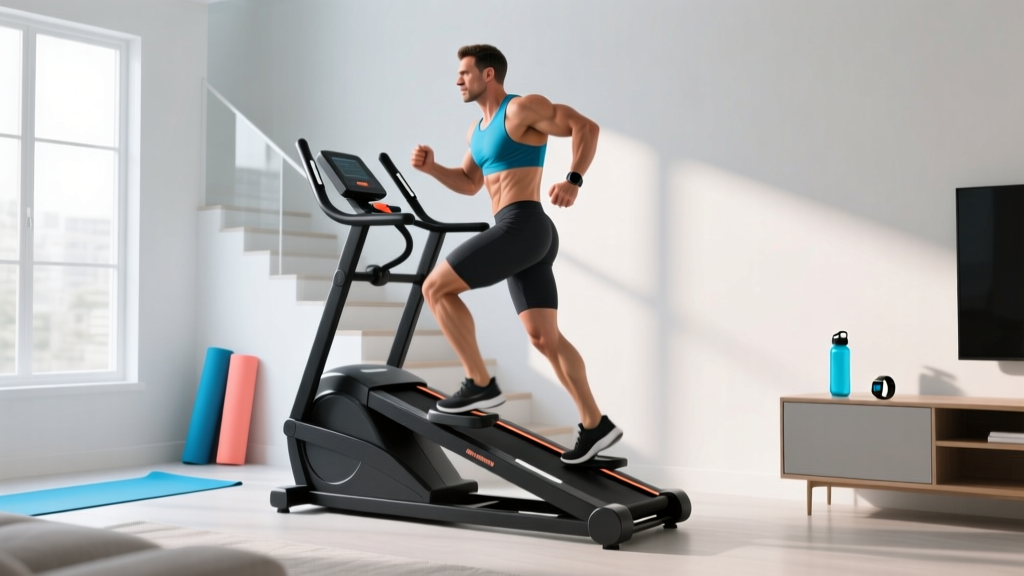
Can Walking on a Treadmill Lose Belly Fat? Home Stair Climber Guide
Wondering if walking on a treadmill can lose belly fat? Discover the truth about spot reduction and why a home stair climber is a superior fat-loss tool.

When building a home gym for weight loss, one of the most common questions we receive at FitGearPulse is: can walking on a treadmill lose belly fat? While treadmill walking is an excellent low-impact cardiovascular exercise, the reality of human physiology dictates that targeting abdominal fat requires a more metabolically demanding approach. This is where the stair climber machine for home use emerges as a vastly superior tool for overall caloric expenditure and lower-body muscle retention.
In this comprehensive troubleshooting and usage guide, we will dismantle the spot-reduction myth, compare the biomechanics of treadmill walking versus stair climbing, and troubleshoot the most common form and machine-maintenance mistakes that sabotage your fat-loss goals in 2026.
The Spot-Reduction Myth: Treadmills vs. Stair Climbers
To answer the question directly: no specific cardio machine can target belly fat. According to Harvard Medical School, fat loss occurs systemically based on a sustained caloric deficit, not the specific muscle group being worked. Furthermore, the Mayo Clinic emphasizes that visceral fat (the dangerous fat surrounding abdominal organs) responds best to vigorous, high-energy-output exercises rather than low-intensity steady-state (LISS) walking.
While a treadmill set to a 0% incline at 3.0 mph is great for active recovery, it simply does not demand enough ATP (cellular energy) to trigger significant post-exercise oxygen consumption (EPOC). A stair climber, however, forces you to lift your entire body weight against gravity with every step, recruiting the gluteus maximus, quadriceps, and hamstrings simultaneously.
Energy Expenditure Comparison (155 lb Individual)
| Metric | Treadmill Walking (3.5 mph, 0% Incline) | Stair Climber (Moderate Pace, 60 SPM) |
|---|---|---|
| Calories Burned (per 30 mins) | ~120 kcal | ~225 kcal |
| Primary Muscle Activation | Calves, Hip Flexors, Hamstrings | Glutes, Quads, Calves, Core Stabilizers |
| Joint Impact Force | 1.2x - 1.5x Body Weight | 0.8x - 1.0x Body Weight (Vertical vector) |
| EPOC (Afterburn) Effect | Negligible | Moderate to High (if utilizing HIIT) |
Top 4 Stair Climber Mistakes Sabotaging Fat Loss
If you have invested in a home stair climber but are not seeing changes in your abdominal composition, you are likely committing one of these critical biomechanical errors.
1. The "Handrail Hang" (Biomechanical Failure)
Leaning your weight onto the side rails or console reduces the effective load your legs must lift. Biomechanical studies show that heavy handrail reliance can decrease caloric expenditure by up to 30%. The Fix: Keep a "soft grip" on the rails purely for balance. If you cannot maintain your target steps-per-minute (SPM) without hanging on the rails, lower the machine's resistance level until your core and legs can support your full body weight.
2. Shallow Stepping and Quad Dominance
Taking quick, shallow steps shifts the workload entirely to the quadriceps and calves, missing the glute engagement necessary for a higher metabolic burn. The Fix: Drive through the heel and press the pedal down to its absolute lowest point. Imagine trying to push the pedal through the floor to fully engage the posterior chain.
3. Ignoring the Eccentric Phase
Many users let the pedal drop rapidly, using momentum to bounce back up. This eliminates the eccentric (lowering) muscle contraction, which is responsible for significant muscle fiber micro-tearing and subsequent metabolic adaptation. The Fix: Control the descent. Take 1 second to push down, and 1 second to resist the upward return.
4. Inconsistent Cadence
Fluctuating between 40 SPM and 90 SPM prevents your cardiovascular system from settling into an optimal fat-oxidation heart rate zone. The Fix: Use the console to lock in a target SPM (e.g., 65 SPM) and maintain it for a minimum of 20 continuous minutes.
Expert Tip: Heart Rate Targeting for LipolysisTo maximize fat utilization as a fuel source, aim for Zone 2 cardio (60-70% of your maximum heart rate). For a 40-year-old, this equates to roughly 108 to 126 BPM. On a stair climber, this usually requires a moderate resistance level at 55-65 SPM. If you are gasping for air, you have crossed into the glycolytic (carbohydrate-burning) zone.
Home Stair Climber Guide: Specs, Pricing, and Troubleshooting
Choosing the right machine and keeping it maintained is vital for uninterrupted fat-loss programming. Here is a breakdown of the top home models in 2026 and how to troubleshoot their most common issues.
Premium Pick: Bowflex Max Trainer M9
- Price: ~$2,299
- Footprint: 49" L x 30.5" W
- Ceiling Clearance Requirement: User Height + 15 inches
- Drive System: Magnetic resistance with a dual-action step/elliptical hybrid motion.
Troubleshooting the M9: A common issue with the Max Trainer series is the console displaying an E1 Error Code. This indicates a speed sensor misalignment. To fix this, unplug the machine, remove the front shroud, and ensure the magnetic reed switch is exactly 2-3mm away from the flywheel magnet. If the gap is wider, the console cannot read the RPMs.
Budget Pick: Sunny Health & Fitness SF-S9011 Stair Stepper
- Price: ~$159
- Footprint: 16" L x 12.5" W
- Drive System: Dual hydraulic cylinders with adjustable tension knob.
- Weight Capacity: 300 lbs
Troubleshooting the SF-S9011: Hydraulic mini-steppers are notorious for two issues. First, squeaking pedals. This is rarely the cylinder; it is usually the pivot ball joints at the base. Apply a few drops of PTFE (Teflon) lubricant to the ball sockets—never use WD-40, as it attracts dust and degrades the nylon bushings. Second, hydraulic fluid leaks. If you see silicone oil pooling on your floor, the internal O-ring seal has blown out due to overheating. This usually happens if you exceed 30 minutes of continuous use. The cylinders cannot be repaired; they must be replaced (Sunny Health sells replacement cylinders for roughly $45).
Programming for Fat Loss: The 30-Minute Stair Protocol
To replace your treadmill walking routine with a stair climber protocol designed to attack systemic body fat, utilize this 30-minute interval structure three times a week:
- Warm-Up (5 Minutes): 40 SPM, Resistance Level 2. Focus on full pedal depth and waking up the glutes.
- Steady-State Climb (15 Minutes): 65 SPM, Resistance Level 5. Maintain Zone 2 heart rate (approx. 120 BPM). Do not hold the handrails.
- Power Intervals (8 Minutes): Alternate 30 seconds of max effort (85+ SPM, Resistance Level 8) with 30 seconds of active recovery (40 SPM, Resistance Level 2). This triggers the EPOC effect.
- Cool Down (2 Minutes): 30 SPM, Resistance Level 1. Allow heart rate to drop below 100 BPM before stepping off.
Final Verdict: Treadmill vs. Stair Climber for Home Use
If your primary goal is general daily movement, a treadmill is a fine investment. But if you are specifically asking "can walking on a treadmill lose belly fat" because you are frustrated by a lack of visible results, it is time to change the stimulus. The stair climber demands higher energy output, builds metabolically active muscle in the lower body, and spares your joints from the repetitive striking impact of a treadmill belt. By avoiding the handrail hang, maintaining strict step depth, and properly maintaining your machine's hydraulics or magnetic sensors, you will create the systemic caloric deficit required to finally reveal your abdominal muscles.
More gear to consider
All reviews
Hometro Treadmill vs Air Bike: 2026 Assault Bike Guide

Market Analysis: The Fastest Treadmills for Small Spaces in 2026
Elliptical vs Treadmill 2026: NordicTrack T 6.5 S Treadmill Review

Cardio Noise Setup: ProForm Treadmill Maintenance Lubrication

Curved vs Motorized: Finding the Best Treadmill Attachment for Laptop
