Treadmill Before or After Workout: 2026 Feature Comparison Guide
Should you use a treadmill before or after workout sessions? Compare top 2026 models for warm-ups vs. post-lift HIIT, featuring Sole, NordicTrack, and Assault.

The Biomechanics: Why Timing Dictates Your Treadmill Choice
The debate over whether to use a treadmill before or after workout sessions is one of the most common dilemmas in strength and conditioning. According to a comprehensive meta-analysis published in the National Center for Biotechnology Information (NCBI), concurrent training (mixing cardio and resistance) yields vastly different physiological adaptations based on sequence. Performing cardio before lifting primarily serves as a neuromuscular warm-up and joint lubrication protocol, requiring low-impact, highly responsive decks. Conversely, utilizing a treadmill after lifting shifts the goal to glycogen depletion, metabolic conditioning, and high-intensity interval training (HIIT), which demands aggressive incline capabilities and high-torque motors.
As a senior equipment reviewer for FitGearPulse, I have tested dozens of cardio machines to determine which models actually survive these distinct physiological demands. In this 2026 head-to-head comparison, we pit the best pre-workout activation treadmills against the ultimate post-workout metabolic finishers to help you buy the right machine for your specific routine.
Pre-Workout Specialists: Joint Protection & Neuromuscular Activation
When stepping on a treadmill before a heavy squat or deadlift session, your central nervous system (CNS) needs activation without accumulating peripheral fatigue. You need a machine with superior shock absorption, quick-start functionality, and a deck that promotes natural foot strike mechanics.
Sole F80 vs. Horizon Fitness 7.0T
The Sole F80 (MSRP: $1,099) remains a staple for pre-lift warm-ups due to its proprietary Cushion Flex Whisper Deck. This system reduces joint impact by up to 40% compared to asphalt, preserving your knees and ankles for heavy compound movements. Its 3.5 CHP motor is whisper-quiet at low speeds (2.5 to 3.5 mph), which is the optimal zone for dynamic walking warm-ups recommended by the American Council on Exercise (ACE).
On the other side, the Horizon Fitness 7.0T (MSRP: $1,099) offers a slightly shorter 55-inch belt but compensates with rapid-dial Bluetooth controls. If you are doing a 5-minute agility walk with lateral shuffles before a sports-specific lifting session, the Horizon's quick-tension belt and responsive incline (up to 15%) allow for seamless transitions without breaking your flow state.
Post-Workout Finishers: Glycogen Depletion & Max Heart Rate HIIT
Using a treadmill after a workout is entirely about metabolic stress. Your muscles are already fatigued, meaning your biomechanics might degrade. You need a machine that enforces good posture, handles rapid speed fluctuations, and provides extreme incline options for low-impact, high-output finishers.
NordicTrack X32i vs. AssaultRunner Pro
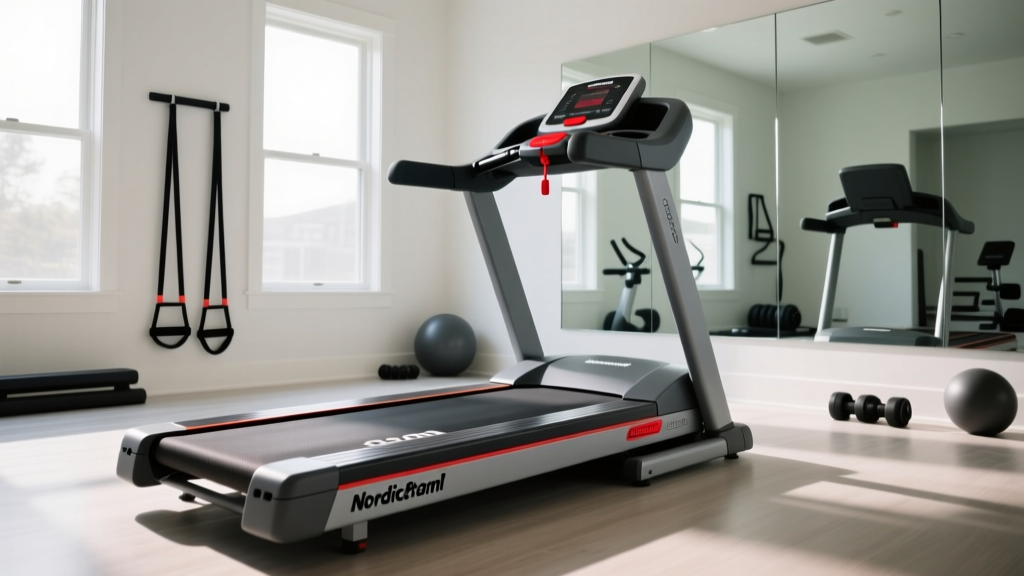
The NordicTrack X32i (MSRP: $3,599) is the undisputed king of the post-lift incline march. Featuring a massive 40% incline and a -6% decline, its 4.25 CHP motor delivers continuous torque even when you are walking at 3.0 mph on a steep grade. This specific feature allows for massive caloric expenditure and glute activation without the eccentric muscle damage associated with running, making it the perfect glycogen-depletion tool after a heavy leg day.
However, if your post-workout routine involves all-out sprint intervals, the AssaultRunner Pro (MSRP: $3,299) is the superior choice. As a manual, curved treadmill with a slatted belt, it requires the user to generate all the power. This design naturally forces a forefoot strike and increases caloric burn by up to 30% compared to motorized treadmills. Because there is no motor to dictate speed, you can instantly transition from a dead stop to a max-effort sprint, which is critical for Tabata-style post-workout protocols.
Head-to-Head Feature Comparison Matrix
| Feature | Sole F80 (Pre-Lift) | NordicTrack X32i (Post-Lift) | AssaultRunner Pro (HIIT) |
|---|---|---|---|
| Primary Use Case | CNS Activation & Warm-up | Steady-State Incline & Depletion | Max-Effort Sprint Intervals |
| Motor / Drive | 3.5 CHP (High Torque) | 4.25 CHP (Continuous Duty) | Manual (Self-Powered Slatted Belt) |
| Incline / Decline | 0% to 15% | -6% to 40% | Fixed 8% Curve Resistance |
| Deck Cushioning | Cushion Flex (High Absorption) | ProShox (Moderate) | Slatted Rubber (High Energy Return) |
| 2026 Price Point | $1,099 | $3,599 | $3,299 |
Spatial Footprint and Home Gym Integration
When designing your 2026 home gym layout, the physical footprint of your cardio machine dictates its placement relative to your squat rack and dumbbell zones. Pre-workout treadmills are often utilized in tight circuits, meaning clearance and console height matter. The Sole F80 measures 80 by 35 inches and features folding hydraulics, allowing you to stow it against a wall when moving heavy plates around your rack.
Conversely, the NordicTrack X32i is a behemoth, measuring 83 by 38 inches and weighing over 300 pounds. Its massive 22-inch HD touchscreen and 40% incline mechanism require a ceiling clearance of at least 8.5 feet to accommodate the user's elevated head position at maximum grade. If you are placing this in a basement gym for post-workout finishers, measure your ceiling joists first. The AssaultRunner Pro, while non-folding, is remarkably compact at 69 by 33 inches, making it an ideal drop-in for functional fitness rigs where space is at a premium.
Real-World Failure Modes: Motor Thermals and Belt Friction
When evaluating equipment for the "treadmill before or after workout" dilemma, most buyers ignore mechanical failure modes. If you buy a budget treadmill (under $600) with a 2.0 CHP motor and attempt a 20-minute post-workout incline walk at 12%, the motor will experience thermal throttling. The internal heat sinks cannot dissipate the heat generated by low-speed, high-resistance dragging, eventually tripping the breaker or warping the deck.
⚠️ Expert Warning: The "Incline Walk" Motor KillerNever use a treadmill with less than a 3.0 CHP motor for steep, low-speed post-workout marches. The amp draw at 15% incline and 2.5 mph is significantly higher than running at 0% incline at 7.0 mph. Always check the continuous duty horsepower (CHP), not peak horsepower, to prevent motor burnout.
Furthermore, curved manual treadmills like the AssaultRunner require strict maintenance. The slatted belt runs on a track of polyurethane wheels. If you use the machine post-workout while sweating heavily, the saline from your sweat can drip onto the track, increasing friction and causing the belt to stick. Wiping down the track with a silicone-based lubricant every 30 days is mandatory for preserving the 300-pound user capacity and smooth glide.
The Verdict: Matching the Machine to Your Routine
Deciding whether to use a treadmill before or after workout sessions ultimately comes down to your primary training goal. If your priority is powerlifting, Olympic weightlifting, or heavy hypertrophy, your treadmill is a preparation tool. Invest in the Sole F80 for its joint-preserving deck and reliable low-speed mechanics. It will prime your CNS without stealing energy from your barbell work.
If your goal is body recomposition, endurance hybrid training, or metabolic conditioning, the treadmill is a destruction tool. The NordicTrack X32i provides the ultimate low-impact, high-yield incline environment to empty the tank after lifting. For pure athletic output and VO2 max improvements, the self-powered AssaultRunner Pro remains unmatched in the 2026 cardio landscape. Choose the machine that aligns with your physiological intent, and it will serve you for thousands of miles.
More gear to consider
All reviews
What Is a Good Rowing Machine for Home Use? 2026 Guide

How Much Power Does a Treadmill Use? 2026 Buying Guide

Better Me 28 Day Treadmill Challenge vs 2026 Air Bike Trends
Curved vs Motorized: NordicTrack T Series 8 Review Guide

Recumbent Bike vs Treadmill Upkeep: Air vs Assault Bike Care