How to Transition From Treadmill to Outdoor Running Using Portable Gear
Discover how to transition from treadmill to outdoor running on a budget. We analyze compact portable cardio equipment to bridge your training gap.

The Financial Reality: Ditching the Monolith
For years, the $2,500 motorized treadmill was the undisputed king of home cardio. But as we move through 2026, a massive shift is happening. Runners are realizing that bulky, subscription-locked treadmills are financial anchors, especially when the ultimate goal is to run outside. If you are trying to figure out how to transition from treadmill to outdoor running, the biggest hurdle isn't just biomechanical—it's financial and logistical. You need a safety net for bad weather days without committing thousands of dollars and 30 square feet of floor space to a traditional rig.
This is where compact portable cardio equipment options shine. By liquidating your full-sized treadmill and reinvesting a fraction of the capital into targeted, portable gear, you can maintain your cardiovascular base, protect your joints during the transition phase, and save over $1,500 in the process. Below, we break down the exact budget analysis, gear specifications, and a 6-week transition protocol to get you from the belt to the pavement safely.
💰 Budget Insight: The average premium treadmill costs $1,800 upfront, plus $39/month for interactive programming and $150 annually for belt lubrication and motor maintenance. Over three years, that is a $3,600+ investment. Swapping to a portable cardio ecosystem costs under $800 total, with zero mandatory subscription fees.Biomechanical Bridges: Why Portable Gear Works
Transitioning from a motorized belt to asphalt requires a shift in muscle recruitment. On a treadmill, the belt pulls your foot backward, reducing the demand on your hamstrings and glutes. Outdoor running requires active posterior chain propulsion to push off the ground. Furthermore, ground reaction forces on asphalt are significantly higher than on a shock-absorbing treadmill deck.
According to the American Heart Association, gradually varying your exercise modalities is crucial for preventing overuse injuries when changing surfaces. Compact portable gear acts as a biomechanical bridge. Instead of trying to replicate a 10-mile outdoor run on a cheap, full-sized budget treadmill (which will destroy your knees due to poor deck cushioning), you use specialized portable equipment to target the specific muscle deficits created by treadmill running.
2026 Compact Portable Cardio Value Matrix
Not all portable gear is created equal. Here is our value analysis of the top three compact categories for transitioning runners, focusing on footprint, cost, and specific transition benefits.
| Equipment Type | Top 2026 Model | Avg. Cost | Footprint | Primary Transition Benefit |
|---|---|---|---|---|
| Folding Walking Pad | King Smith WalkingPad R2 | $599 | 14 sq ft | Cadence maintenance & active recovery |
| Portable Elliptical Glider | Sunny Health SF-E3912 | $149 | 6 sq ft | Zero-impact lactic acid flushing |
| Mini Stair Stepper | Xiser Commercial Mini | $389 | 1.5 sq ft | Posterior chain & hill-climb strength |
Deep Dive: Top Portable Options for Transitioning Runners
1. The Folding Walking Pad: King Smith WalkingPad R2
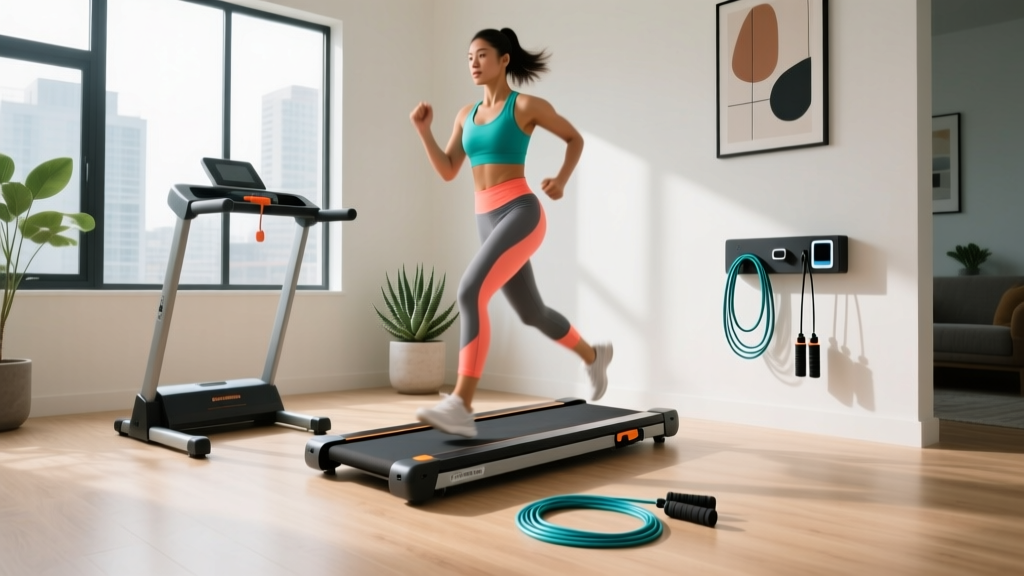
The Specs: 2.5 HP motor, 47 x 17-inch belt, max speed 7.5 mph, weight capacity 240 lbs.
Value Analysis: At $599, the WalkingPad R2 is not designed for high-intensity sprinting. It is a tool for zone 2 aerobic base building and cadence work. When transitioning to outdoor running, maintaining a high cadence (170-180 steps per minute) is critical to reducing impact forces on asphalt. The R2 allows you to practice high-cadence, low-impact jogging indoors when the weather is hostile.
⚠️ Edge Case Warning: Do not use the WalkingPad R2 for interval training at its max 7.5 mph speed for longer than 20 minutes. The 2.5 HP motor lacks the thermal mass of a 3.5 HP commercial treadmill motor. Pushing it to max speed with a 180lb+ user will trigger the internal thermal shutoff switch, requiring a 45-minute cooldown. Use it strictly for steady-state recovery jogs.2. The Portable Elliptical Glider: Sunny Health & Fitness SF-E3912
The Specs: Magnetic resistance, 11-inch stride length, 8 resistance levels, 330 lbs capacity.
Value Analysis: Priced at just $149, this machine is a budget powerhouse for one specific purpose: active recovery. Outdoor running introduces severe eccentric muscle damage, particularly in the calves and quads, due to asphalt impact. The 11-inch stride on the SF-E3912 is too short to simulate a running gait, but it is mathematically perfect for flushing blood through the lower extremities without any ground reaction force. It folds down to a 6-square-foot footprint and slides under a bed or sofa.
3. The Mini Stair Stepper: Xiser Commercial Mini Stairmaster
The Specs: 14 x 14-inch base, hydraulic cylinder resistance, 10-inch step height.
Value Analysis: At $389, the Xiser is the most expensive of the ultra-compact options, but it solves the biggest weakness of treadmill runners: weak glutes and hamstrings. Treadmill belts do the pulling work; outdoor hills require explosive posterior chain extension. The Xiser forces you to drive through your heels, activating the gluteus maximus and mimicking the biomechanics of outdoor hill climbing. It weighs just 14 lbs and stores in a closet.
The 6-Week Budget Transition Protocol
To successfully transition without triggering shin splints or Achilles tendinopathy, you must follow a structured volume shift. The Mayo Clinic recommends gradual progression when altering exercise routines to allow connective tissues to adapt to new loads.
Here is your week-by-week blueprint utilizing your new portable gear alongside outdoor runs:
- Week 1 (The 80/20 Split): 80% of your cardio volume remains on the WalkingPad R2 (Zone 2 jogging). 20% is an easy outdoor run on a soft surface (grass or dirt trail) to test footwear and initial joint response.
- Week 2 (Introducing the Stepper): Shift to 60% WalkingPad, 20% Xiser Stepper (focusing on heel-drive for glute activation), and 20% outdoor running on paved bike paths.
- Week 3 (The 50/50 Threshold): 50% outdoor running (introducing mild elevation changes), 30% WalkingPad (cadence drills at 175 SPM), 20% Sunny Elliptical (post-run recovery flush).
- Week 4 (Volume Shift): 70% outdoor running. Use the Sunny Elliptical exclusively on the mornings after your longest outdoor runs to mitigate delayed onset muscle soreness (DOMS).
- Week 5 (Asphalt Adaptation): 85% outdoor running on standard concrete/asphalt. The WalkingPad is now reserved only for days with severe weather (ice, heavy rain, extreme heat).
- Week 6 (Full Transition): 95% outdoor running. Your portable gear is now officially relegated to the role of 'bad weather backup' and 'active recovery station'.
Real-World Edge Cases & Failure Modes
When executing this budget breakdown, runners frequently encounter three specific failure modes. Here is how to avoid them:
- The Stride Length Trap: Many budget-conscious runners buy cheap, full-sized treadmills under $500 to 'bridge the gap.' These machines typically feature 45-inch belts and 1.5 HP motors. If you are taller than 5'8", your natural outdoor stride will exceed the belt length, causing you to subconsciously shorten your gait. This altered biomechanics will lead to severe hip flexor strain when you return to the pavement. Solution: Stick to the compact WalkingPad for walking/light jogging, and do your actual running outdoors.
- Footwear Neglect: You saved $1,500 by selling your NordicTrack. Do not run outside in your old treadmill shoes. Treadmill shoes wear down evenly on the heel and midfoot. Outdoor running requires shoes with specific forefoot rocker geometry and durable carbon-rubber outsoles. Reinvest $160 of your savings into a dedicated outdoor road shoe (e.g., Brooks Ghost 16 or Hoka Clifton 9).
- Stepper Knee Hyperextension: When using the Xiser Mini Stepper, users often lock their knees at the top of the stepping motion to rest. This transfers the load directly to the patellar tendon. Solution: Maintain a 'soft knee' (a 5-degree bend) at the apex of every step to keep the tension on the glutes and quads.
Final Verdict: The Smart Money is on Portability
Learning how to transition from treadmill to outdoor running doesn't require you to abandon indoor fitness entirely, nor does it require you to keep paying $39 a month for a screen attached to a 300-pound machine. By breaking down your budget and reallocating funds toward highly specialized, compact portable cardio equipment like the WalkingPad R2, Sunny SF-E3912, and Xiser Stepper, you build a versatile, joint-friendly ecosystem. You get the biomechanical preparation needed for the pavement, the active recovery tools to prevent injury, and the financial freedom to actually enjoy the outdoors.
More gear to consider
All reviews
Green Screen Treadmill Setup: Motor Size & Horsepower Guide
Air Bike vs Assault Bike: Treadmill Mileage Calculator Conversions

ProForm Crosswalk Treadmill vs Curved Manual: Troubleshooting Guide

NYRR RunCenter Gait Analysis 2024 & Older NordicTrack Treadmills

Portable Cardio 2026: How to Lose Weight on a Treadmill in a Month