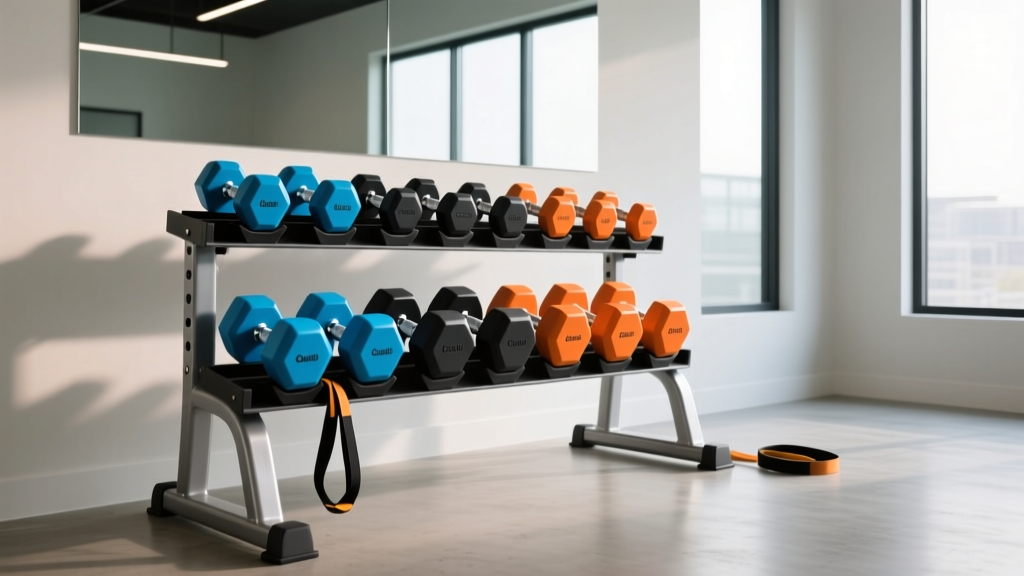
How to Train Shoulders With Dumbbells: Hex vs Urethane for Small Gyms
Learn how to train shoulders with dumbbells in tight spaces. We compare rubber hex vs urethane dumbbells for optimal home gym layout and space efficiency.

The Geometry of Deltoid Development in Micro-Gyms
As home fitness spaces evolve in 2026, the trend has shifted heavily toward micro-gyms, ADU (Accessory Dwelling Unit) conversions, and apartment-friendly workout zones. When you are operating within a 5x5 foot or 6x6 foot footprint, every square inch of floor and rack space is premium real estate. Understanding how to train shoulders with dumbbells effectively in these restricted environments requires more than just knowing the exercises; it requires mastering your physical environment and the geometry of your equipment.
The shoulder joint (glenohumeral joint) demands a massive 'movement envelope'—the three-dimensional space your arms must travel through to achieve full range of motion during presses, raises, and rotations. If your dumbbells are too bulky, or if your storage layout forces you to navigate around rolling weights, your workout efficiency plummets. This brings us to a critical equipment debate for space-conscious lifters: rubber hex dumbbells vs. urethane dumbbells. While both protect your floors, their physical density, head geometry, and storage requirements drastically alter how you design your gym layout and execute shoulder hypertrophy work.
The Spatial Footprint: Material Density and Rack Real Estate
The most immediate difference between rubber hex and urethane dumbbells is material density. Urethane is significantly denser than virgin rubber, meaning a urethane dumbbell packs the same mass into a much smaller physical volume. When designing a home gym layout, this density dictates your storage footprint.
| Feature | Rubber Hex (e.g., REP Fitness) | Urethane (e.g., Rogue Fitness) |
|---|---|---|
| Overall Length | ~14.5 inches | ~12.2 inches |
| Head Width (Per Side) | ~6.5 inches | ~4.8 inches |
| Linear Rack Space (10 Pairs) | ~52 - 55 inches | ~40 - 43 inches |
| Avg. Price Per Pound | $1.60 - $1.90 / lb | $3.20 - $4.10 / lb |
| Roll Risk on Floor | Zero (Flat Edges) | Moderate (Round/Subtle Flats) |
As noted in equipment specifications from Rogue Fitness, a standard 5-tier horizontal dumbbell rack holding 10 pairs (15 lbs to 50 lbs) requires roughly 54 inches of linear wall space when loaded with rubber hex dumbbells. By switching to urethane, that same rack requirement shrinks to about 42 inches. In a narrow hallway gym or a tight corner layout, reclaiming 12 inches of linear wall space allows you to pivot your rack 90 degrees or fit a folding squat rack adjacent to your weight storage.
The Movement Envelope: How Head Geometry Alters Biomechanics
When researching deltoid exercise mechanics, you will find that shoulder training relies heavily on grip width and clearance. The bulky, oversized heads of rubber hex dumbbells introduce a unique spatial problem: they force your hands wider apart during overhead movements.
Expert Layout Insight: The 'Clink' FactorDuring an Arnold Press or a tight neutral-grip overhead press, the medial and anterior deltoids require the dumbbells to start close together at chest level. With 50lb rubber hex dumbbells, the massive rubber heads will physically collide ('clink') before your hands can achieve a true shoulder-width or narrower starting position. Urethane's compact heads allow for a flush, tight starting position, preserving the natural biomechanical groove of the shoulder joint without forcing an artificially wide grip that can impinge the rotator cuff in tight spaces.
Navigating Lateral Raises in Narrow Corridors
Lateral raises target the medial deltoid and require significant lateral clearance. If your gym layout places your dumbbell rack directly behind your workout mat, swinging a 14.5-inch long rubber hex dumbbell outward increases the risk of striking the wall or the rack. Urethane dumbbells, being shorter and sleeker, reduce the distal end of the lever arm's physical footprint, giving you an extra 2-3 inches of clearance on each side—often the difference between a full repetition and a drywall dent.
How to Train Shoulders With Dumbbells in a 5x5 Foot Zone
So, how do you practically execute a shoulder workout when your layout is severely restricted? The answer lies in matching the dumbbell shape to the spatial constraints of the floor. Here is a space-optimized shoulder layout protocol utilizing the unique traits of both dumbbell types.
- The Baseboard Floor Press (Best with Hex): In a 5x5 space, a bench might be impossible to store. Seated on the floor with your back against a baseboard, use rubber hex dumbbells for seated floor presses. Because hex dumbbells do not roll, you can rest them on the floor directly beside your hips between sets without them rolling under doors or into the center of your limited walking path.
- Corner-Seated Lateral Raises (Best with Urethane): Sit in the corner of your room to utilize diagonal clearance. Use urethane dumbbells here. Their compact heads prevent the 'clinking' effect at the bottom of the movement, and their high-density steel cores provide a more balanced moment arm for strict medial deltoid isolation.
- Wall-Facing Rear Delt Flyes (Best with Hex): Stand facing a wall, hinge at the hips, and perform rear delt flyes. Hex dumbbells are superior here because if you need to drop them suddenly due to fatigue, they will stay exactly where they land, keeping your narrow escape path clear.
Storage Configurations: Vertical vs. Horizontal Layouts
Your choice of dumbbell material must align with your storage apparatus. Space optimization is not just about the floor; it is about the vertical Z-axis of your gym.
Horizontal Tiered Racks
If you are using a standard 3-tier or 5-tier horizontal rack against a flat wall, urethane is the undisputed king of space efficiency. The sleek profile allows for tighter tier spacing and narrower overall rack widths. However, if you are buying a used or budget rack that has wide spacing designed for commercial gyms, rubber hex dumbbells will fit more securely without looking lost on the shelves.
Vertical Dumbbell Trees
For corner layouts, vertical dumbbell trees are popular. However, vertical trees have a wide base to prevent tipping. REP Fitness and similar manufacturers design rubber hex dumbbells with contoured handles that rest easily on angled tree prongs. Urethane dumbbells, especially those with straight, thick handles, can sometimes be harder to slide onto tightly spaced vertical tree prongs. If your layout dictates a corner tree, ensure the prong spacing accommodates the thicker handles often found on premium urethane sets.
Real-World Edge Cases and Environmental Factors
Space optimization also means optimizing for the environment. A cramped space with poor ventilation changes the material calculus entirely.
Warning: The Off-Gassing Hazard in Small RoomsIf your compact gym is in a spare bedroom, closet, or poorly ventilated basement, avoid cheap recycled rubber hex dumbbells. In 2026, while virgin rubber manufacturing has improved, lower-tier rubber hex dumbbells can still off-gas volatile organic compounds (VOCs) that smell like burning tires. In a 5x5 unventilated space, this odor becomes overwhelming and can cause headaches during high-exertion shoulder sets. Urethane is virtually odorless and completely inert, making it the only safe choice for enclosed, micro-gym layouts.
Furthermore, consider the 'Drop Zone'. In a tight layout, you are inevitably going to set weights down on the floor. Rubber hex dumbbells feature flat edges that allow them to be lined up flush against a baseboard, creating a clean, walkable perimeter. Round or semi-round urethane dumbbells require a dedicated 'tray' or mat with raised lips to prevent them from migrating into the center of the room, which consumes additional floor space.
The Final Layout Verdict
Deciding between rubber hex and urethane dumbbells for a space-optimized home gym comes down to your specific spatial bottlenecks:
- Choose Urethane If: Your primary constraint is wall space and rack width. You need to fit a full set of dumbbells onto a narrow horizontal rack, you prioritize joint-friendly biomechanics (narrower grips for overhead pressing), and your gym is in an enclosed, unventilated room where rubber odor is a dealbreaker.
- Choose Rubber Hex If: Your primary constraint is floor space and rolling hazards. You train on the floor without a bench, you need to set heavy dumbbells down in narrow walking paths without them rolling away, and you are operating on a stricter budget (saving roughly $1.50 per pound compared to urethane, which can be reallocated toward a space-saving folding squat rack).
Mastering how to train shoulders with dumbbells in a compact environment means treating your equipment not just as resistance tools, but as physical objects that dictate the flow, safety, and efficiency of your entire workout space. Measure your walls, map your movement envelope, and choose the geometry that fits your life.
More gear to consider
All reviews
Power Rack vs Squat Rack: Best for Barbell or Dumbbell Bent Over Rows?

EZ Curl Bar vs Straight Bar: Outgrowing the Dips Dumbbell
Dumbbell Lat Pulldown and Kettlebells: Cast Iron vs Competition Budget
Cast Iron vs Competition Kettlebells vs Back Routine with Dumbbells

Best Storage Solutions for SA Gear Dumbbells & Heavy Free Weights